Interview · South Dakota · Stephanie Charging Eagle · OSEU 3
Themes: Kinship & family, Education & learning, Spirituality & ceremony, Values & generosity, Listening & observation, Children & young people
Learn About questions
What is the importance of carrying out relationships in any setting?
What is a takosa?
What is a unci?
What does it mean for a relationship to be sacred?
What does it mean for a relationship to be spiritual?
What are different relationships that need to be carried forward?
Learn From questions
Who are my relatives?
How do I relate to my relatives? For example, how is my relationship with a grandparent different from an aunt or mother?
Do I have special names my relatives call me? If so what are they and how do those special names impact my relationship with them?
What are examples of sacred relationships in my life? What makes them sacred?
In what ways do my relationships change depending on the setting I am in?
How do I care for my relationships?
Transcripts
Kinship Terms - Stephanie Charging Eagle - OSEU #3
Watch this interview on YouTubeBut what does not change is the concept…the philosophy of what it is we did. For example, if we no longer address each other as relatives…use those relationship terms…then we are going to experience that disrespect from younger people and person to person. But the concept that needs to be carried on today…because I understand that you could be somebody’s mother in the classroom…and you’re the teacher…your student…or maybe your child…or you have some students that are closely related to you…they see you as your “auntie.” Well, in a classroom setting, it’s very difficult. But you still have to…in some way…bring forth the concept of the relationship between you and that student and that student and yourself. And so, you still have to acknowledge and carry that in your classroom. The concept is that that relationship is so important, you cannot ignore it. So, in your own way, you treat that child as if you would them at home. They still learn from you as a teacher…and as a student…and the rest of the group. And pretty soon you just say…for example…I’m at the age now where I have grandchildren in some of the classes I go to or work with…so I would call them “takosa” which is the general term for grandchild. And so, they know that I’m “unci” or grandma to them. And pretty soon the whole group acknowledges me as grandma or unci. And it doesn’t do anything less for them academically.
But that is the concept…that that relationship is so important…that from over here when the children called you by unci and not your first name and vice versa…that concept is so sacred. It’s so spiritual that…if you’re a teacher in a classroom and you have students who are your own children or your own grandchildren… nieces and nephews…that should be carried out, but carried out in however it's comfortable. But the idea is that you still bring the concept forward.
Resource text
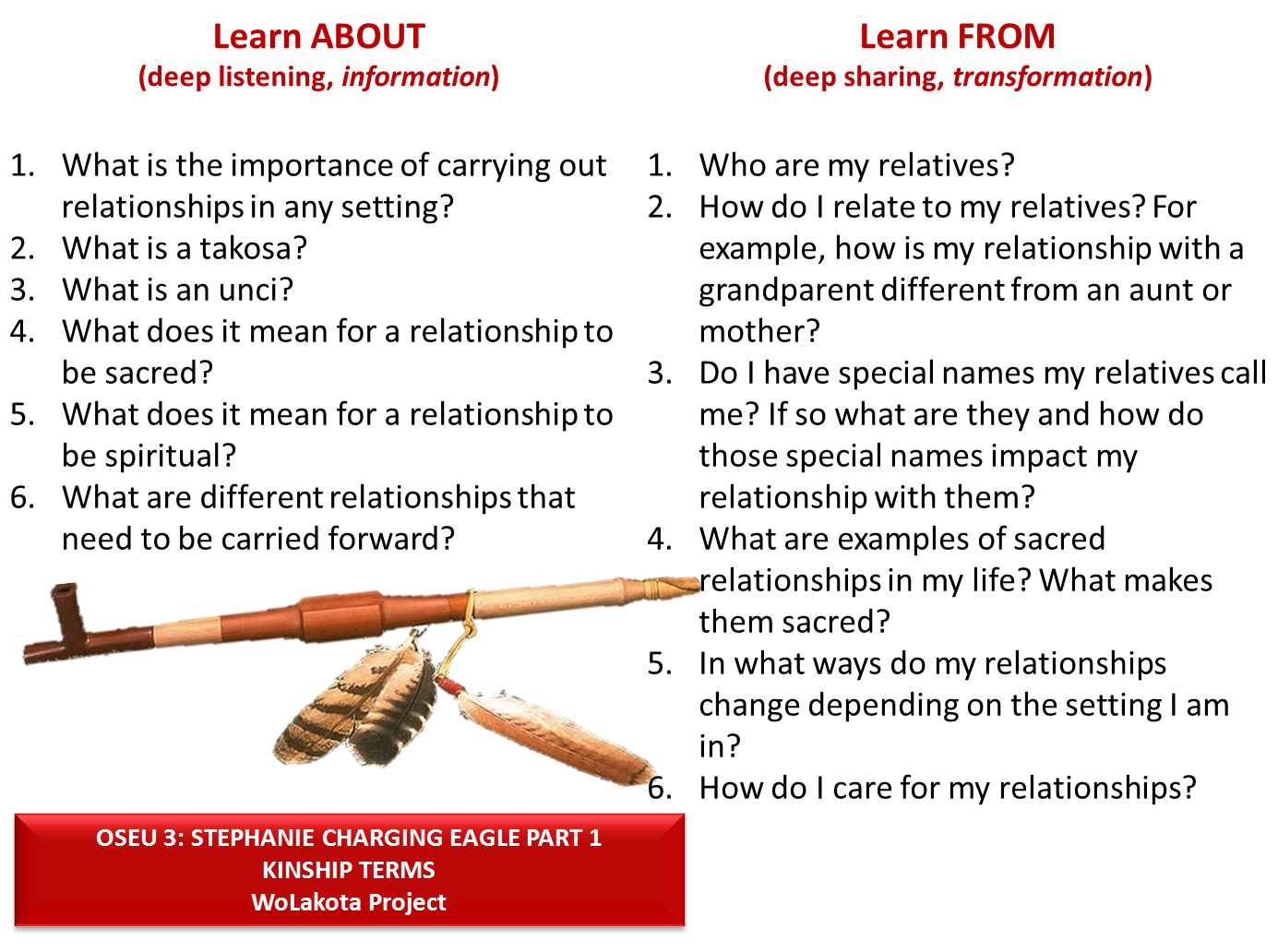
Learn ABOUT Learn FROM
(deep listening, information) (deep sharing, transformation)
1. What is the importance of carrying out 1. Who are my relatives?
relationships in any setting? 2. Howdol relate to my relatives? For
2. What is a takosa? example, how is my relationship with a
3. What is an unci? grandparent different from an aunt or
4. What does it mean for a relationship to mother?
be sacred? 3. Dol have special names my relatives call
5. What does it mean for a relationship to me? If so what are they and how do
be spiritual? those special names impact my
6. What are different relationships that relationship with them?
need to be carried forward? 4. What are examples of sacred
= elationshipsin my life? What makes
them sacred?
laf 5. In what ways do my relationships
oe : change depending on the setting | am
> in?
. How do | care for my relationships?
OSEU 3: STEPHANIE CHARGING EAGLE PART 1
KINSHIP TERMS
WoLakota Project
From the current WoLakota source page:
Kinship Terms
Stephanie Charging Eagle
Transcript
(deep listening, information)
(deep listening, transformation)
Some indexed text was extracted from scanned material. Check the original source for exact wording and spelling.
Source materials
Supplied transcript document. Text preserved as supplied; spellings and transcription uncertainties have not been corrected.
Additional source transcripts
Kinship Terms
Kinship Terms - Stephanie Charging Eagle - OSEU #3
But what does not change is the concept…the philosophy of what it is we did. For example, if we no longer address each other as relatives…use those relationship terms…then we are going to experience that disrespect from younger people and person to person. But the concept that needs to be carried on today…because I understand that you could be somebody’s mother in the classroom…and you’re the teacher…your student…or maybe your child…or you have some students that are closely related to you…they see you as your “auntie.” Well, in a classroom setting, it’s very difficult. But you still have to…in some way…bring forth the concept of the relationship between you and that student and that student and yourself. And so, you still have to acknowledge and carry that in your classroom. The concept is that that relationship is so important, you cannot ignore it. So, in your own way, you treat that child as if you would them at home. They still learn from you as a teacher…and as a student…and the rest of the group. And pretty soon you just say…for example…I’m at the age now where I have grandchildren in some of the classes I go to or work with…so I would call them “takosa” which is the general term for grandchild. And so, they know that I’m “unci” or grandma to them. And pretty soon the whole group acknowledges me as grandma or unci. And it doesn’t do anything less for them academically.
But that is the concept…that that relationship is so important…that from over here when the children called you by unci and not your first name and vice versa…that concept is so sacred. It’s so spiritual that…if you’re a teacher in a classroom and you have students who are your own children or your own grandchildren… nieces and nephews…that should be carried out, but carried out in however it's comfortable. But the idea is that you still bring the concept forward.