Interview · North Dakota · South Dakota · Gladys Hawk · OSEU 3 · NDNAEU 5
Themes: Language & revitalization, Kinship & family, Education & learning, Boarding schools & assimilation, Values & generosity, Culture & continuity, Listening & observation, Children & young people, Intergenerational learning
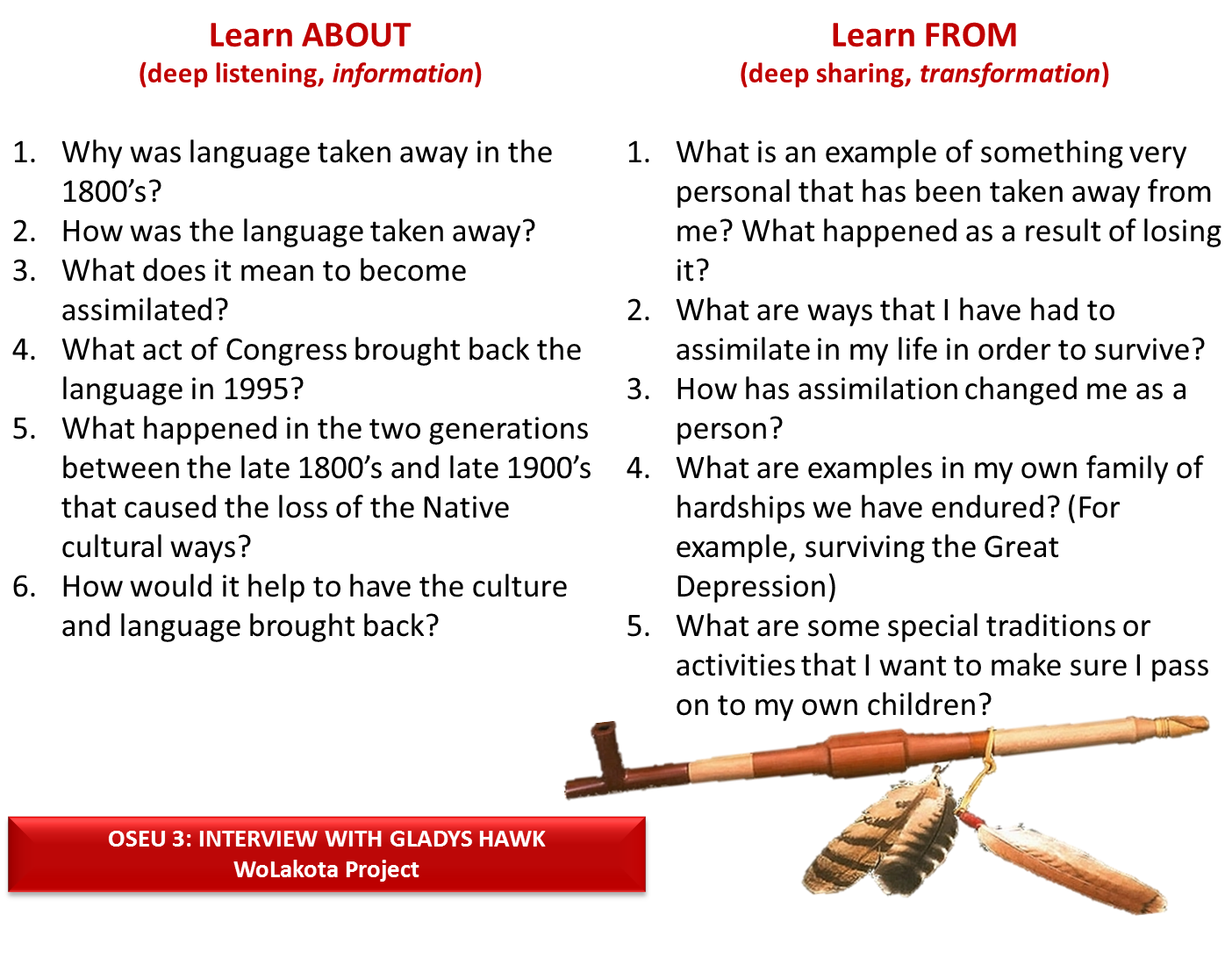
Learn About questions
1. Why was language taken away in the 1800’s?
2. How was the language taken away?
3. What does it mean to become assimilated?
4. What act of Congress brought back the language in 1995?
5. What happened in the two generations between the late 1800’s and the late 1900’s that caused the loss of the Native cultural ways?
6. How would it help to have the culture and language brought back?
Learn From questions
1. What is an example of something very personal that has been taken away from me? What happened as a result of losing it?
2. What are ways that I have had to assimilate in my life in order to survive?
3. How has assimilation changed me as a person?
4. What are examples in my own family of hardships we have endured? (For example, surviving the Great Depression)
5. What are some special traditions or activities that I want to make sure I pass on to my own children?
Transcripts
Language & Culture Loss - Gladys Hawk - OSEU 3
Watch this interview on YouTubeI think it would be important for them to know it was taken away from us in the late 1800’s by the federal government. And so, they established schools and had our ancestors taken away from their families to get them assimilated into the new society…so we could become farmers for example…or we could become teachers maybe…bakers…cooks…or whatever of the time. So that concept came on down until it reached the point where now women are just as equal to men in positions of work and employment. So perhaps maybe there is another way to explain that. I’m not too sure either. If there’s something I don’t know, then I don’t like to say too much about it because I could be wrong. Anyway, that part of our culture has changed through the years. In 1995, they brought back our language through an act of Congress. Before that in 1978, they told us that we could practice our religion. That was a law that came…and it was part of our culture forever…until it was taken from us. And there’s a whole span of two generations I will say where we couldn’t do anything. And that’s where we lost a lot of cultural stuff…our practicing…our ways. But now it’s different. It’s coming back. And it’s people like myself and Stephanie…whoever else. We’re trying to bring those things back so that the future kids…or students I should say…I should say kids…I even called my students kids in my classroom. But if we could ask the teachers to instill that into the children…that we are trying to teach them our culture…perhaps we might have a different look, a new look.
Resource text
From the current WoLakota source page:
Language & Culture Loss
Gladys Hawk
Transcript
(deep listening, information)
(deep listening, information)
Teachings of Our Elders resource text:
<span data-mce-type="bookmark" style="display: inline-block; width: 0px; overflow: hidden; line-height: 0;" class="mce_SELRES_start"></span>
NDNAEU Alignment:
Some indexed text was extracted from scanned material. Check the original source for exact wording and spelling.
Source materials
Supplied transcript document. Text preserved as supplied; spellings and transcription uncertainties have not been corrected.
Additional source transcripts
Language & Culture Loss
Language & Culture Loss - Gladys Hawk - OSEU 3
I think it would be important for them to know it was taken away from us in the late
1800’s by the federal government. And so, they established schools and had our
ancestors taken away from their families to get them assimilated into the new
society…so we could become farmers for example…or we could become teachers
maybe…bakers…cooks…or whatever of the time. So that concept came on down until it
reached the point where now women are just as equal to men in positions of work and
employment. So perhaps maybe there is another way to explain that. I’m not too sure
either. If there’s something I don’t know, then I don’t like to say too much about it
because I could be wrong. Anyway, that part of our culture has changed through the
years. In 1995, they brought back our language through an act of Congress. Before that
in 1978, they told us that we could practice our religion. That was a law that came…and
it was part of our culture forever…until it was taken from us. And there’s a whole span of
two generations I will say where we couldn’t do anything. And that’s where we lost a lot
of cultural stuff…our practicing…our ways. But now it’s different. It’s coming back. And
it’s people like myself and Stephanie…whoever else. We’re trying to bring those things
back so that the future kids…or students I should say…I should say kids…I even called
my students kids in my classroom. But if we could ask the teachers to instill that into the
children…that we are trying to teach them our culture…perhaps we might have a
different look, a new look.