Interview · South Dakota · David Bald Eagle · OSEU 6
Themes: Kinship & family, Education & learning, Treaties & sovereignty, Spirituality & ceremony, Values & generosity, Food & plants, Listening & observation, Intergenerational learning
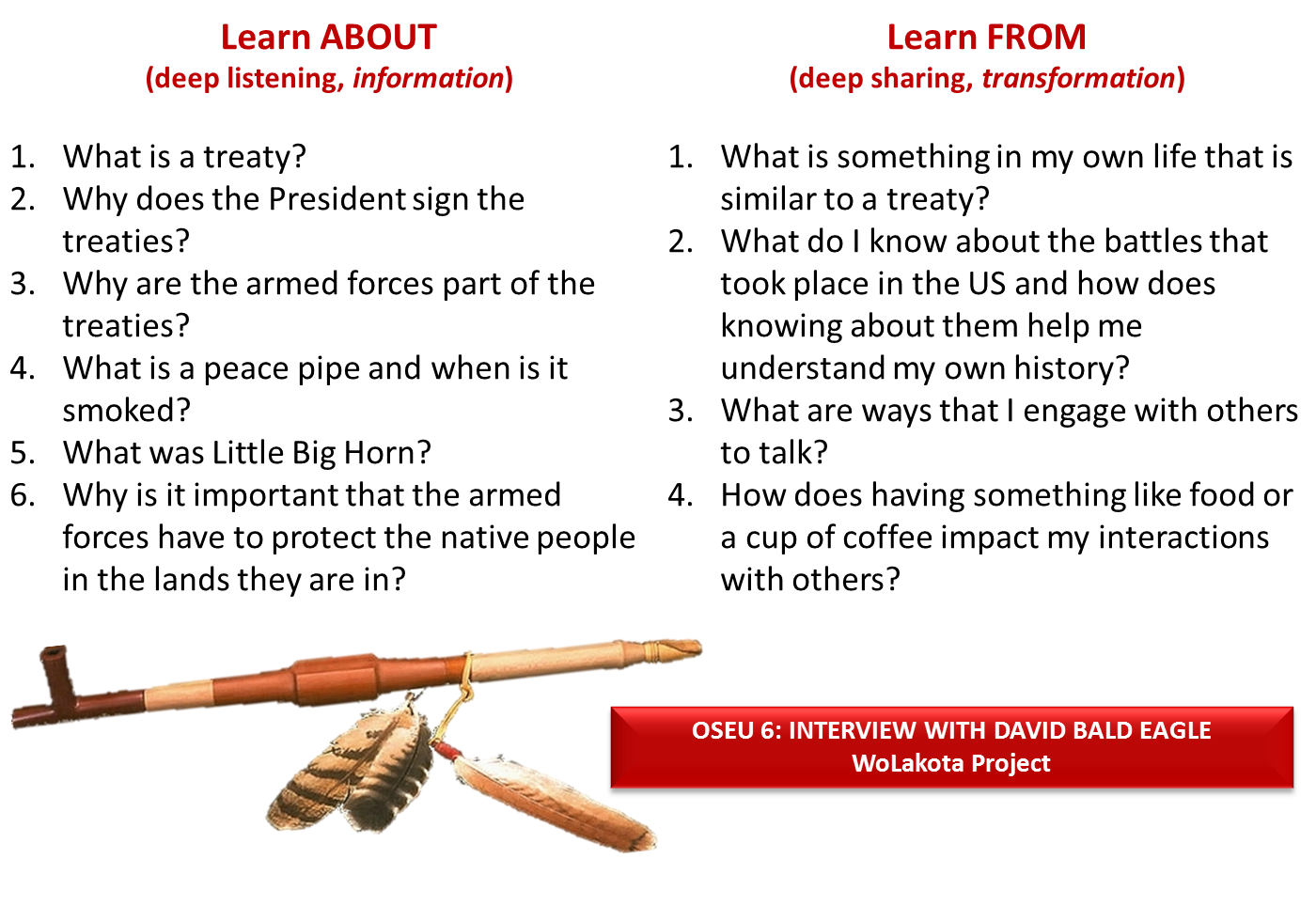
Learn About questions
What is a treaty?
Why does the president sign the treaties?
Why are the armed forces part of the treaties?
What is a peace pipe and when is it smoked?
What was Little Big Horn?
Why is it important that the armed forces have to protect the Native people in the lands they are in?
Learn From questions
What is something in my own life that is similar to a treaty?
What do I know about the battles that took place in the US and how does knowing about them help me understand my own history?
What are ways that I engage with others to talk?
How does having something like food or a cup of coffee impact my interactions with others?
Transcripts
Armed Forces and Treaties
Watch this interview on YouTubeArmed Forces & Treaties - David Bald Eagle - OSEU
6
The treaties were made by the President of the United States and the Armed Forces
Commander too. And the Chiefs, they sat together and they smoked a pipe of peace.
And the General made out the orders, the treaty orders and everything. And they read it
and they had an interpreter there, interpreted the whole thing. And so the General
signed it and the President of the United States signed it. Congress didn't have nothing
to do with it and the Senate had nothing to do with it, just the President and the
Commanding Officer.
So the education comes from the Armed Forces. All the regulations come from the
Armed Forces. So they have to take care of us. And I was in Germany about five, no it
was about ten years ago, I was in Germany and I spoke to the Armed Forces in
Germany. They were all there in that auditorium. My daughter was a Colonel and she
sat beside me and the Generals were all sitting with her. And as I was speaking on the
microphone, I told them about what happened at the Little Bighorn. I told them about
that and how the U.S. Army was defeated.
I told them about that and you could see that there were some Indian boys there in the
Army. And they just, hey, you know. And when I was talking there, I said that the Army,
no matter what country the U.S. Army goes to, if they have a base there, they are there
to protect the natives of that country. The way I understand, in the treaties I said. And
that's what they do. In any country they occupy, they protect the natives of that country.
And after I spoke, after I got through speaking, this General got up, this General came
over and he, they called his name, he came over and he said, Chief Bald Eagle,
everything you said was correct. Everything you said was right. According to the
treaties, he said that, you said that any country the Army occupies, they protect the
natives of that country. Now tell me where you learned that. So I said, it's from my
grandfather. My grandfather was a white bull, I said, like I told you. Like I told you. He
told me that.
And I had an experience in Greenland, when I was in the Armed Forces. They brought a
lady to surgery. She was going to have an emergency surgery. They wanted one. So
they took her to the Army Hospital. And then she was stuck at the entrance. The guys
didn't know whether they should take her in there for surgery because she was an
Eskimo girl, Eskimo woman. So they sent for the commanding officer of that post. So he
came over. What's the trouble? He said. And I was a guard there. During that time, I
was a steady guard there. This officer came over.
He says, what's the trouble? So they told her, they told him, we're going to take this lady
in for surgery, emergency surgery. But we don't know whether we should take her in or
not. She's an Eskimo. And here, he said, he looked at her and he said, take her in, take
her in and have surgery, have that emergency surgery. Gave it to her. And he turned
around, he told us, we all stood there.
He turned around and he told the personnel, all the guards, officers that were there, he
says, any time that the United States Army occupies or has a post in any country, he
says, they are to protect the natives of that country. Always keep that in mind, he said.
That's the first thing we were told as officers. So I read, I mean, I saw that when I was in
the Army, that was told to us as a guard. And here, the general said, that's right. He
says, we, all the Army officers went through that.
Any country we occupy, we are to protect the natives of that country. So when I talked to
the chiefs, they said, what if they turn the Army on us? So I said, it never could be done,
never will be done. I said, they're there, they're here to protect our country. The Army,
U.S. Army, they call themselves the U.S. Army. So that's why I said there's a lot of
these. The Army officer and the United States President signed those treaties.
Resource text
Learn ABOUT Learn FROM
(deep listening, information) (deep sharing, transformation)
1. What is a treaty? 1. What is something in my own life that is
2. Why does the President sign the similar to a treaty?
treaties? 2. What do | know about the battles that
3. Why are the armed forces part of the took place in the US and how does
treaties? knowing about them help me
4. What is a peace pipe and when is it understand my own history?
smoked? 3. What are ways that | engage with others
5. What was Little Big Horn? to talk?
6. Why is it important that the armed 4. How does having something like food or
forces have to protect the native people a cup of coffee impact my interactions
in the lands they are in? with others?
OSEU 6: INTERVIEW WITH DAVID BALD EAGLE
<a WoLakota Project
Some indexed text was extracted from scanned material. Check the original source for exact wording and spelling.
Source materials
Transcripts from supplied documents and the current WoLakota source pages. Text preserved as published.