Interview · South Dakota · Joseph Marshall III · OSEU 6
Themes: Land & stewardship, Kinship & family, Storytelling & oral tradition, Education & learning, Treaties & sovereignty, Values & generosity, Culture & continuity, Listening & observation, Children & young people, Humor & play, Self-determination & leadership
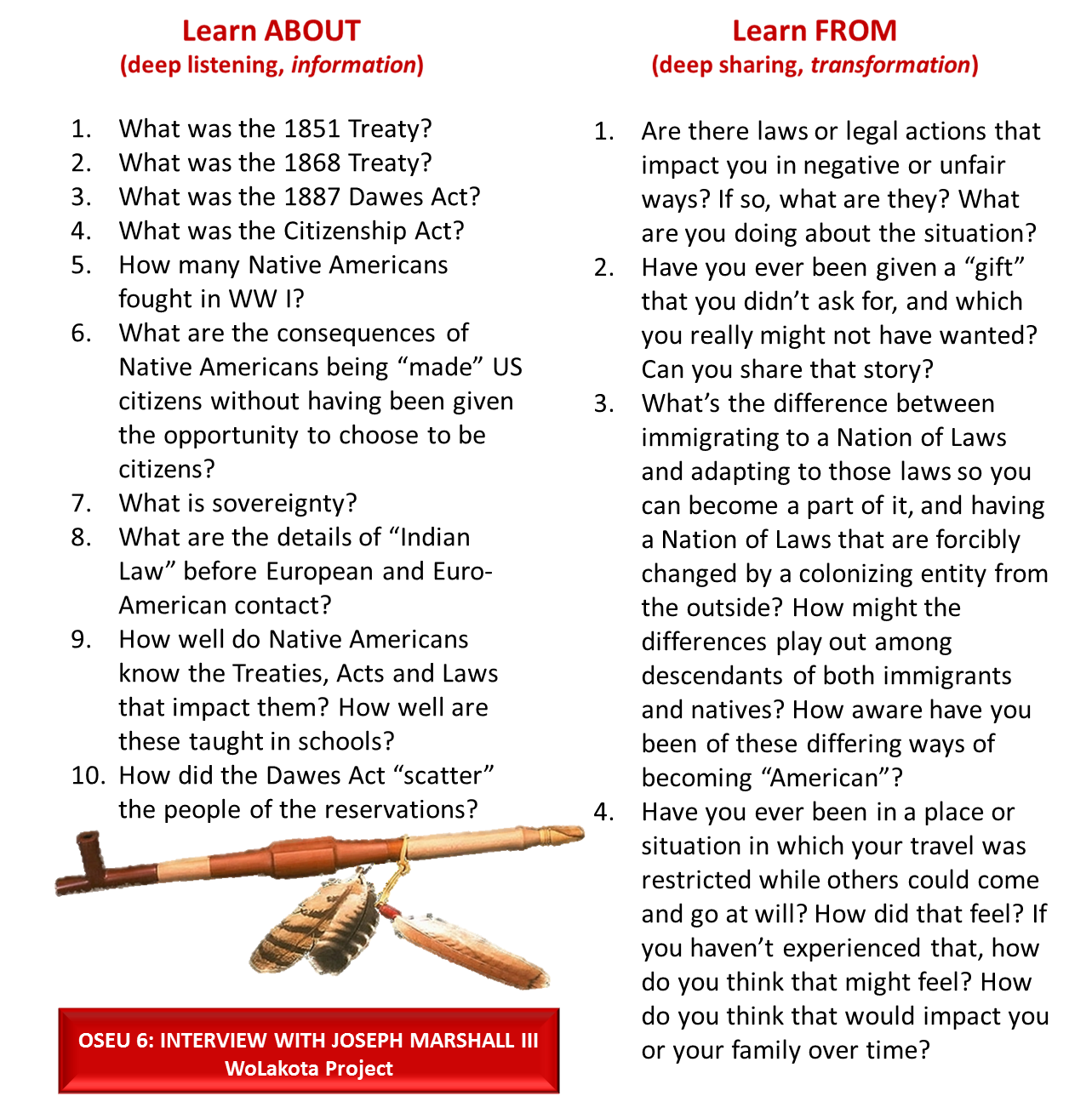
Learn About questions
What was the 1851 Treaty?
What was the 1868 Treaty?
What was the 1887 Dawes Act?
What was the Citizenship Act?
How many Native Americans fought in WW I?
What are the consequences of Native Americans being “made” US citizens without having been given the opportunity to choose to be citizens?
What is sovereignty?
What are the details of “Indian Law” before European and Euro-American contact?
How well do Native Americans know the Treaties, Acts and Laws that impact them? How well are these taught in schools?
How did the Dawes Act “scatter” the people of the reservations?
Learn From questions
Are there laws or legal actions that
impact you in negative or unfair
ways? If so, what are they? What
are you doing about the situation?
Have you ever been given a “gift” that you didn’t ask for, and which you really might not have wanted? Can you share that story?
What’s the difference between immigrating to a Nation of Laws and adapting to those laws so you can become a part of it, and having a Nation of Laws that are forcibly changed by a colonizing entity from the outside? How might the differences play out among descendants of both immigrants and natives? How aware have you been of these differing ways of becoming “American”?
Have you ever been in a place or situation in which your travel was restricted while others could come and go at will? How did that feel? If you haven’t experienced that, how do you think that might feel? How do you think that would impact you or your family over time?
Transcripts
Indian Law Before and After
Watch this interview on YouTubeIndian Law “Before & After” - Joseph Marshall III -
OSEU 6
Well, that's always been a mystery to me. I've never understood. I'm not, you know, I'm
not a lawyer.
So I don't understand, you know, fully the ramifications of all of that, but I do know this,
that even today we're living the consequences of all of that, you know, the 1851 Treaty,
the 1868 Treaty, where we're concerned, and then the 1887 Dawes Act, the Citizenship
Act, and I often wonder if, you know, and the Citizenship Act was not just for us, it was
for everybody, all natives, and they said, well, it's because your young men did so well
in World War I, we want to make you citizens. I guess that was the premise, that's what I
hear.
But if the question had been put to us individually as tribes, do you want to be citizens? I
think some of us would have turned it down. Some of us would have said no. But we
didn't get that opportunity. The law was passed, and there's this broad brushstroke that
says, now you're citizens. We just didn't have that opportunity to debate it. We were,
one day we weren't, the next day we were, and so that has, you know, consequences
down the line. And what it did was diminish our sovereignty. But we have to think about
this. We talk about Indian law.
But there's the Indian law after, from that point where the United States government
began to enact those kinds of things, the treaties and acts that affected our lives.
There's been Indian law since then, and there's Indian law before that. The social norms
and the things that we developed as a culture over time, those rules and norms that we
lived by before the Europeans and the Americans came along, that was Indian law
before that. And there's been Indian law since then. So we need to make that
distinction. We can't forget what those were before.
And certainly it's important to remember, all those things that affect us now, we have to
contend with that day in and day out, all the time. The tribal governments have to do
that. And we should be aware of it. We should teach that in our school, to our native
kids. You know, what the Dawes Act was, how it impacted us.
I hear the story of, before the Dawes Act, after 1877, we were put up here on all the
different reservations, because of, after the killing of Crazy Horse, there was a fear that
there would be an uprising, so they scattered us all over the reservations, western
South Dakota, and put us on the different reservations. And on my reservation, there's a
story of people, you know, kind of migrating up and down the Little White River. You
know, in their teams and wagons.
You know, they would go and live for a while here, visit relatives, and go up and down
from Screen Creek all the way to the Big White. And then once the Dawes Act came,
and the allotment, you know, they surveyed the land in individual plots. We couldn't do
that anymore. So that stopped that. So, you know, that had that kind of an impact. So it
had those kind of things all over the place. But we don't teach that enough in our
schools, you know. Pre-European and after. Pre-American and after America. We have
to make that distinction.
I think it's important.
Resource text
VPWNrP
9
10.
OSEU 6: INTERVIEW WITH JOSEPH MARSHALL III
WoLakota Project
From the current WoLakota source page:
Indian Law Before and After
Joseph Marshall III
Transcript
(deep listening, information)
(deep listening, information)
Some indexed text was extracted from scanned material. Check the original source for exact wording and spelling.
Source materials
Transcripts from supplied documents and the current WoLakota source pages. Text preserved as published.