Interview · South Dakota · Faith Spotted Eagle · OSEU 7
Themes: Land & stewardship, Language & revitalization, Kinship & family, Storytelling & oral tradition, Education & learning, Treaties & sovereignty, Healing & resilience, Spirituality & ceremony, Values & generosity, Culture & continuity, Community & responsibility, Listening & observation, Children & young people, Humor & play, Intergenerational learning
Learn About questions
What does it mean to “Stand on the Prayers of my people”?
In what ways do you hear the prayers of your people?
How is Mother Earth a partner?
What is the “shaking” and why is it happening?
In what ways can we give back to Mother Earth?
How does learning about one’s culture help us survive into the future?
What is PTSD?
What is genetic memory”?
Learn From questions
(deep listening, transformation
What do I know about the prayers or desires of my own ancestors? Do their wishes play a role in my actions?
In what ways do I partner with the natural environment? In what ways do I learn from the natural environment?
What signs do I see that the natural environment might be impacted negatively by the actions of humans or even by my own actions?
Are there ways that I try to give back to the earth? Are there ways that I would like to give back to the earth?
What do I know about my heritage and culture? Does my own knowledge or lack of knowledge about my culture impact me?
What sources of trauma have occurred in my life? What traumas might I have inherited from my family or my broader cultural community?
Are there things that I seem to know deep inside without having learned from the outside? What are those things?
Has there ever been a time when I learned something from an elder or teacher for the first time, but it felt like I’d somehow always known it? What is that story?
Transcripts
Pt 1 Standing on the Prayers of My People - Faith Spotted Eagle - OSEU 7
Watch this interview on YouTubeMy son always says that whenever he embarks on something, he says that I always have to remember that I'm standing on the prayers of my people. So like, the things that his grandfathers prayed about, maybe even during that treaty era, that those prayers that they laid were coming to fruition through him and through my daughter and other children. So it's not like it was a long time ago. It's very current. And some of those prayers, we can hear them. And the other thing I think that is happening is that the partner in all of this is Mother Earth.
In our language, we call it Inamaka. But in our prophecies, we say that there's going to be a shaking, that the Earth, when you ask me about natural law, we talk about the balance that when you ask for something, you have to give something back, that the whole history in the Western Cup has been taking for Mother Earth, and you have to give something back. And if it doesn't, then it will implode, and Mother Earth is shaking right now.
And so that's the concept that I think our young people are becoming aware that the best cultural good medicine that they can get is to learn about their culture. That's going to help them survive into the future. And I see that because as a PTSD therapist and working with young people, when you talk about culture with young people, it makes the most sense in the whole world. No matter how violent or frustrated or sad they are, it's almost like they have a genetic memory that, oh yeah, I remember this. So it's the best medicine.
Resource text
Additional Related Resources
Lakota Prayers
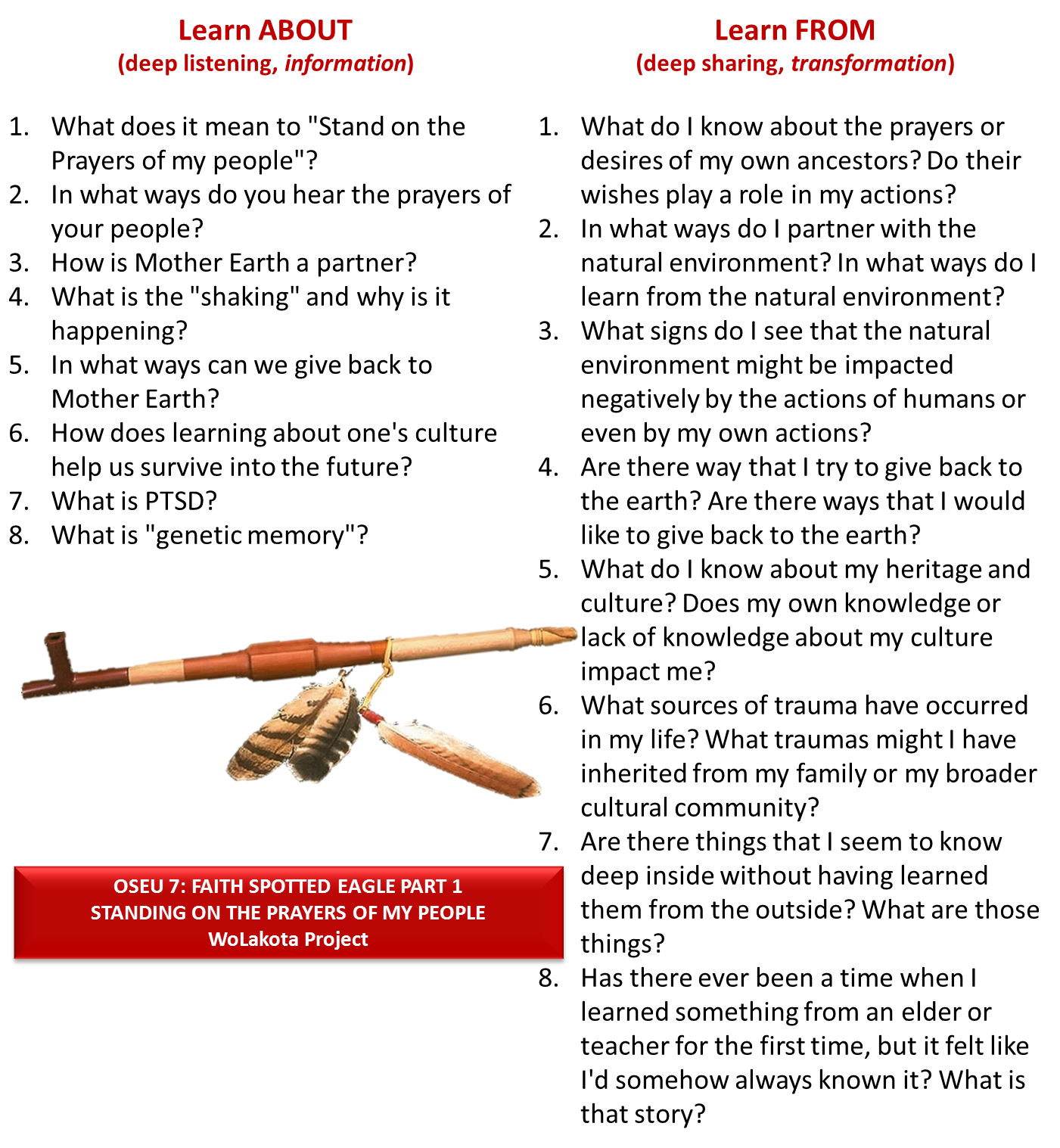
Learn ABOUT Learn FROM
(deep listening, information) (deep sharing, transformation)
1. What does it mean to "Stand on the 1. What do | know about the prayers or
Prayers of my people"? desires of my own ancestors? Do their
2. In what ways do you hear the prayers of wishes play a role in my actions?
your people? 2. In what ways do | partner with the
3. Howis Mother Earth a partner? natural environment? In what ways do |
4. What is the "shaking" and why is it learn from the natural environment?
happening? 3. What signs do | see that the natural
5. In what ways can we give back to environment might be impacted
Mother Earth? negatively by the actions of humans or
6. How does learning about one's culture even by my own actions?
help us survive into the future? 4. Are there way that | try to give back to
7. What is PTSD? the earth? Are there ways that | would
8. Whatis "genetic memory"? like to give back to the earth?
5. What do! know about my heritage and
culture? Does my own knowledge or
oe lack of knowledge about my culture
- impact me?
r 6.
; What sources of trauma have occurred
re . in my life? What traumas might | have
> inherited from my family or my broader
cultural community?
7. Are there things that | seem to know
OSEU 7. FAITH SPOTTED EAGLE PART 1 deep inside without having learned
STANDING ON THE PRAYERS OF MY PEOPLE them from the outside? What are those
WoLakota Project things?
8. Has there ever been a time when |
learned something from an elder or
teacher for the first time, but it felt like
I'd somehow always known it? What is
that story?
Some indexed text was extracted from scanned material. Check the original source for exact wording and spelling.
Source materials
Supplied transcript document. Text preserved as supplied; spellings and transcription uncertainties have not been corrected.
Additional source transcripts
Standing on the Prayers of My People
Pt 1 Standing on the Prayers of My People - Faith
Spotted Eagle - OSEU 7
My son always says that whenever he embarks on something, he says that I always
have to remember that I'm standing on the prayers of my people. So like, the things that
his grandfathers prayed about, maybe even during that treaty era, that those prayers
that they laid were coming to fruition through him and through my daughter and other
children. So it's not like it was a long time ago. It's very current. And some of those
prayers, we can hear them. And the other thing I think that is happening is that the
partner in all of this is Mother Earth.
In our language, we call it Inamaka. But in our prophecies, we say that there's going to
be a shaking, that the Earth, when you ask me about natural law, we talk about the
balance that when you ask for something, you have to give something back, that the
whole history in the Western Cup has been taking for Mother Earth, and you have to
give something back. And if it doesn't, then it will implode, and Mother Earth is shaking
right now.
And so that's the concept that I think our young people are becoming aware that the
best cultural good medicine that they can get is to learn about their culture. That's going
to help them survive into the future. And I see that because as a PTSD therapist and
working with young people, when you talk about culture with young people, it makes the
most sense in the whole world. No matter how violent or frustrated or sad they are, it's
almost like they have a genetic memory that, oh yeah, I remember this. So it's the best
medicine.