Interview · South Dakota · Faith Spotted Eagle · OSEU 6
Themes: Land & stewardship, Language & revitalization, Kinship & family, Treaties & sovereignty, Values & generosity, Culture & continuity, Listening & observation, Intergenerational learning
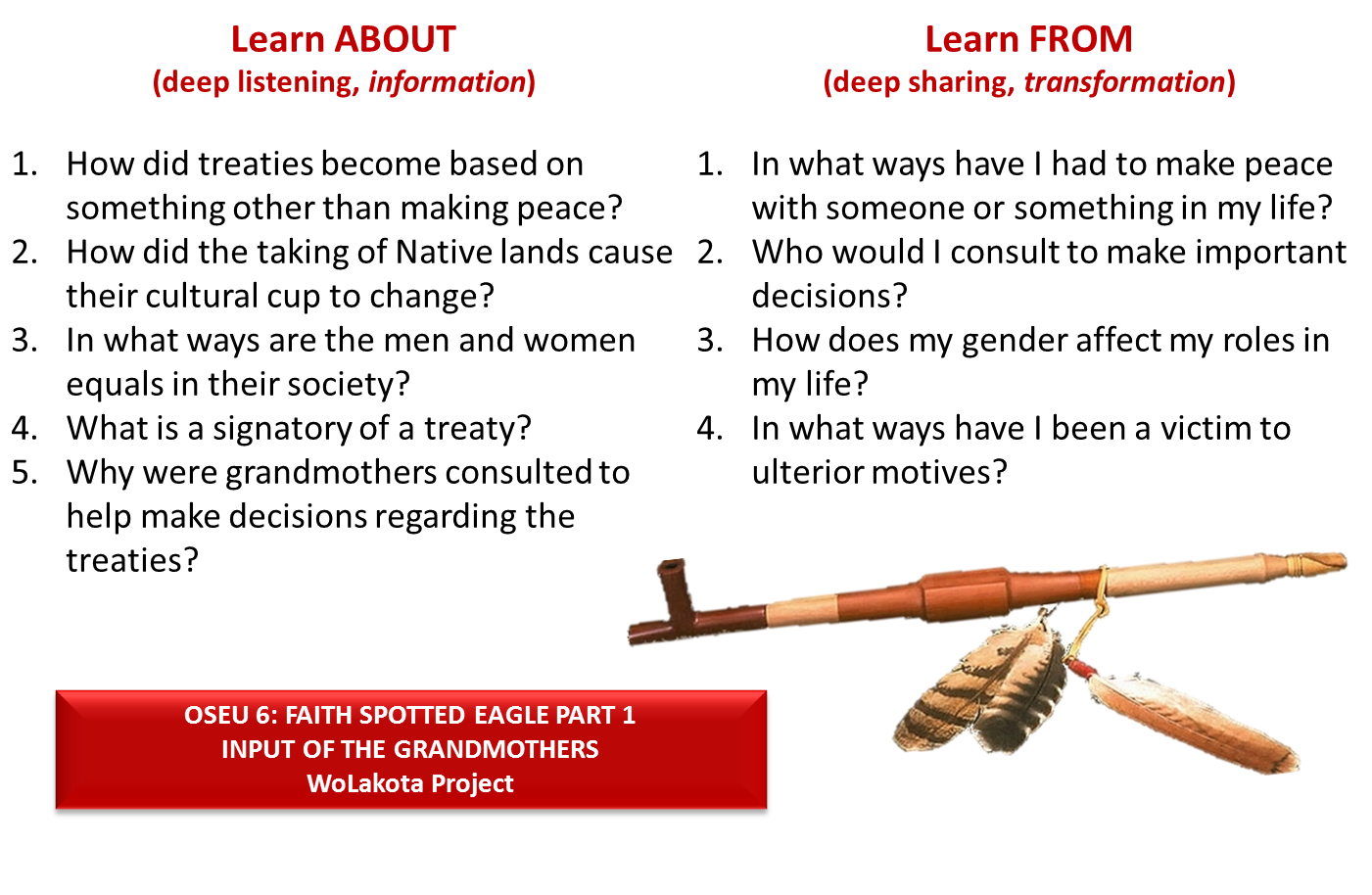
Learn About questions
How did treaties become based on something other than making peace?
How did the taking of Native lands cause their cultural cup to change?
In what ways are the men and women equals in their society?
What is a signatory of a treaty?
Why were grandmothers consulted to help make decisions regarding the treaties?
Learn From questions
In what ways have I had to make peace with someone or something in my life?
Who would I consult to make important decisions?
How does my gender affect my roles in my life?
In what ways have I been a victim to ulterior motives?
Transcripts
Pt 1 Input of the Grandmothers - Faith Spotted Eagle - OSEU 6
Watch this interview on YouTubeThe treaties were based on making peace, which was a good thing, but there was an ulterior motive of land taking and so that's when the cultural cut began to change. When the settlers came in on the eastern coast and they asked the men in our tribes, in our camps to make the treaty, they said they needed three-fourths of the adult males.
Oftentimes they would say that and some of the tribes would say, uh-uh we need our women here. We need our clan mothers, our clan grandmothers, and we can't make this treaty without them.
So some of them asserted it and others didn't. But the point that they were trying to make is that we came from a society that was essentially equal. We all had labor roles, but when it all came out in the wash, the women were not really signatories of the treaties. And I think it was because the men in their mind were respecting that they would always go back and talk to the women. I just came from a treaty meeting this morning and that's what they were saying.
They said that when the men would meet and they couldn't come to, and this was all said in our language, that they couldn't come to a decision, they would go back and they would consult the grandmothers and they would say we need to make this decision and we need your help. So it was not ever neglected, but I think the government officials didn't understand that and they just thought that the women didn't have a right. But they did. They had a very important role.
There's instances where I remember my grandma telling me that when they would have meetings and that camp circle would be meeting and the men might be in the forefront, but if a woman wanted to say something and it was really important for her to be up there, she would throw a stone out in the circle and that was saying I want the microphone. I need to say something and then that time would come. So there were different ways that evolved to get that input.
Resource text
=
Learn ABOUT Learn FROM
(deep listening, information) (deep sharing, transformation)
How did treaties become based on 1. In what ways have | had to make peace
something other than making peace? with someone or something in my life?
How did the taking of Native lands cause 2. Who would! consult to make important
their cultural cup to change? decisions?
In what ways arethe men and women 3. _Howdoes my gender affect my roles in
equals in their society? my life?
What is a signatory of a treaty? 4. In what ways have | been a victim to
Why were grandmothers consulted to ulterior motives?
help make decisions regarding the
treaties? =
Ae zs 7,
OSEU 6: FAITH SPOTTED EAGLE PART 1
INPUT OF THE GRANDMOTHERS
WoLakota Project
From the current WoLakota source page:
Input of the Granmothers
Faith Spotted Eagle
Transcript
(deep listening, information)
(deep listening, information)
Some indexed text was extracted from scanned material. Check the original source for exact wording and spelling.
Source materials
Supplied transcript document. Text preserved as supplied; spellings and transcription uncertainties have not been corrected.
Additional source transcripts
Input of the Granmothers
Pt 1 Input of the Grandmothers - Faith Spotted Eagle
- OSEU 6
The treaties were based on making peace, which was a good thing, but there was an
ulterior motive of land taking and so that's when the cultural cut began to change. When
the settlers came in on the eastern coast and they asked the men in our tribes, in our
camps to make the treaty, they said they needed three-fourths of the adult males.
Oftentimes they would say that and some of the tribes would say, uh-uh we need our
women here. We need our clan mothers, our clan grandmothers, and we can't make
this treaty without them.
So some of them asserted it and others didn't. But the point that they were trying to
make is that we came from a society that was essentially equal. We all had labor roles,
but when it all came out in the wash, the women were not really signatories of the
treaties. And I think it was because the men in their mind were respecting that they
would always go back and talk to the women. I just came from a treaty meeting this
morning and that's what they were saying.
They said that when the men would meet and they couldn't come to, and this was all
said in our language, that they couldn't come to a decision, they would go back and they
would consult the grandmothers and they would say we need to make this decision and
we need your help. So it was not ever neglected, but I think the government officials
didn't understand that and they just thought that the women didn't have a right. But they
did. They had a very important role.
There's instances where I remember my grandma telling me that when they would have
meetings and that camp circle would be meeting and the men might be in the forefront,
but if a woman wanted to say something and it was really important for her to be up
there, she would throw a stone out in the circle and that was saying I want the
microphone. I need to say something and then that time would come. So there were
different ways that evolved to get that input.