Interview · South Dakota · Faith Spotted Eagle · OSEU 6
Themes: Land & stewardship, Language & revitalization, Kinship & family, Treaties & sovereignty, Spirituality & ceremony, Values & generosity, Community & responsibility, Listening & observation, Intergenerational learning
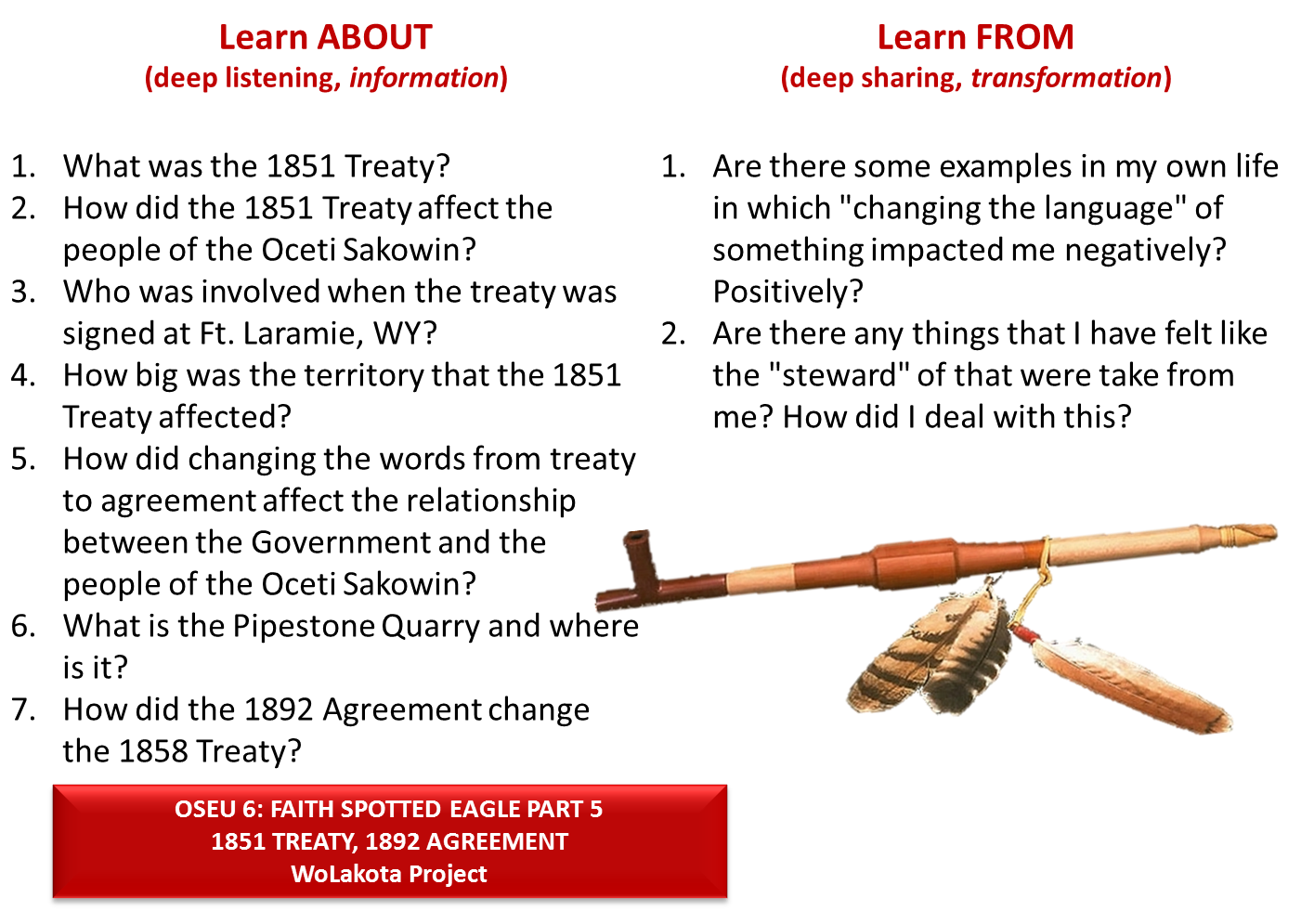
Learn About questions
(deep listening, information
What was the 1851 Treaty?
How did the 1851 Treaty affect the people of the Oceti Sakowin?
Who was involved when the treaty was signed at Ft. Laramie, WY?
How big was the territory that the 1851 Treaty affected?
How did changing the words from treaty to agreement affect the relationship between the Government and the people of the Oceti Sakowin? What is the Pipestone Quarry and where is it?
How did the 1892 Agreement change the 1858 Treaty?
Learn From questions
Are there some examples in my own life in which “changing the language of something impacted me negatively? Positively?
Are there any things that I have felt like the “steward” of that thing were taken from me? How did I deal with this?
Transcripts
Pt 5 1851 Treaty, 1892 Agreement - Faith Spotted Eagle - OSEU 6
Watch this interview on YouTubeThe other thing about treaties is for the area that we're in since we're talking about South Dakota is there was a really large treaty that encompasses this very land in the Black Hills that we're sitting in today and that was the 1851 treaty. The 1851 treaty was signed in Fort Laramie, Wyoming. The government summoned the people to come and my tribe was part of that.
I think there were four parties and essentially the territory reached down south into Nebraska, it went into Wyoming, parts of Montana, up into the Canadian border and up into Minnesota and into Iowa. So we were literally, we had established with the government in a unilateral agreement that the 1851 treaty reserved this for us. And so that treaty of course was abrogated by the U.S. government.
So when they decided that this treaty making might not be so good and they ended the treaty era in 1871 they said no no no no no more treaties with Native people but they changed the name. After they said no more treaties they thought wait now we have our eye on this territory over here.
In our case the Pipestone Quarry, we had an 1858 treaty with the Ihantwa where my great great-grandfather struck by the reed, his Indian name was Padani Apapi, and he said he would not sign the 1858 treaty unless we were guaranteed that we continued to be the keepers of the Pipestone Quarry for all of the Oceti Shakoi and he would not absolutely sign the treaty unless they consented and so they did.
They said that the Ihantwa people would forever have responsibility for the Pipestone Quarry and they could always be a presence there and they would be recognized by the rest as the keepers. So that happened in 1858 and the treaty era ended. So now we come into 1890. Now all of a sudden the city of Pipestone decides that they want the Pipestone Quarry and the government is saying well they're settlers out there and we need to take that land. So then they come up with the name agreement.
So they came up with the 1892 agreement and this is where again this is not about it's not about blame it's about denial and it's about I think when you know your country's history it's kind of like a liberation. So what the government did is we have documents that show they came to my community of White Swan and they brought combs, they brought blankets, they brought mirrors and they asked the people to have a meeting at White Swan and they said we want you to sign this 1892 agreement and they said no we don't want that agreement. We know we're not interested. That's our query. It's already been done by treaty and so they left. The people left. The Indian people left. So what do you know what the agent did? He went around from household to household and he told them that this other family had signed and they were really not doing what he thought they were doing but they were just being good relatives in a sense and so he went around from household to household and he got signatures and that's how the 1892 agreement was forged. It was totally illegal.
There was not ever a council that was held and so that's one of the parts of the rank history that we know about and that can be forgiven and maybe redone you know who knows maybe there'll be parts of the Black Hills and there'll be parts of our 1858 treaty that will be restored and actually a restoration of that for the US government and the what is wrong with co-managing the Pipestone Quarry? That Yankton could be an equal partner. What is wrong with that? That's the forgiveness and the denial so that's what we're seeking.
We met with the Park Service and we're talking about how we have every right to
co-manage and be a partner in that process because the Oceti Shakoni recognizes us as keepers. We have that responsibility because the Pipestone is where we get our pipes to pray and the weh means the blood and so Pipestone contains the heart and the blood of our people just like there's a heart here in the Black Hills.
Resource text
Learn ABOUT Learn FROM
(deep listening, information) (deep sharing, transformation)
What was the 1851 Treaty? 1. Are there some examples in my own life
How did the 1851 Treaty affect the in which "changing the language" of
people of the Oceti Sakowin? something impacted me negatively?
Who was involved when the treaty was Positively?
signed at Ft. Laramie, WY? 2. Are there any things that | have felt like
How big was the territory that the 1851 the "steward" of that were take from
Treaty affected? me? How did | deal with this?
How did changing the words from treaty
to agreement affect the relationship
between the Government and the ee
people of the Oceti Sakowin?
What is the Pipestone Quarry and where
is it?
. How did the 1892 Agreement change
the 1858 Treaty?
OSEU 6: FAITH SPOTTED EAGLE PART 5
1851 TREATY, 1892 AGREEMENT
WoLakota Project
Some indexed text was extracted from scanned material. Check the original source for exact wording and spelling.
Source materials
Supplied transcript document. Text preserved as supplied; spellings and transcription uncertainties have not been corrected.
Additional source transcripts
1852 Treaty and 1892 Agreement
Pt 5 1851 Treaty, 1892 Agreement - Faith Spotted
Eagle - OSEU 6
The other thing about treaties is for the area that we're in since we're talking about
South Dakota is there was a really large treaty that encompasses this very land in the
Black Hills that we're sitting in today and that was the 1851 treaty. The 1851 treaty was
signed in Fort Laramie, Wyoming. The government summoned the people to come and
my tribe was part of that.
I think there were four parties and essentially the territory reached down south into
Nebraska, it went into Wyoming, parts of Montana, up into the Canadian border and up
into Minnesota and into Iowa. So we were literally, we had established with the
government in a unilateral agreement that the 1851 treaty reserved this for us. And so
that treaty of course was abrogated by the U.S. government.
So when they decided that this treaty making might not be so good and they ended the
treaty era in 1871 they said no no no no no more treaties with Native people but they
changed the name. After they said no more treaties they thought wait now we have our
eye on this territory over here.
In our case the Pipestone Quarry, we had an 1858 treaty with the Ihantwa where my
great great-grandfather struck by the reed, his Indian name was Padani Apapi, and he
said he would not sign the 1858 treaty unless we were guaranteed that we continued to
be the keepers of the Pipestone Quarry for all of the Oceti Shakoi and he would not
absolutely sign the treaty unless they consented and so they did.
They said that the Ihantwa people would forever have responsibility for the Pipestone
Quarry and they could always be a presence there and they would be recognized by the
rest as the keepers. So that happened in 1858 and the treaty era ended. So now we
come into 1890. Now all of a sudden the city of Pipestone decides that they want the
Pipestone Quarry and the government is saying well they're settlers out there and we
need to take that land. So then they come up with the name agreement.
So they came up with the 1892 agreement and this is where again this is not about it's
not about blame it's about denial and it's about I think when you know your country's
history it's kind of like a liberation. So what the government did is we have documents
that show they came to my community of White Swan and they brought combs, they
brought blankets, they brought mirrors and they asked the people to have a meeting at
White Swan and they said we want you to sign this 1892 agreement and they said no
we don't want that agreement.
We know we're not interested. That's our query. It's already been done by treaty and so
they left. The people left. The Indian people left. So what do you know what the agent
did? He went around from household to household and he told them that this other
family had signed and they were really not doing what he thought they were doing but
they were just being good relatives in a sense and so he went around from household to
household and he got signatures and that's how the 1892 agreement was forged. It was
totally illegal.
There was not ever a council that was held and so that's one of the parts of the rank
history that we know about and that can be forgiven and maybe redone you know who
knows maybe there'll be parts of the Black Hills and there'll be parts of our 1858 treaty
that will be restored and actually a restoration of that for the US government and the
what is wrong with co-managing the Pipestone Quarry? That Yankton could be an equal
partner. What is wrong with that? That's the forgiveness and the denial so that's what
we're seeking.
We met with the Park Service and we're talking about how we have every right to
co-manage and be a partner in that process because the Oceti Shakoni recognizes us
as keepers. We have that responsibility because the Pipestone is where we get our
pipes to pray and the weh means the blood and so Pipestone contains the heart and the
blood of our people just like there's a heart here in the Black Hills.