Resource · South Dakota · OSEU 5
Themes: Kinship & family, Storytelling & oral tradition, Education & learning, Values & generosity, Culture & continuity, Racism & representation, Arts & expression, Listening & observation, Intergenerational learning
Resource text
Learning Question Pages for classroom use:
Click on each title below to find interviews accompanied by “Learn About” and “Learn From” questions for use in classrooms, in small groups or for deeper personal exploration of each video.
Not all videos are accompanied by questions.
Pehin Hanska: Song & Translation by Earl Bullhead
Developing Native Writers with Lowell Amiotte
Iktomi Stories with Vernon Ashley
Story: How the Wood Duck Got His Red Eyes with Vernon Ashley
David Bald Eagle’s Military Service in WWII
David Bald Eagle Tells of His Grandfathers & Crazy Horse
“Black Kettle” with Waylon Black Crow
NEW!
Song: “Come Home” with Sidney Byrd
Song: “How Rabbit Lost His Tail” with Sidney Byrd
Lakota Name for the “White Man” with Sidney Byrd
The Story of Wounded Knee with Sidney Byrd
Being Able to Listen with Stephanie Charging Eagle
The Story of Iktome & the Ducks with Janet Claymore Ross
Appreciating Multiple Versions of Stories with Jace DeCory
Oral Tradition with Victor Douville
NEW!
Grandmother’s Stories with Gladys Hawk
The Importance of Stories with Duane Hollow Horn Bear
The Story of Star Boy with Duane Hollow Horn Bear
Origin Story with Duane Hollow Horn Bear
Biased History Texts with Drs. Johnson & Eastman
The Story of the Mother Eagle and the Boy with Pearl Kennedy-Colombe
The Story of the Girl and the Wolf with Pearl Kennedy-Colombe
A History of Guns with Pearl Kennedy-Colombe
The Story of Iktomi and the Ducks with Velma Kills Back
The Story of the Moon Boy with Velma Kills Back
Who Gets to Tell the Story? with Joseph Marshall III
Oral History & Ledger Art with Donald Montileaux
Why Isn’t This Taught? with Whitney Rencountre
Types of Stories with Faith Spotted Eagle
Storytelling & Oral Tradition with
Delores Taken Alive
The Story of the Child & The Hairy Man with Delores Taken Alive
Lakota History with Lydia Whirlwind Soldier
NEW!
Oceti Sakowin Essential Understanding 5 Extended Description
One major concern of American Indians is that in written history, notes, and early notes, observations and first impressions of the Tribal people were interpreted, judged, and visualized into the European concept or Western way of thinking. When these observations and first impressions did not fit into western culture and concept of how things should be, we were judged as being uncivilized. (A. White Hat 2012)
From the time of first contact and into today’s society there have been misrepresentations found in literature, movies, and other forms of popular culture that reinforce cultural misunderstandings. To add to the misconceptions, those in positions to write history determine what and how
Oceti Sakowin
history is written.
Oral tradition encounters resistance from scholars because it has been labeled as being unverifiable. Historians often label and misrepresent oral tradition as “just stories” and subjective information. This viewpoint has allowed valuable information from the indigenous people to be lost. Oral tradition is a way that knowledge is transmitted from one generation to the next. Oral tradition is a way to transmit history, literature, law, culture and traditions of the people. Oral tradition is the first form of education; it shapes and structures thought patterns, expression, social relations, and values shaping culture and behaviors. Just as important, it is a way to retell memories and histories by those who experienced historical eras and events. It is a way of passing down wisdom learned from mistakes and successes of elders.
Currently, historical perspective, oral tradition and written accounts about the
Oceti Sakowin
are being revisited and examined for accuracy, validation, and inclusiveness. The
Oceti Sakowin
people have long integrated literacy into their culture, and yet did not sacrifice their high regard for their historical oral tradition.
Storytelling is the most studied of Native oral tradition. Oral tradition includes creation stories, tribal historical accounts, legends, and stories that teach proper behavior and lessons of life. Though traditionally,
Oceti Sakowin
languages were purely oral, they did employ a form of writing in cave/wall etchings, shirt wearer shirt designs and in their annual Winter Counts. A Winter Count is a history of a people that contained the most important event of the year. That important event was depicted by a symbol or a pictograph which told the entire story of that event. There are many ways in which oral tradition can be used in the classroom through oral interviews, review of literature, archives, books, articles, journals and reports. Museum visits, drawings, photos and maps may be collected and studied. Education will be much better as a result of the commitment to meaningful engagement. Studies of oral tradition can raise consciousness, resolve differences, create compassion, and empower. (L. Whirlwind Soldier 2012)
s:, ( Wolakota
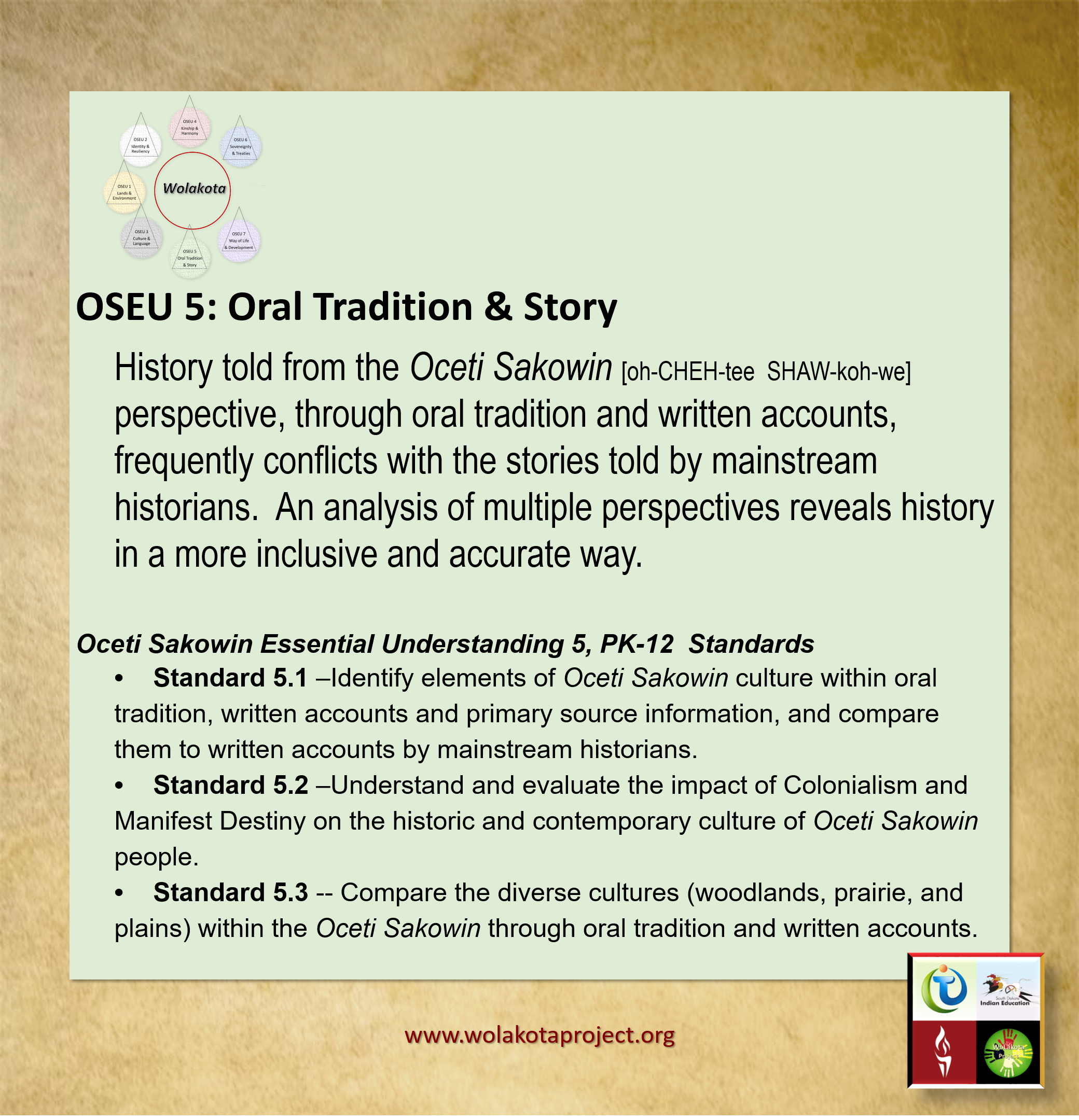
OSEU 5: Oral Tradition & Story
History told from the Oceti Sakowin [oh-CHEH-tee shaw-KOH-we]
perspective, through oral tradition and written accounts,
frequently conflicts with the stories told by mainstream
historians. An analysis of multiple perspectives reveals history
in a more inclusive and accurate way.
Oceti Sakowin Essential Understanding 5, PK-12 Standards
¢ Standard 5.1 —Identify elements of Oceti Sakowin culture within oral
tradition, written accounts and primary source information, and compare
them to written accounts by mainstream historians.
¢ Standard 5.2 —Understand and evaluate the impact of Colonialism and
Manifest Destiny on the historic and contemporary culture of Oceti Sakowin
people.
¢ Standard 5.3 -- Compare the diverse cultures (woodlands, prairie, and
plains) within the Oceti Sakowin through oral tradition and written accounts.
www.wolakotaproject.org A
V
Some indexed text was extracted from scanned material. Check the original source for exact wording and spelling.
Source materials
- Open source material
- Pehin Hanska: Song & Translation by Earl Bullhead
- Developing Native Writers with Lowell Amiotte
- Iktomi Stories with Vernon Ashley
- Story: How the Wood Duck Got His Red Eyes with Vernon Ashley
- Open source material
- Open source material
- David Bald Eagle’s Military Service in WWII
- Open source material
- David Bald Eagle Tells of His Grandfathers & Crazy Horse
- Open source material
- Open source material
- “Black Kettle” with Waylon Black Crow
- Song: “Come Home” with Sidney Byrd
- Song: “How Rabbit Lost His Tail” with Sidney Byrd
- Lakota Name for the “White Man” with Sidney Byrd
- The Story of Wounded Knee with Sidney Byrd
- Being Able to Listen with Stephanie Charging Eagle
- Open source material
- The Story of Iktome & the Ducks with Janet Claymore Ross
- Appreciating Multiple Versions of Stories with Jace DeCory
- Open source material
- Oral Tradition with Victor Douville
- Grandmother’s Stories with Gladys Hawk
- The Importance of Stories with Duane Hollow Horn Bear
- The Story of Star Boy with Duane Hollow Horn Bear
- Origin Story with Duane Hollow Horn Bear
- Open source material
- Biased History Texts with Drs. Johnson & Eastman
- Open source material
- The Story of the Mother Eagle and the Boy with Pearl Kennedy-Colombe
- The Story of the Girl and the Wolf with Pearl Kennedy-Colombe
- A History of Guns with Pearl Kennedy-Colombe
- Open source material
- The Story of Iktomi and the Ducks with Velma Kills Back
- The Story of the Moon Boy with Velma Kills Back
- Open source material
- Who Gets to Tell the Story? with Joseph Marshall III
- Open source material
- Oral History & Ledger Art with Donald Montileaux
- Why Isn’t This Taught? with Whitney Rencountre
- Types of Stories with Faith Spotted Eagle
- Storytelling & Oral Tradition with Delores Taken Alive
- The Story of the Child & The Hairy Man with Delores Taken Alive
- Open source material
- Lakota History with Lydia Whirlwind Soldier