Interview · South Dakota · Janet Claymore Ross · OSEU 5
Themes: Storytelling & oral tradition, Education & learning, Values & generosity, Culture & continuity, Food & plants, Arts & expression, Listening & observation, Humor & play
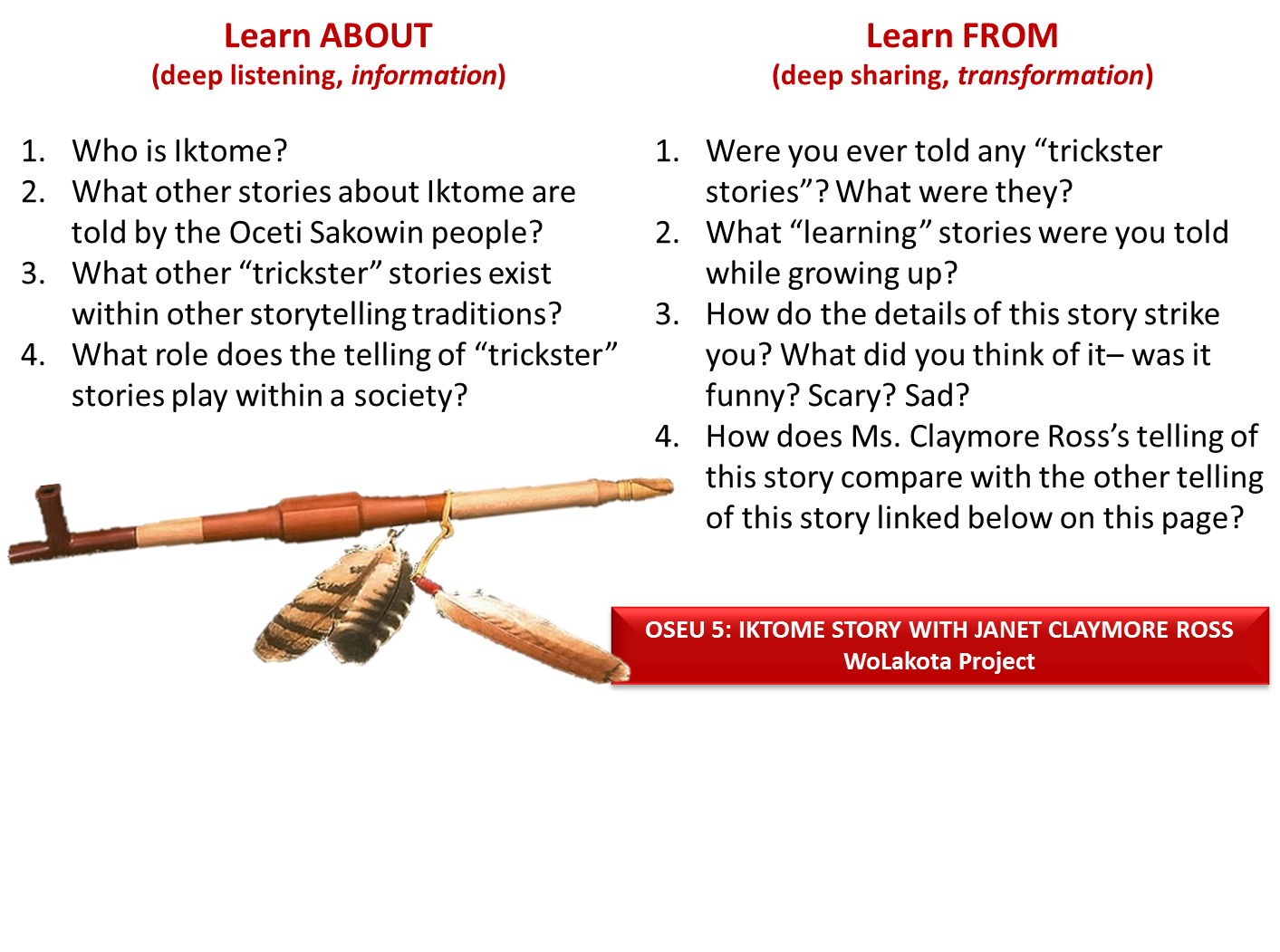
Learn About questions
Who is Iktomi?
What other stories about Iktomi are told by the Oceti Sakowin people?
What other “trickster” stories exist within other storytelling traditions?
What role does the telling of “trickster” stories play within a society?
Learn From questions
Were you ever told an “trickster stories”? What were they?
What “learning” stories were you told while growing up?
How do the details of this story strike you? What did you think of it-was it funny? Scary? Sad?
How does Ms. Claymore Ross’s telling of this story compare with the other telling of this story linked below on this page?
Transcripts
Janet Claymore Ross - Iktomi and the Ducks - OSEU 5
Watch this interview on YouTubeIktomi lived in a village, and he was not very nice. You know Iktomi, he's lazy, expects everybody to serve him. So he was sitting in the village one day, and he was saying, Can I have some of your food? And the person said, You know Iktomi, it's impolite for us to say no. But you have not helped us. You go out, and you bring some food back, and I will fix it for you. I'm not going to do that.
You're kicking me out?
I know when I'm not wanted. So off he goes, and he finds another village. Well that village soon came to realize that Iktomi, again, was lazy. So he thought, Well, I'm just going to go to another village, so I'll do that. So he gets up, and he starts walking, and walking, and walking, and he goes along, and he goes along, and he comes to a hill, and he goes down the hill, and up the hill, and down the hill, and up the hill, and he goes, Oh, I'm so tired.
Those lazy people in that village didn't even give me anything to eat so that I could go on this trip. How lazy they are. It's a good thing I brought my drum. I can entertain myself. And so he's going up a hill, and he's singing a song, and as he looks down the hill, there's this beautiful pond, and on the pond, there's lots of ducks.
Oh, good, I can eat, I can eat, I'm going to run down the road. What do you think?
No. So he starts to... I think that's the right way. So he gets up again,... and then he stops, and he goes, Oh, I know what that way is. Okay, so he goes down the hill, and he's singing a song, and he's singing about a traditional song because he says he's practicing it, and the ducks go, Iktomi, Iktomi, let's fly away!
And he just doesn't pay any attention to the ducks, and the ducks go, He's not paying any attention to us. Iktomi is just singing a song, and the ducks go, Why isn't he paying any attention to us?
So they get up, and they go, Iktomi! Iktomi goes, Go away, I'm busy. He's pounding his drum, and he's singing, and he goes, Iktomi, quack, quack, what are you doing?
Quack, quack, I want to see you! Quack, quack, what are you doing?
Let us tell us what you're saying! Quack, quack, quack, All right! You are so noisy! Be quiet, be quiet.
Resource text
Other Tellings of this Story:
Story: How the Wood Duck Got His Red Eyes with Vernon Ashley
The Story of Iktomi and the Ducks with Velma Kills Back
Learn ABOUT Learn FROM
(deep listening, information) (deep sharing, transformation)
1. Who is Iktome? 1. Were you ever told any “trickster
2. What other stories about Iktome are stories”? What were they?
told by the Oceti Sakowin people? 2. What “learning” stories were you told
3. What other “trickster” stories exist while growing up?
within other storytelling traditions? 3. How do the details of this story strike
4. What role does the telling of “trickster” you? What did you think of it— was it
stories play within a society? funny? Scary? Sad?
4. How does Ms. Claymore Ross’s telling of
this story compare with the other telling
of this story linked below on this page?
Ca OSEU 5: IKTOME STORY WITH JANET CLAYMORE ROSS
> WoLakota Project
From the current WoLakota source page:
The Story of Iktomi & the Ducks
Janet Claymore Ross
Transcript
(deep listening, information)
(deep listening, transformation)
Some indexed text was extracted from scanned material. Check the original source for exact wording and spelling.
Source materials
Supplied transcript document. Text preserved as supplied; spellings and transcription uncertainties have not been corrected.
Additional source transcripts
The Story of Iktomi & the Ducks
Janet Claymore Ross - Iktomi and the Ducks - OSEU
5
Iktomi lived in a village, and he was not very nice. You know Iktomi, he's lazy, expects
everybody to serve him. So he was sitting in the village one day, and he was saying,
Can I have some of your food? And the person said, You know Iktomi, it's impolite for us
to say no. But you have not helped us. You go out, and you bring some food back, and I
will fix it for you. I'm not going to do that.
You're kicking me out?
I know when I'm not wanted. So off he goes, and he finds another village. Well that
village soon came to realize that Iktomi, again, was lazy. So he thought, Well, I'm just
going to go to another village, so I'll do that. So he gets up, and he starts walking, and
walking, and walking, and he goes along, and he goes along, and he comes to a hill,
and he goes down the hill, and up the hill, and down the hill, and up the hill, and he
goes, Oh, I'm so tired.
Those lazy people in that village didn't even give me anything to eat so that I could go
on this trip. How lazy they are. It's a good thing I brought my drum. I can entertain
myself. And so he's going up a hill, and he's singing a song, and as he looks down the
hill, there's this beautiful pond, and on the pond, there's lots of ducks.
Oh, good, I can eat, I can eat, I'm going to run down the road. What do you think?
No. So he starts to... I think that's the right way. So he gets up again,... and then he
stops, and he goes, Oh, I know what that way is. Okay, so he goes down the hill, and
he's singing a song, and he's singing about a traditional song because he says he's
practicing it, and the ducks go, Iktomi, Iktomi, let's fly away!
And he just doesn't pay any attention to the ducks, and the ducks go, He's not paying
any attention to us. Iktomi is just singing a song, and the ducks go, Why isn't he paying
any attention to us?
So they get up, and they go, Iktomi! Iktomi goes, Go away, I'm busy. He's pounding his
drum, and he's singing, and he goes, Iktomi, quack, quack, what are you doing?
Quack, quack, I want to see you!
Quack, quack, what are you doing?
Let us tell us what you're saying! Quack, quack, quack, All right! You are so noisy! Be
quiet, be quiet.
So then he's singing a song. Well, what are you doing? right. I'll tell you, I'm practicing a
song, and the song that I'm singing is a sacred song because I have to go to this village
that's over there and sing these songs, so I'm practicing. Well, we want to hear the
song, and we want to dance to it, too. No, you cannot hear the song, and you cannot
dance to it. It's a sacred song. Now I have to sing it in my mind. So he's hitting the drum,
and the ducks go,... quack, sing it so we can dance, quack, Why do you have to be so
noisy?
Okay, okay, okay.
But in these conditions, you have to close your eyes. Well, why do we have to close our
eyes? Quack, quack.
Why?
Well, because it's a sacred song, and if you don't close your eyes, your eyes will turn
red. Oh, okay. So Tomi gets in the center, and he starts singing this song, and it's a
sacred song, and so the ducks start going around and around with their eyes closed,
and they're kind of bumping into each other, and Tomi hits one, and then he hits another
one, and he hits another one, and he hits another one.
One of the ducks falls over, oh, open your eyes, you fools, if Tomi is killing us, and off
they fly.
But Tomi has four nice fat ducks, and those ones that flew off, that's why they have red
eyes to this day, because it was a sacred song.