Interview · South Dakota · Duane Hollow Horn Bear · OSEU 5
Themes: Land & stewardship, Storytelling & oral tradition, Spirituality & ceremony, Values & generosity, Culture & continuity, Food & plants, Community & responsibility, Listening & observation
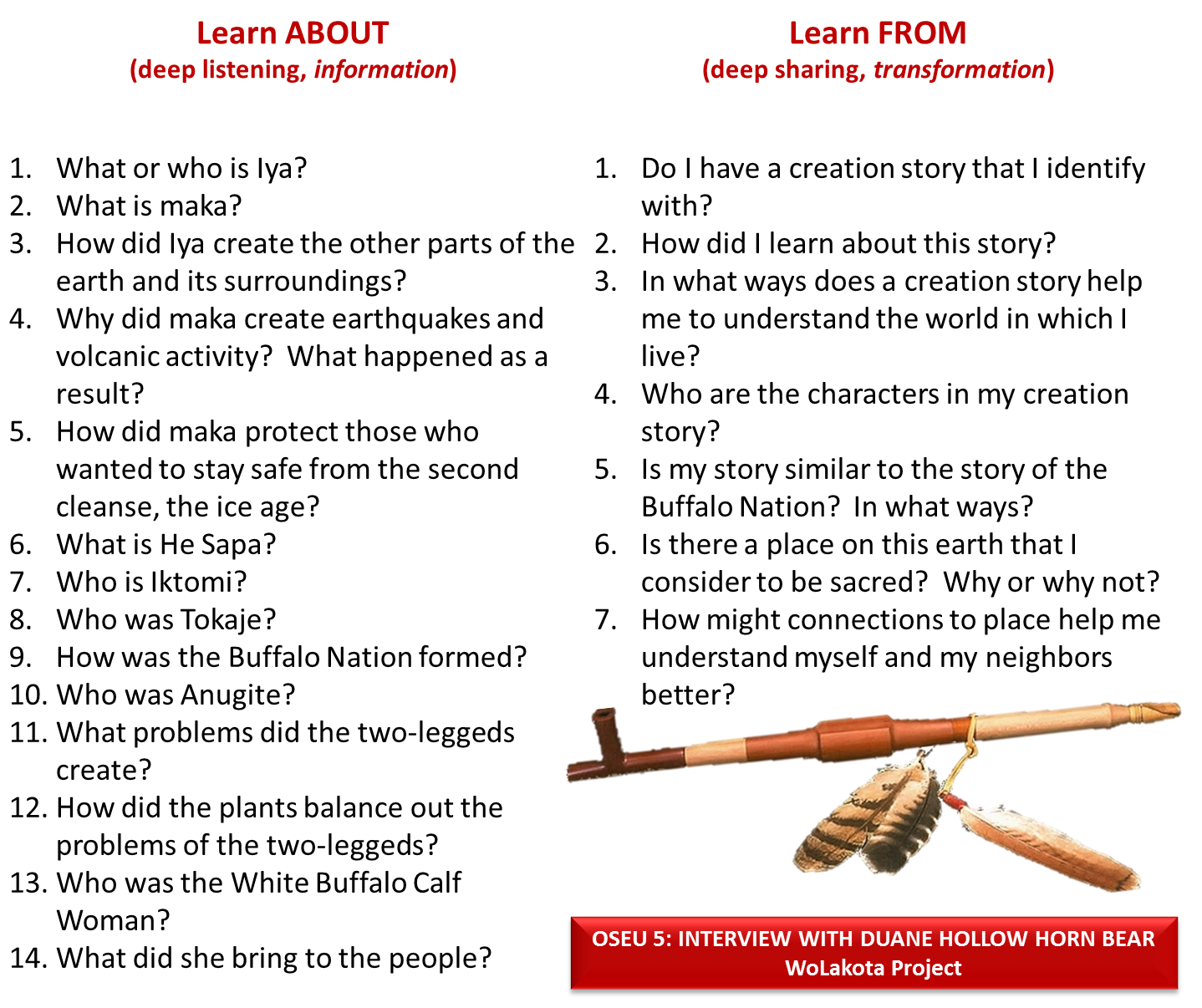
Learn About questions
What or who is Iya?
What is maka?
How did Iya create the other parts of the earth and its surroundings?
Why did maka create earthquakes and volcanic activity? What happened as a result?
How did maka protect those who wanted to stay safe from the second cleanse, the ice age?
What is He Sapa?
Who is Iktomi?
Who was Tokaje?
How was the Buffalo Nation formed? Create?
Who was Anugite?
What problems did the two-leggeds create?
How did the plants balance out the problems of the two-leggeds
Who was the White Buffalo Calf Woman?
What did she bring to the people?
Learn From questions
Do I have a creation story that | identify
with?
How did I learn about this story?
In what ways does a creation story help me to understand the world in which I live?
Who are the characters in my creation story?
Is my story similar to the story of the Buffalo Nation? In what ways
Is there a place on this earth that I consider to be sacred? Why or why not?
How might connections to place help me understand myself and my neighbors better?
Transcripts
Origin Story
Watch this interview on YouTubeOrigin Story - Duane Hollow Horn Bear - OSEU 5
You know, all ethnic groups around the world have an idea or a belief as to where
everything comes from? Where did this world come from? Where did the sun come
from? Where did the moon, where did the trees come from? Where did I come from?
And they have a belief in creation, or evolution, or a combination of the two. But they
have some sort of idea where everything came from. Well, as Lakota people, we still
talk about our origin story, on where everything came from. We talk about an entity, an
entity we refer to as Ea.
Ea was a power, a massive power, very, very powerful, very powerful that nothing else
could exist except for Ea. Ea at a point took a part of itself and began to form this orb
and squeezing and squeezing tighter and tighter and tighter and tighter and tighter until
what oozed out of it looked like it's blue blood, leaving a half-hard, brittle body, and Ea
called it Makkah, Earth. Makkah existed in total darkness, questioning Ea, what's my
purpose? What's my reason for being here? Why am I here? Is there anything else?
Ea took other parts of itself and created Apewi, the sun, Hawewi, the moon, Wichahpi
Oyate, the stars, the galaxies, the universe, and put everything in correlation with itself.
And time went on. Time went on. But at one point, Makkah complained, when I faced
Apewi, it became very hot, uncomfortable. And so when I turn and I face Hawewi, the
moon, it becomes dark, and it gets cold. Could you give me a covering, something to
protect myself?
Ea, in counsel with the other entities of itself, told Makkah, if we give you a covering,
you must promise to bring forth life and to nourish it. Makkah promised. And so life went
on. Life went on for a very long time. But at a point, life became ugly, very corrupt,
senseless destruction, killing. Makkah said, this is not the way that life is intended to be
upon me. I must cleanse. Let's try to imagine all of these catastrophes happening all at
the same time. Earthquakes, volcanic eruptions, hurricanes, hundreds of them,
hundreds of tornadoes.
Makkah, this one half landmass, shaking and shaking and shaking, shaking so hard that
the one half land mass broke apart, broke apart, separating the peoples into the
different continents.
Life went on. But at a point again, eons of time later, life again became very corrupt,
very corrupt, because I must cleanse again. Those of you that are keeping the ways of
life as intended to be, come deep down inside me, where I may protect you. Again,
these catastrophes. And it came in the form of the Ice Age, changing the surface of the
world when the ice melted back, leaving lakes, bodies of water everywhere, small lakes,
rivers.
In this beautiful area today known as the Black Hills, Hesapa, in the southern Black
Hills, we have a trickster in our culture. We call him Iktomi. Iktomi was walking around in
the Black Hills. He was wandering around. It was an era of giants, giants, dinosaurs,
and bears. Iktomi heard this heavy breathing and took to hiding under the bushes
because he thought he was going to be trampled. But he didn't hear the thrashing of
trees and shrubs, just a heavy breathing. Now, curiosity always gets the best of Iktomi.
So he came out from hiding, listening to that breathing. He followed it. And he came
upon this opening in the ground, peered down into that opening and felt a wind come up
and a wind being drawn back in. He looked down into the opening and he saw the
subterranean species living deep down in that hole, calling down to them. He said,
come up here. Come here. But they were afraid. No, no, no. Go away. Leave us alone.
I'm not going to hurt you. I'm not going to hurt you. Come up here. I want to show you
something.
One brave young individual says, I'll go see. And this individual came out the very first
one to come back to the surface of the world. And we call him Tkhokahe, which means
the very first. Came back to the surface of the world. Iktomi says, look at you. Look
around you. Look around you. Look how beautiful it is. Feel the warmth of that sun. Isn't
that nice? Feel that cool breeze. Here, try some of these chokecherries. Eat some of
these plums. Aren't they delicious? Lay down in that soft green grass. That little stream
of water. Taste that.
It's wonderful. Why do you want to live deep down in that dark hole when you can come
up and you can have all of this? Go get your people. I'm going to go find my friend.
We're going to prepare a grand feast for you. Bring your people up here. Tkhokahe
says, I will do it. He goes back down into the hole, gathers the people together, and he
talks about everything he experienced. How wonderful it was. But an elder is there. An
elder says, Tkhokahe, there is danger. You do not know all of the danger that lurks up
there. Tkhokahe says, no, I have seen it all.
It's wonderful. We must get ready to go. The elder says he's being very foolish. I must
go ahead and make plans for when danger strikes. And so the old man sneaks away
from the group, comes out of the opening, and transforms into the Buffalo Nation.
Tkhokahe and the rest emerge. And Iktomi is there with his companion, Anugite, the
double-faced woman. Very, very beautiful on one side. But she would not let the people
see her on this side. She served him. She talked to them. Always on one side.
And at a point after the people had gorged themselves, they ate, they were in the water
swimming, they were sleeping in the grass. Sunbathing, you might say. And then
Anugita turns, and she shows the ugliness, the hideous side of her, and the people
panic. They scream. They run back to the opening. But their bodies had grown,
because of all the food they had eaten. All of the air that they breathed in, the water.
Their bodies grew. They couldn't fit back into that opening to go back down. Now Iktomi,
Iktomi loves to trick people.
And when he sees them make a mistake, or he sees them hurt themselves, or when
they're in misery, he laughs. He laughs. I did it. I did it. They're trapped on the surface. I
did it. I got him. He's rolling on the ground laughing. Buffalo Nation comes forward.
Buffalo Nation says, we are here for you. All that we are is for you. We are your food.
We're your shelter. Your medicine. Your tools. And we became known as the Buffalo
People. Following the Buffalo. Relying upon the Buffalo for everything. And the Buffalo
Nation has never let us down.
Because as we began to adopt and adapt to living on the surface of the world again,
you might say we became a little overbearing. Taken more than we needed. Taken
without respect. Taken without giving anything back. The four-legged, the winged ones,
they cut off communication with us. They say, you know, it's because of these
two-leggeds that the world had to cleanse twice. Maybe this would be a better world
without these two-leggeds. We should get rid of them. Yes, let's do it. We can do it.
We can send into these two-leggeds all of these illnesses, all of these diseases, and
wipe them out. As they were going to proceed to do so. Underneath them, the plant life.
The plant life said, it is not up to them to decide who lives or who dies. For every
sickness, every illness, they send into the two-leggeds. We have a root. We have
medicine. An herb. And so the balance was kept. And life went on. Life went on for a
time again. But again, as two-leggeds, we became overbearing. Again, no respect. No
honor. Creations.
What are we going to do about these two-leggeds? Oh, Buffalo Nation! Buffalo Nation!
You said you would be responsible for these two-leggeds. Look at the way they are.
What are you going to do? Buffalo Nation said, we will take care of it. What are you
going to do? You cannot go to them the way you are. They're very destructive. They'll
kill you. They'll eat you. They consume everything. What are you going to do? Buffalo
Nation said, we will take care of it.
So at a point in time, they sent to us from the Buffalo Nation, the White Buffalo Calf
Woman, bringing to us the sacred pipe to remind us that there is to be a spiritual
connection of what is on this earth is in the stars. It's in the universe. And what's in the
stars is on this earth. And the spiritual connection must be kept. Remember that story.
Thank you.
Resource text
N
. Who was Anugite?
. What problems did the two-leggeds
. Who was the White Buffalo Calf “ay,
Woman?
. . OSEU 5: INTERVIEW WITH DUANE HOLLOW HORN BEAR
Learn ABOUT Learn FROM
(deep listening, information) (deep sharing, transformation)
What or who is lya? 1. Do! have a creation story that | identify
What is maka? with?
How did lya create the other parts of the 2. Howdid | learn about this story?
earth and its surroundings? 3. In what ways does a creation story help
Why did maka create earthquakes and me to understand the world in which |
volcanic activity? What happened as a live?
result? 4. Who are the characters in my creation
How did maka protect those who story?
wanted to stay safe from the second 5. Is my story similar to the story of the
cleanse, the ice age? Buffalo Nation? In what ways?
What is He Sapa? 6. Is there a place on this earth that |
Who is Iktomi? consider to be sacred? Why or why not?
Who was Tokaje? 7. How might connections to place help me
How was the Buffalo Nation formed? understand myself and my neighbors
better?
create?
How did the plants balance out the
problems of the two-leggeds?
From the current WoLakota source page:
Origin Story
Duane Hollow Horn Bear
Transcript
(deep listening, information)
(deep listening, transformation)
Some indexed text was extracted from scanned material. Check the original source for exact wording and spelling.
Source materials
Transcripts from supplied documents and the current WoLakota source pages. Text preserved as published.