Interview · South Dakota · Stephanie Charging Eagle · OSEU 3
Themes: Land & stewardship, Language & revitalization, Kinship & family, Identity & belonging, Education & learning, Values & generosity, Culture & continuity, Community & responsibility, Listening & observation
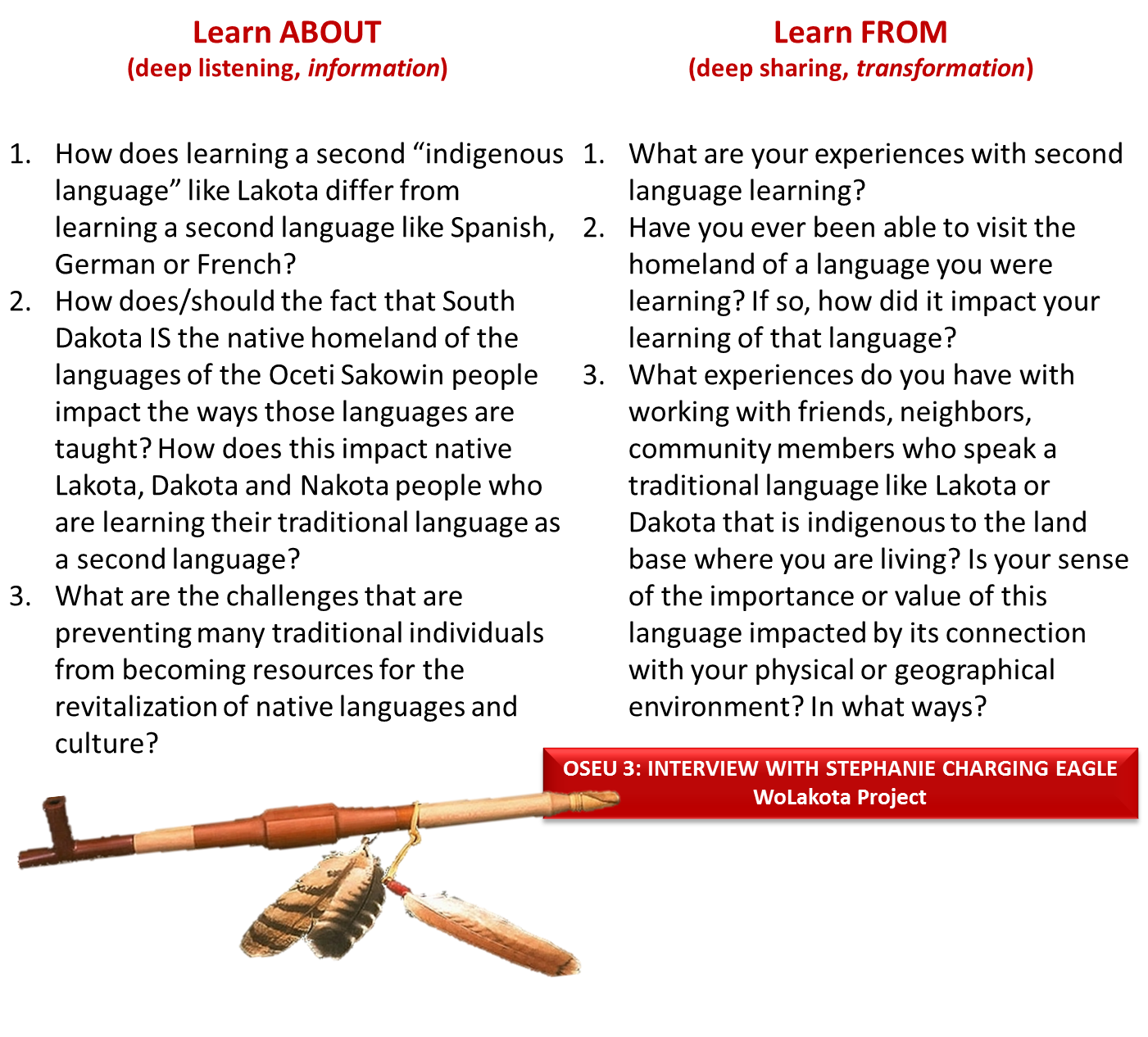
Learn About questions
How does learning a second “indigenous language” like Lakota differ fro learning a second language like Spanish, German or French?
How does/should the fact that South Dakota IS the native homeland of the languages of the Oceti Sakowin people impact the ways those languages are taught? How does this impact native Lakota, Dakota and Nakota people who are learning their traditional language as a second language?
What are the challenges that are preventing many traditional individuals from becoming resources for the revitalization of native languages and culture?
Learn From questions
What are your experiences with the second language learning?
Have you ever been able to visit with the homeland of a language you were learning? If so, how did it impact your learning of that language?
What experiences do you have with working with friends, neighbors, community members who speak a traditional language like Lakota or Dakota that is indigenous to the land base where you are living? Is your sense of the importance or value of this language impacted by its connection with your physical or geographical environment? In what ways?
Transcripts
Second Language Learners - Stephanie Charging Eagle - OSEU #3
Watch this interview on YouTubeMy whole career has been based on really…putting out the word about the learners who are now coming into our schools as second language learners of Lakota language. And that’s a concern because it’s unlike English as a second language or any language as a second language…because indigenous languages are connected to kinship…to the land…to everything. It goes back to being connected with the…who we are…our homelands…we say there’s a saying that…the people who…the immigrants who came to this country can go home to wherever their ancestors are from. But we have no homeland. This is our homeland. Our homeland is where we are. We don’t have the luxury of being able to going somewhere and saying, “We’re going home.” So we have to make the best of the situation. And education is one avenue for that.
Education has become, for me, an avenue…a manageable tool to do a lot of the work that needs to be done. There has been a lot of work that has been done, but we still have plenty to do. And as I think about my colleagues…the people who I worked with in the eighties, nineties, early two-thousands…we…I look at them…and some of them are gone now… some are retired, semi-retired…and we’re sitting on a whole treasure chest of people who have the knowledge…the wisdom. And we’re not tapping into it. The people who need to be tapping into those resources are not.
I would like to see education…it’s the best thing we can do right now. We always say we want to go back to the families to do this. But we also have a problem there. So we have to go with what is best and the most practical…and that is using our educational institutions…and that is how we share.
Resource text
Learn ABOUT Learn FROM
(deep listening, information) (deep sharing, transformation)
1. How does learning a second “indigenous 1. What are your experiences with second
language” like Lakota differ from language learning?
learning a second language like Spanish, 2. Have you ever been able to visit the
German or French? homeland of a language you were
2. How does/should the fact that South learning? If so, how did it impact your
Dakota IS the native homeland of the learning of that language?
languages of the Oceti Sakowin people 3. What experiences do you have with
impact the ways those languages are working with friends, neighbors,
taught? How does this impact native community members who speak a
Lakota, Dakota and Nakota people who traditional language like Lakota or
are learning their traditional language as Dakota that is indigenous to the land
a second language? base where you are living? Is your sense
3. What are the challenges that are of the importance or value of this
preventing many traditional individuals language impacted by its connection
from becoming resources for the with your physical or geographical
revitalization of native languages and environment? In what ways?
culture?
OSEU 3: INTERVIEW WITH STEPHANIE CHARGING EAGLE
' WoLakota Project
From the current WoLakota source page:
Second Language Learners
Stephanie Charging Eagle
Transcript
(deep listening, information)
(deep listening, transformation)
Some indexed text was extracted from scanned material. Check the original source for exact wording and spelling.
Source materials
Supplied transcript document. Text preserved as supplied; spellings and transcription uncertainties have not been corrected.
Additional source transcripts
Second Language Learners
Second Language Learners - Stephanie Charging
Eagle - OSEU #3
My whole career has been based on really…putting out the word about the learners
who are now coming into our schools as second language learners of Lakota language.
And that’s a concern because it’s unlike English as a second language or any language
as a second language…because indigenous languages are connected to kinship…to
the land…to everything. It goes back to being connected with the…who we are…our
homelands…we say there’s a saying that…the people who…the immigrants who came
to this country can go home to wherever their ancestors are from. But we have no
homeland. This is our homeland. Our homeland is where we are. We don’t have the
luxury of being able to going somewhere and saying, “We’re going home.” So we have
to make the best of the situation. And education is one avenue for that.
Education has become, for me, an avenue…a manageable tool to do a lot of the work
that needs to be done. There has been a lot of work that has been done, but we still
have plenty to do. And as I think about my colleagues…the people who I worked with in
the eighties, nineties, early two-thousands…we…I look at them…and some of them are
gone now… some are retired, semi-retired…and we’re sitting on a whole treasure chest
of people who have the knowledge…the wisdom. And we’re not tapping into it. The
people who need to be tapping into those resources are not.
I would like to see education…it’s the best thing we can do right now. We always say we
want to go back to the families to do this. But we also have a problem there. So we
have to go with what is best and the most practical…and that is using our educational
institutions…and that is how we share.