Resource · South Dakota · OSEU 6
Themes: Land & stewardship, Language & revitalization, Kinship & family, Identity & belonging, Storytelling & oral tradition, Education & learning, Treaties & sovereignty, Boarding schools & assimilation, Spirituality & ceremony, Values & generosity, Culture & continuity, Racism & representation, Arts & expression, Community & responsibility, Economy & livelihoods, Self-determination & leadership, Intergenerational learning
Resource text
Learning Question Pages for classroom use:
Click on each title below to find interviews accompanied by “Learn About” and “Learn From” questions for use in classrooms, in small groups or for deeper personal exploration of each video.
Not all videos are accompanied by questions.
Tawapaha Olowan: Song & Translation by Earl Bullhead
Navigating Two Cultures for Change with Lowell Amiotte
The Dakota Uprising with Vernon Ashley
Boarding School, Oceti Sakowin & The Wheeler Howard Act with Vernon Ashley
Life in the 1930s with Vernon Ashley
World War II with Vernon Ashley
Pick-Sloan Act & Loss of Honesty Vernon Ashley
Armed Forces & Treaties with David Bald Eagle
David Bald Eagle On Man-Made Laws (extended)
“Day Schoolers” and “Boarders” with Waylon Black Crow
NEW!
Boarding School 03a –“Leaving Home” with Sidney Byrd
Boarding School 03b–“A Friend on the Train” with Sidney Byrd
Boarding School 03c–“Arriving At School” with Sidney Byrd
Boarding School 03d–“Students Drilling” with Sidney Byrd
Boarding School 03e–“Rose Pumpkinseed” with Sidney Byrd
Boarding School 03f–“Draw Day” with Sidney Byrd
Boarding School 03g–“Returning Home” with Sidney Byrd
Santee Christian Homesteading with Sidney Byrd
Civil Rights Movement & MLK with Sidney Byrd
The Dakota Uprising with Sidney Byrd
The Impact of Forced Treaties with Stephanie Charging Eagle
More Valuable than Money with Victor Douville
NEW!
Mitakuye Oyasin with Ricky Gray Grass
NEW!
Water is Life with Ricky Gray Grass
NEW!
Understanding Treaties with Drs. Johnson & Eastman
Indian Law “Before & After” with Joseph Marshall III
Working Together with Whitney Rencountre
Input of the Grandmothers with Faith Spotted Eagle
Doctrine of Discovery with Faith Spotted Eagle
Chipping Away at Treaties with Faith Spotted Eagle
Treaties & the US Constitution with Faith Spotted Eagle
1851 Treaty & 1892 Agreement with Faith Spotted Eagle
Peace Treaty with Faith Spotted Eagle
Keystone Resolution with Faith Spotted Eagle
Indian Citizenship Act with Eli Tail Sr.
NEW!
They’ll Say, “I Didn’t Know” with Jesse Taken Alive
Benefits Aren’t Free with Lydia Whirlwind Soldier
NEW!
Oceti Sakowin
Essential Understanding 6 Extended Description
When teaching
Oceti Sakowin
history, culture, federal policies, and treaties, it would be appropriate to examine each in a chronological order. This chronological approach makes it easier to study the origins of treaties, federal policies, and where they lead today.
Confederacies such as the Iroquois, Muskogee and
Oceti Sakowin
are prototypes of tribal organizations. Tribal sovereignty can truly be examined by studying how these confederacies were organized and how they functioned. The three basic parts of tribal sovereignty are its function, its organization and its purpose.
Both tribal sovereignty and age of discovery are important to the
Oceti Sakowin
because they established how colonial powers initially recognized tribal sovereignty.
The unique way each
Oceti Sakowin
Band retains its tribal sovereignty are powerful elements of survival, how it evolved to its present form, and where it will eventually evolve. The current and historical facts about this topic are supported by the incredible amount of information available. Moreover, oral tradition has come into its own by responding to the historical facts from an
Oceti Sakowin
viewpoint. This would include winter counts, recordings and videos of elders and others sharing stories and information, and written accounts of history using primary documents.
There are different perspectives on tribal sovereignty. For example, one perspective focuses on the idea that tribes are not truly sovereign because they lack the model of sovereignty, especially when compared to the United States model of sovereignty. This is clearly based on the interpretation of Supreme Court Chief Marshall’s idea of the “domestic dependent nations” concept. (V. Douville).
One of the key events in the Age of Discovery is the legal groundwork created by Emmerich Vattel to address the ownership of tribal land. This will have a lasting impact of how the United States viewed treaties, land acquisition, and the right of discovery concept.
The key link is the case of Rosebud Sioux vs. Kneip and its potential to emerge in the future with jurisdictional implications, impacting issues such as courts, seatbelts and water rights. There are also other issues such as the Cobell lawsuit involving the trust status of land ownership and Bureau of Indian Affairs (BIA) mismanagement of land. Trust land monopolized by the BIA and Federal Government raises some key issues of Vattel’s interpretation of ownership of tribal lands.
Differing perceptions exist concerning the idea that the land issues were settled in the past by the simplest method, “Might Makes Right.” On the other hand, the attitude by some tribal members is that since the government dealt from a “weak” position–having been defeated at the “Battle of One Hundred Slain” (1866)—the US simply “signed” treaties like the 1868 Fort Laramie Treaty. After the US government wrote the treaty, some Lakota chiefs and leaders used thumbprints or oral consent using a pipe. Sometimes soldiers or government agents signed for the Lakota person. The treaty ceded a large land base from the Lakota and Dakota. In the end, the tribes lost out because in signing the 1868 Fort Laramie Treaty, authored by the Federal Government through the military branch, the
Oceti Sakowin
unknowingly made major concessions because gold was discovered in the Black Hills.
The treaty-making period lasted from 1805 to 1871, according to the Federal Government, or from 1805 to 1934, according to the tribal elders of the
Oceti Sakowin
. Treaties are still in effect when land claims are discussed. The impacts of the treaties are still evident in the continued funding of each tribal nation today. Benefits to tribes from treaties should not be connected to tax or welfare, but rather as a replacement for a lifestyle that was lost by coercion. Treaties should be viewed as applied in the U.S. Constitution and the interpretation of Supreme Court Chief Justice Marshall.
Some non-tribal members have a negative perception of the usage of tax dollars for funding tribal needs. Taxation is an unpopular subject. This is countered by a positive feedback by tribal perceptions and historians who are using facts to show that treaties are legitimate and that the federal government should be held accountable for reneging on treaty obligations.
Federal policies can be divided into three parts: congressional acts, judicial decisions based on interpretations of the laws, and executive orders. Moreover, pre-federal policies should be included because they are regarded as formative, including the Marshall trilogy, the creation of the BIA, as well as various policies. One such policy is the long-range mission of the United States to transform the tribal members into citizens of the United States starting with treaties of friendship to get the tribes to recognize United States sovereignty over them. The policy also included taking land by war whenever necessary, placing tribes on reservations, breaking up reservations into individual holdings, and acculturating/assimilating tribal members.
It is most imperative for all learners to ascertain a complete understanding of the past to show how the concept and practice of federal policies applies in today’s context and how this same concept and practice will apply in the future.
When the tribal perspective is included in government policies, better discussions can only lead to positive outcomes based on critical thinking. Most of the negativity comes from the paternalistic attitude of the BIA, an agency that manages tribal trust lands. The evolution of the BIA shows how this organization still has a stranglehold on the
Oceti Sakowin
members and other tribal groups, until the modern times when this grip has somewhat loosened.
The
Oceti Sakowin
has survived the gamut of federal policies that are designed to destroy the traditional base of knowledge and practice. The tribes have survived the dark past envisioned by a man who knew what was best for Native people, “Kill the Indian and save the man.” (Captain Richard H. Pratt 1892).
Today, our endeavor is to save the
Oceti Sakowin
history and culture and destroy the stereotypes. (V. Douville 2012)
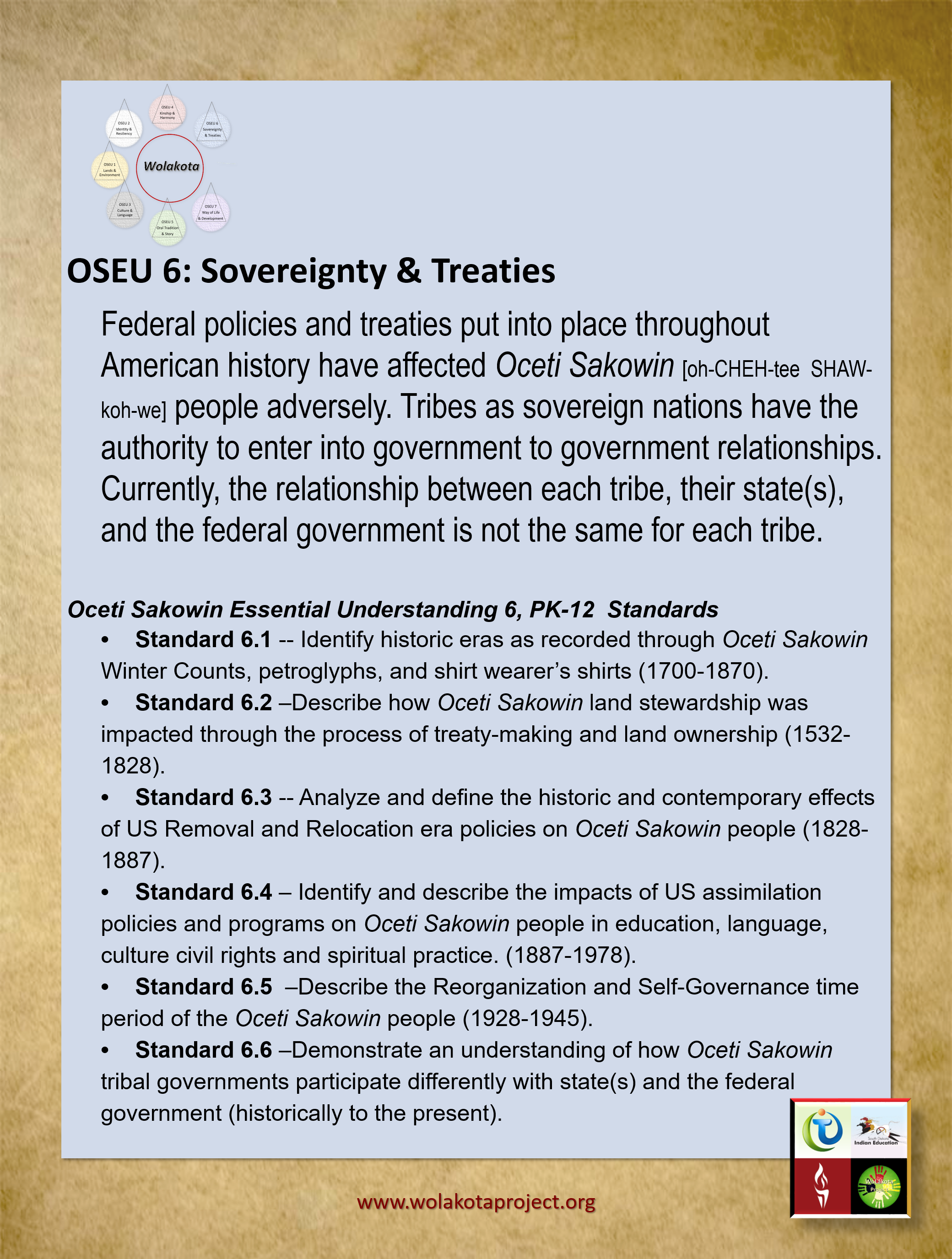
( wotakoto)
Sey
OSEU 6: Sovereignty & Treaties
Federal policies and treaties put into place throughout
American history have affected Oceti Sakowin [on-cHEH-tee shaw-
KOH-we] people adversely. Tribes as sovereign nations have the
authority to enter into government to government relationships. |
Currently, the relationship between each tribe, their state(s),
and the federal government is not the same for each tribe.
Oceti Sakowin Essential Understanding 6, PK-12 Standards
* Standard 6.1 -- Identify historic eras as recorded through Oceti Sakowin |
Winter Counts, petroglyphs, and shirt wearer's shirts (1700-1870).
* Standard 6.2 —-Describe how Oceti Sakowin land stewardship was
impacted through the process of treaty-making and land ownership (1532-
1828).
* Standard 6.3 -- Analyze and define the historic and contemporary effects
of US Removal and Relocation era policies on Oceti Sakowin people (1828-
1887).
* Standard 6.4 — Identify and describe the impacts of US assimilation
policies and programs on Oceti Sakowin people in education, language,
culture civil rights and spiritual practice. (1887-1978).
* Standard 6.5 —Describe the Reorganization and Self-Governance time
period of the Oceti Sakowin people (1928-1945).
* Standard 6.6 —-Demonstrate an understanding of how Oceti Sakowin
tribal governments participate differently with state(s) and the federal
government (historically to the present).
www.wolakotaproject.org
Some indexed text was extracted from scanned material. Check the original source for exact wording and spelling.
Source materials
- Open source material
- Tawapaha Olowan: Song & Translation by Earl Bullhead
- Navigating Two Cultures for Change with Lowell Amiotte
- The Dakota Uprising with Vernon Ashley
- Boarding School, Oceti Sakowin & The Wheeler Howard Act with Vernon Ashley
- Life in the 1930s with Vernon Ashley
- World War II with Vernon Ashley
- Pick-Sloan Act & Loss of Honesty Vernon Ashley
- Armed Forces & Treaties with David Bald Eagle
- David Bald Eagle On Man-Made Laws (extended)
- Open source material
- Open source material
- “Day Schoolers” and “Boarders” with Waylon Black Crow
- Boarding School 03a –“Leaving Home” with Sidney Byrd
- Boarding School 03b–“A Friend on the Train” with Sidney Byrd
- Boarding School 03c–“Arriving At School” with Sidney Byrd
- Boarding School 03d–“Students Drilling” with Sidney Byrd
- Boarding School 03e–“Rose Pumpkinseed” with Sidney Byrd
- Boarding School 03f–“Draw Day” with Sidney Byrd
- Boarding School 03g–“Returning Home” with Sidney Byrd
- Santee Christian Homesteading with Sidney Byrd
- Civil Rights Movement & MLK with Sidney Byrd
- The Dakota Uprising with Sidney Byrd
- The Impact of Forced Treaties with Stephanie Charging Eagle
- Open source material
- More Valuable than Money with Victor Douville
- Open source material
- Mitakuye Oyasin with Ricky Gray Grass
- Water is Life with Ricky Gray Grass
- Understanding Treaties with Drs. Johnson & Eastman
- Indian Law “Before & After” with Joseph Marshall III
- Working Together with Whitney Rencountre
- Input of the Grandmothers with Faith Spotted Eagle
- Doctrine of Discovery with Faith Spotted Eagle
- Chipping Away at Treaties with Faith Spotted Eagle
- Treaties & the US Constitution with Faith Spotted Eagle
- 1851 Treaty & 1892 Agreement with Faith Spotted Eagle
- Peace Treaty with Faith Spotted Eagle
- Keystone Resolution with Faith Spotted Eagle
- Open source material
- Indian Citizenship Act with Eli Tail Sr.
- They’ll Say, “I Didn’t Know” with Jesse Taken Alive
- Open source material
- Benefits Aren’t Free with Lydia Whirlwind Soldier