Interview · South Dakota · Stephanie Charging Eagle · OSEU 2
Themes: Land & stewardship, Language & revitalization, Kinship & family, Identity & belonging, Education & learning, Healing & resilience, Spirituality & ceremony, Values & generosity, Community & responsibility, Economy & livelihoods, Listening & observation
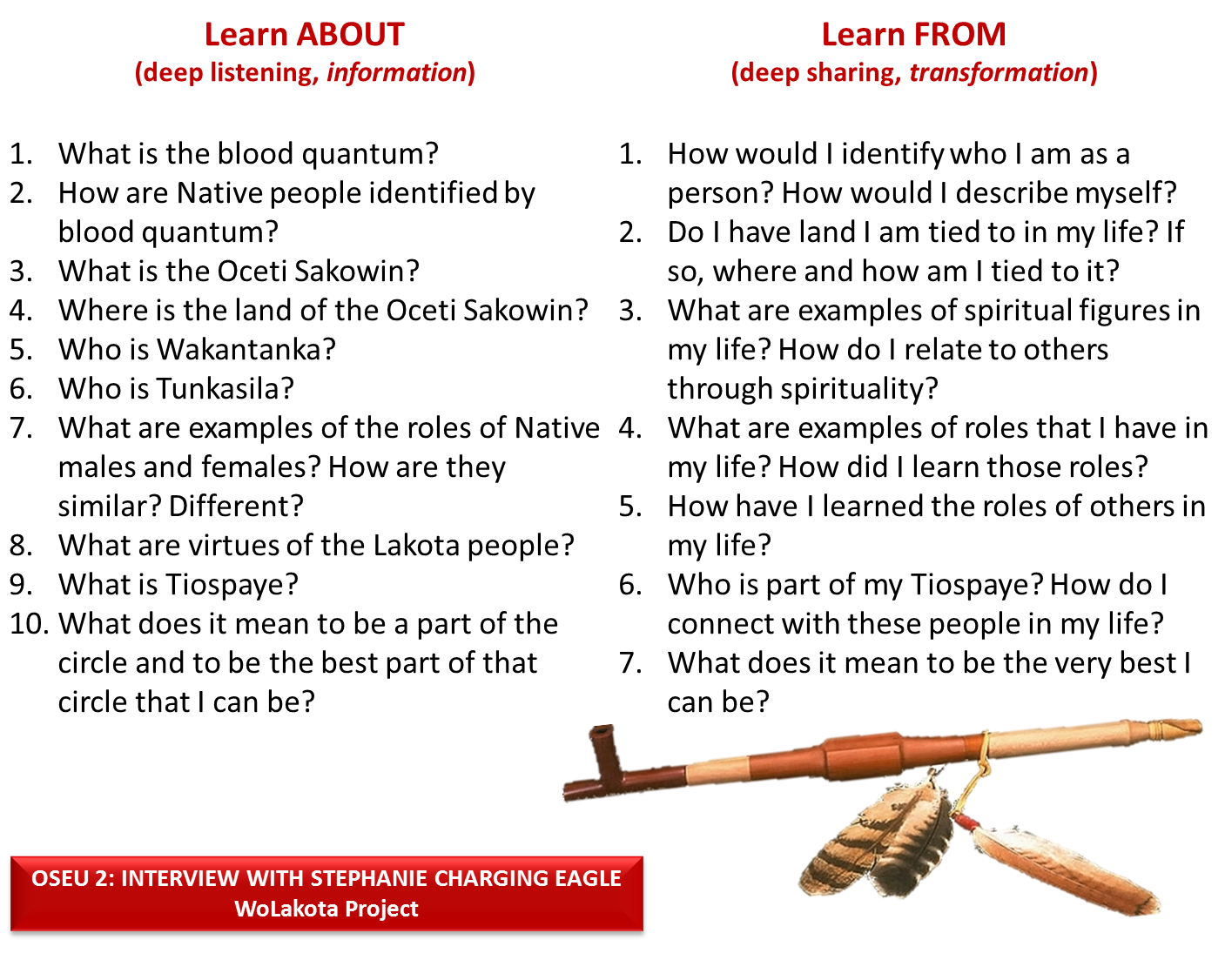
Learn About questions
What is the blood quantum?
How are Native people identified by blood quantum?
What is the Oceti Sakowin?
Where is the land of the Oceti Sakowin?
Who is Wakantanka?
Who is Tunkasila?
What are examples of the roles of Native males and females? How are they similar? Different?
What are virtues of the Lakota people?
What is Tiospaye?
What does it mean to be part of the circle and to be the best part of that circle that I can be?
Learn From questions
How would I identify who I am as a person? How would I describe myself?
do I have land I am ties to in my life? If so, where and how am I tied to it?
What are examples of spiritual figures in my life? How do I relate to other through spirituality?
What are examples of roles that I have in my life? How did I learn those roles?
How have I learned the roles of other in my life?
Who is part of my Tiospaye? How do I connect with these people in my life?
What does it mean to be the very best I can be?
Transcripts
Lakota Identity and Virtues - Stephanie Charging Eagle - OSEU #2
Watch this interview on YouTubeMost importantly, we have to acknowledge that there is a system in place that was… I guess you could say… forced upon us… to acknowledge who we are, you know…in that way. And that is with the blood quantum… and that is the reality. So, we have to work with that. But we… what we want our students of South Dakota… who use this curriculum… is that we consider ourselves people of the Oceti Sakowin… because we come from that land… we come from that lineage of people… who fought for that…who lived that life… who acknowledge spiritually who Wakan Tanka is… who Tunkasila is. If we were to… this is just my personal… I guess this is personal for me… if I were asked to pick people in my community who would be the people that would be acknowledged as Lakota… because of criteria, certain criteria…I would have to say first that they live the life of a Lakota person… which is a male or female… and to live that life as a Lakota person would. And that is, you know, all the teachings we've gotten as a Lakota woman…what I was taught were certain responsibilities… certain roles that I had to know and to be able to do as a woman… and that was my role in the circle… and the male is the same. So I wouldn't be like a male and the male wouldn't be like a female.
The… our roles and responsibilities. So I would have to look at the individual and say, “They are… I would say they are Lakota because every day they live that life. They're generous in the way that we as Lakota people are generous. They are spiritual in the way that our Lakota people are spiritual.” And so it's all these very abstract virtues or characteristics. And then language… to be able to speak the language… not just surface language…but to be able to understand when we say, “tiospaye,” what does that mean? We know that means “extended family,” but what does that word really mean? And to have the language in that sense would be another very important criteria. The other thing is… to understand the spiritual part of who we are…to understand that we are one in a circle…but that to be the best we are in that circle individually is what makes us whole… strong as a whole. We are never an individual for ourselves, but that we do our best to be who we are.
And that's what I believe… when we talk about variety and resilience, that is the key there… for me to be the best educator… not because I'm going to get lots of money. I never…I'll never be rich, you know…but to be the best educator…to be the best woman… to be the best in what I do because I'm doing it within the circle to make the circle stronger.
And that I believe is the variety and the resilience of our people. And that's what we would like our students of South Dakota to see and understand.
Resource text
Learn ABOUT Learn FROM
(deep listening, information) (deep sharing, transformation)
1. What is the blood quantum? 1. How would | identify who lam asa
2. How are Native people identified by person? How would | describe myself?
blood quantum? 2. Dol have land! am tied to in my life? If
3. What is the Oceti Sakowin? so, where and how am | tied to it?
4. Where is the land of the Oceti Sakowin? 3. What are examples of spiritual figures in
5. Who is Wakantanka? my life? How do | relate to others
6. Who is Tunkasila? through spirituality?
7. What are examples of the roles of Native 4. What are examples of roles that | have in
males and females? How are they my life? How did | learn those roles?
similar? Different? 5. How have | learned the roles of others in
8. What are virtues of the Lakota people? my life?
9. What is Tiospaye? 6. Who is part of my Tiospaye? How do |
10. What does it mean to be a part of the connect with these people in my life?
circle and to be the best part of that 7. What does it mean to be the very best |
circle that | can be? can be?
a
ies
OSEU 2: INTERVIEW WITH STEPHANIE CHARGING EAGLE
WoLakota Project
From the current WoLakota source page:
Lakota Identity and Virtues
Stephanie Charging Eagle
Transcript
(deep listening, information)
(deep listening, transformation)
Some indexed text was extracted from scanned material. Check the original source for exact wording and spelling.
Source materials
Supplied transcript document. Text preserved as supplied; spellings and transcription uncertainties have not been corrected.
Additional source transcripts
Lakota Identity and Virtues
Lakota Identity and Virtues - Stephanie Charging
Eagle - OSEU #2
Most importantly, we have to acknowledge that there is a system in place that was…
I guess you could say… forced upon us… to acknowledge who we are, you
know…in that way. And that is with the blood quantum… and that is the reality. So,
we have to work with that. But we… what we want our students of South Dakota…
who use this curriculum… is that we consider ourselves people of the Oceti
Sakowin… because we come from that land… we come from that lineage of
people… who fought for that…who lived that life… who acknowledge spiritually who
Wakan Tanka is… who Tunkasila is. If we were to… this is just my personal… I
guess this is personal for me… if I were asked to pick people in my community who
would be the people that would be acknowledged as Lakota… because of criteria,
certain criteria…I would have to say first that they live the life of a Lakota person…
which is a male or female… and to live that life as a Lakota person would. And that
is, you know, all the teachings we've gotten as a Lakota woman…what I was taught
were certain responsibilities… certain roles that I had to know and to be able to do
as a woman… and that was my role in the circle… and the male is the same. So I
wouldn't be like a male and the male wouldn't be like a female.
The… our roles and responsibilities. So I would have to look at the individual and
say, “They are… I would say they are Lakota because every day they live that life.
They're generous in the way that we as Lakota people are generous. They are
spiritual in the way that our Lakota people are spiritual.” And so it's all these very
abstract virtues or characteristics. And then language… to be able to speak the
language… not just surface language…but to be able to understand when we say,
“tiospaye,” what does that mean? We know that means “extended family,” but what
does that word really mean? And to have the language in that sense would be
another very important criteria. The other thing is… to understand the spiritual part of
who we are…to understand that we are one in a circle…but that to be the best we
are in that circle individually is what makes us whole… strong as a whole. We are
never an individual for ourselves, but that we do our best to be who we are.
And that's what I believe… when we talk about variety and resilience, that is the key
there… for me to be the best educator… not because I'm going to get lots of money.
I never…I'll never be rich, you know…but to be the best educator…to be the best
woman… to be the best in what I do because I'm doing it within the circle to make
the circle stronger.
And that I believe is the variety and the resilience of our people. And that's what we
would like our students of South Dakota to see and understand.