Resource · South Dakota · OSEU 2
Themes: Land & stewardship, Language & revitalization, Kinship & family, Identity & belonging, Storytelling & oral tradition, Education & learning, Boarding schools & assimilation, Healing & resilience, Spirituality & ceremony, Values & generosity, Culture & continuity, Racism & representation, Arts & expression, Community & responsibility, Economy & livelihoods, Children & young people, Humor & play
Resource text
Learning Question Pages for classroom use:
Click on each title below to find interviews accompanied by “Learn About” and “Learn From” questions for use in classrooms, in small groups or for deeper personal exploration of each video.
Not all videos are accompanied by questions.
Wo I ste Olowan wan: Song and Translation by Earl Bullhead
We’re Not All the Same with Lowell Amiotte
European Laws & Native People with David Bald Eagle
David Bald Eagle, Casey Tibbs & “Indian” Names
David Bald Eagle Welcomes His Wife Josie
David Bald Eagle Post-War Struggles
Jo
sie Bald Eagle Tells About Joining the Lakota Community
“Black Kettle” with Waylon Black Crow
NEW!
Sidney Byrd’s Naming with Sidney Byrd
G.I. Bill with Sidney Byrd
Lakota Identity and Virtues with Stephanie Charging Eagle
Tiospaye, Relatives and Prayer with Jace DeCory
Pride in Where I Come From with Victor Douville
NEW!
Choosing to Walk the Red Road with April Fallis
It’s Up to You with April Fallis
After Treatment with April Fallis
You Are Your Mother with April Fallis
Nun or Checkout Clerk? with April Fallis
Enrollment, Reservations & the Name “Sioux” with Gladys Hawk
The Story of Time with Duane Hollow Horn Bear
The Importance of the Sun Dance with Drs. Johnson & Eastman
75 Cents per Hour with Pearl Kennedy-Colombe
No “Stop Signs” with Pearl Kennedy-Colombe
Crayons & Shelterb
elts with Kevin Locke
Forces of Disintegration & Integration with Kevin Locke
Bows & Variety & Culture Sharing with Joseph Marshall III
Traditional Values with Whitney Rencountre
Enrollment and Blood Quantum with Faith Spotted Eagle
Variety, Naming & Ceremony with Faith Spotted Eagle
Trauma & Resilience with Faith Spotted Eagle
Lakota Identity with Delores Taken Alive
Indian Names with Jesse Taken Alive
Lakota Sense of Humor and Freedom with Jesse Taken Alive
The Solutions are at Home with Jesse Taken Alive
Making New Lakota Words with Jesse Taken Alive
Succeeding in Both Worlds with Jesse Taken Alive
There is No Generic Indian with Lydia Whirlwind Soldier
NEW!
This Is Who We Are with Janelle Williams
Oceti Sakowin
Essential Understanding 2 Extended Description
Environment has a tremendous influence on
Oceti Sakowin
lifestyles. There is a distinct difference between the tribes who live in the woodland areas and those who live on the plains. Much like all other cultural groups in American society, individual differences within tribal groups vary. Variations of individual differences within any cultural group are influenced by assimilation into society at large, language other than the Native language, upbringing, personal relationships, life experiences, and socioeconomics. However, assimilation efforts by the United States government and religious organizations as early as 1790 contributed to drastic changes in tribal society and to individual differences.
Americanization policies were based on the idea that when indigenous people learned (European-American) customs and values they would be able to merge tribal traditions with European-American culture and peacefully join the majority society. After the end of the Indian Wars, in the late 19th and early 20th centuries, the government outlawed the practice of Native American traditional religious (spiritual) ceremonies. It established boarding schools and children were taken from their homes and families and attendance in boarding schools was mandatory. In these schools the children were forced to speak only English, study standard subjects, attend church, and leave their traditions behind. (Adams, David Wallace 1995)
These mandated policies created forced change for individuals and individual
Oceti Sakowin
families. The boarding school system contributed greatly to the erosion of tribal culture that reverberates into this century, causing many social dysfunctions and in some cases disillusion in American society. After 1890 the tribes continued to resist forced assimilation passively, by simply refusing to forfeit their cultures. The spiritual ceremonies went underground and were held in secrecy.
Oceti Sakowin
language was still spoken in the home when children returned from boarding school. However, not all families resisted the changes; some willingly accepted the assimilation policies of the government and religious organizations.
Despite individual differences that do exist within tribal groups,
Oceti Sakowin
people strongly identify with their tribal group through enrollment into the tribe, common origin, history, culture, and language.
If the general public assumes that there is a “generic American Indian,” then that assumption carries with it society’s visible injustice of stereotyping, racism, and other forms of prejudice and discrimination. In South Dakota, it is most respectful to say “
Oceti Sakowin
,” or, depending on the dialect group from which they come, to say “
Dakota
,” “
Nakota
,” and “
Lakota
” people.
As a country of diverse cultures we have cultural knowledge that we can share positively and constructively with each other. By honoring and respecting each culture’s perspectives, ideas, differences, and similarities we can create a better, stronger, and more peaceful American society. (L.Whirlwind Soldier 2012)
ba
ny
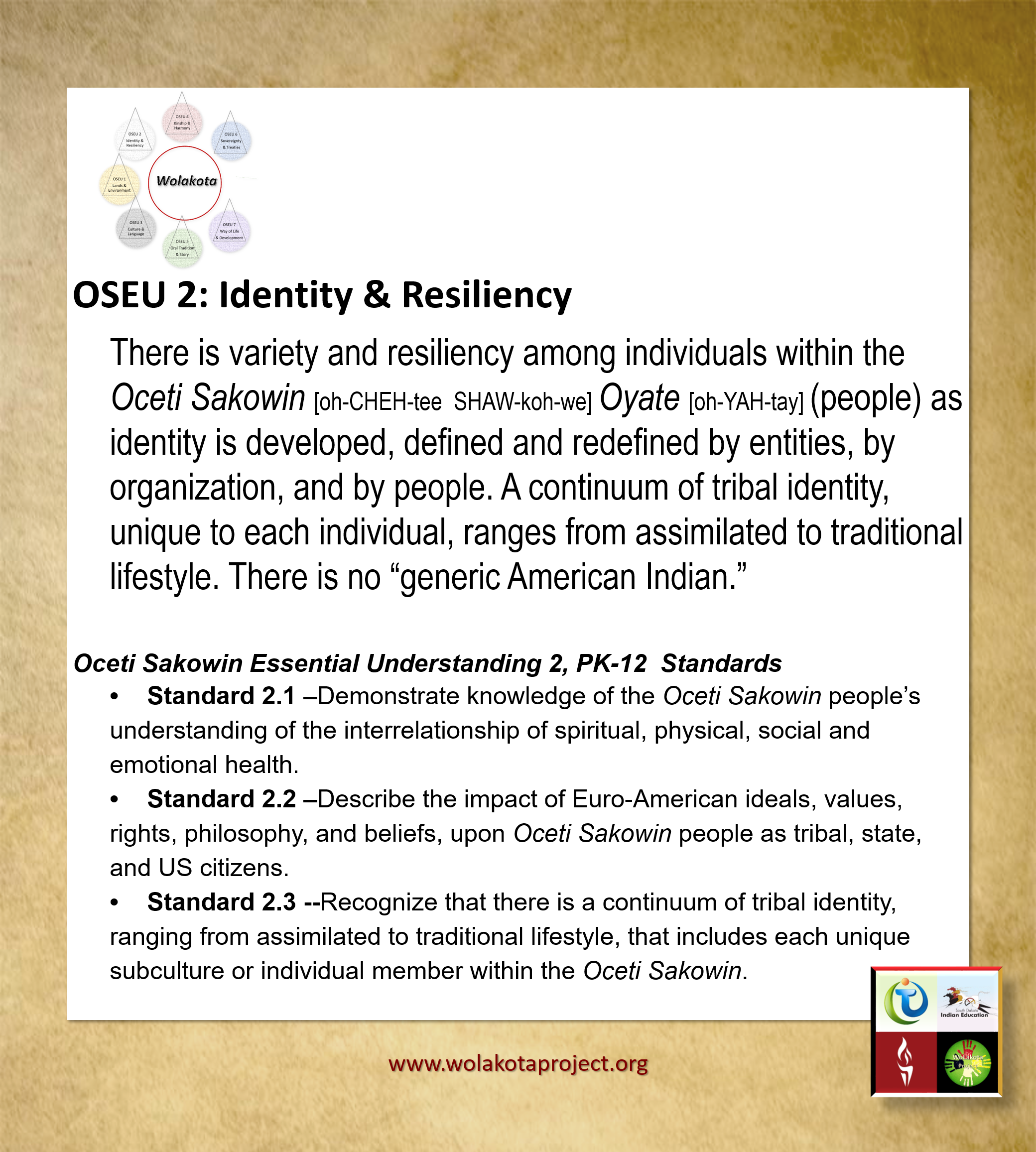
_ OSEU 2: Identity & Resiliency
There is variety and resiliency among individuals within the
Oceti Sakowin foh-CHEH-tee shaw-KOH-we] Oyate [oh-YAH-tay] (people) as
identity is developed, defined and redefined by entities, by
organization, and by people. A continuum of tribal identity,
unique to each individual, ranges from assimilated to traditional
lifestyle. There is no “generic American Indian.”
_____ Oceti Sakowin Essential Understanding 2, PK-12 Standards
+ Standard 2.1 -Demonstrate knowledge of the Oceti Sakowin people's
understanding of the interrelationship of spiritual, physical, social and
emotional health.
* Standard 2.2 —-Describe the impact of Euro-American ideals, values,
rights, philosophy, and beliefs, upon Oceti Sakowin people as tribal, state,
and US citizens.
¢ Standard 2.3 --Recognize that there is a continuum of tribal identity,
ranging from assimilated to traditional lifestyle, that includes each unique
subculture or individual member within the Oceti Sakowin.
www.wolakotaproject.org
Some indexed text was extracted from scanned material. Check the original source for exact wording and spelling.
Source materials
- Open source material
- Wo I ste Olowan wan: Song and Translation by Earl Bullhead
- We’re Not All the Same with Lowell Amiotte
- European Laws & Native People with David Bald Eagle
- David Bald Eagle, Casey Tibbs & “Indian” Names
- David Bald Eagle Welcomes His Wife Josie
- David Bald Eagle Post-War Struggles
- Open source material
- Jo
- Open source material
- sie Bald Eagle Tells About Joining the Lakota Community
- Open source material
- “Black Kettle” with Waylon Black Crow
- Sidney Byrd’s Naming with Sidney Byrd
- G.I. Bill with Sidney Byrd
- Lakota Identity and Virtues with Stephanie Charging Eagle
- Tiospaye, Relatives and Prayer with Jace DeCory
- Open source material
- Pride in Where I Come From with Victor Douville
- Choosing to Walk the Red Road with April Fallis
- It’s Up to You with April Fallis
- After Treatment with April Fallis
- You Are Your Mother with April Fallis
- Nun or Checkout Clerk? with April Fallis
- Enrollment, Reservations & the Name “Sioux” with Gladys Hawk
- Open source material
- The Story of Time with Duane Hollow Horn Bear
- The Importance of the Sun Dance with Drs. Johnson & Eastman
- Open source material
- 75 Cents per Hour with Pearl Kennedy-Colombe
- No “Stop Signs” with Pearl Kennedy-Colombe
- Open source material
- Crayons & Shelterb
- Open source material
- elts with Kevin Locke
- Forces of Disintegration & Integration with Kevin Locke
- Bows & Variety & Culture Sharing with Joseph Marshall III
- Traditional Values with Whitney Rencountre
- Enrollment and Blood Quantum with Faith Spotted Eagle
- Variety, Naming & Ceremony with Faith Spotted Eagle
- Trauma & Resilience with Faith Spotted Eagle
- Lakota Identity with Delores Taken Alive
- Indian Names with Jesse Taken Alive
- Lakota Sense of Humor and Freedom with Jesse Taken Alive
- The Solutions are at Home with Jesse Taken Alive
- Making New Lakota Words with Jesse Taken Alive
- Succeeding in Both Worlds with Jesse Taken Alive
- Open source material
- There is No Generic Indian with Lydia Whirlwind Soldier
- Open source material
- This Is Who We Are with Janelle Williams