Interview · South Dakota · Pearl Kennedy-Colombe · OSEU 2
Themes: Kinship & family, Education & learning, Values & generosity, Economy & livelihoods, Listening & observation, Children & young people
Learn About questions
What was the liquor law that was repealed in 1952?
How did the repealing of that law affect the native populations in South Dakota?
What is the minimum wage from different eras of history?
When did the minimum wage begin and why?
Learn From questions
What is your experience with alcohol? Has it affected you or your family? In what way?
What is your experience of working for minimum wage?
What is the lowest minimum wage you remember working for?
Pearl lived on $.75 per hour and saved enough to buy a house for herself and her siblings…what is your experience of living on a low wage?
Have you ever had someone outside of your family who cared for you or made a notable impact on your life the way that Mrs. Liefferman did for Pearl and her siblings?
Have you ever had to care for a family member that wasn’t necessarily something you should have been expected to do? What was the experience like?
Transcripts
75 Cents Per Hour - Pearl Kennedy-Colombe - OSEU #2
Watch this interview on YouTubeIn 1952, they let the liquor law loose. They turned the Indians loose to go ahead and drink. And my life started going downhill. My parents started drinking. And so in 1959, they died in a car accident…both of them…together. My mother died on her 50th birthday, and my dad died the next day. But he prepared me. We used to go fishing…and he’d talk to me…and he told me “These older kids…they don’t think…they don’t worry about you guys. If anything happens to me, you look out for the younger ones.”
So when they died in 1959, I…since I was fourteen years old…I was working in Chamberlain at the Derby Cafe every summer…and there was a lady in Chamberlain, Mrs. Leiferman…would give us rooms to rent for five dollars a week. Minimum wage was like 75 cents.
So I paid my rent every week and I stayed all summer long. Me and my sisters and my cousins…she took in all the Indians, you know. She was really good to us. She treated us like we were her grandchildren. She would always talk to us. And I went there until I graduated from high school. And then a year after high school, I stayed at her place.
After my folks died and I graduated from high school, my aunt had my brothers and my younger sister.
I worked until I was twenty-five. I got me a little house and moved in my brothers and sisters. So we were a family again. I took care of them, but it wasn’t a job, ya know. It wasn’t a job. They were my family. That’s how we got along. I finished raising them…sent them to school and everything. Howard graduated from high school…and I just continued all my life looking out for them…welcome them in the home.
When I got married, my husband…one of my girls got jealous of my brothers…”How come they come here?” And they said, “She’s the only mother they know.” So, they didn’t ask any questions. They were always welcome…and my sister Tina.
Resource text
OSEU 2: INTERVIEW WITH PEARL KENNEDY-COLOMBE
WoLakota Project
From the current WoLakota source page:
75 Cents per Hour
Pearl Kennedy-Colombe
Transcript
(deep listening, information)
(deep listening, transformation)
Some indexed text was extracted from scanned material. Check the original source for exact wording and spelling.
Source materials
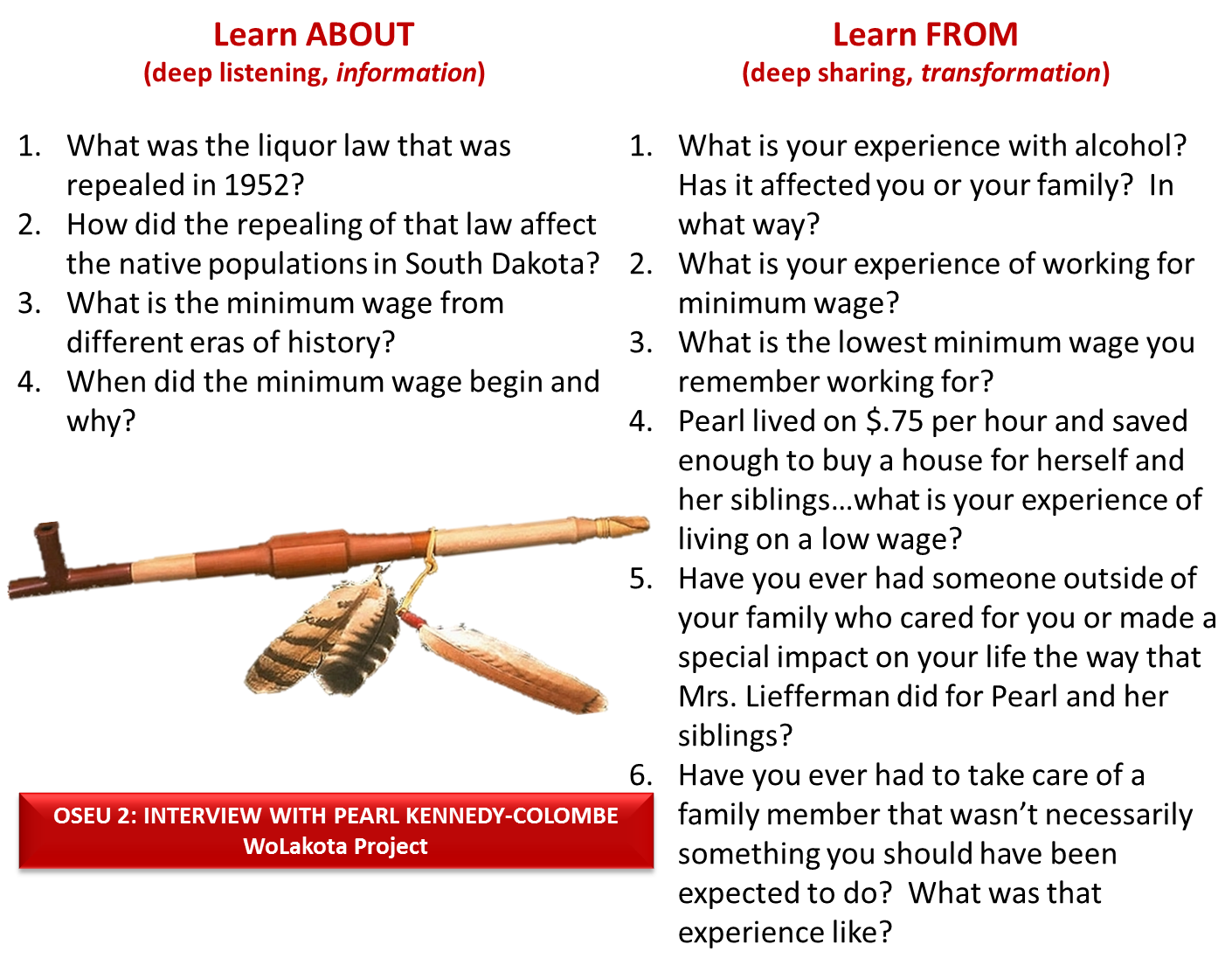
Supplied transcript document. Text preserved as supplied; spellings and transcription uncertainties have not been corrected.
Additional source transcripts
75 Cents per Hour
75 Cents Per Hour - Pearl Kennedy-Colombe - OSEU
#2
In 1952, they let the liquor law loose. They turned the Indians loose to go ahead and
drink. And my life started going downhill. My parents started drinking. And so in 1959,
they died in a car accident…both of them…together. My mother died on her 50th
birthday, and my dad died the next day. But he prepared me. We used to go
fishing…and he’d talk to me…and he told me “These older kids…they don’t think…they
don’t worry about you guys. If anything happens to me, you look out for the younger
ones.”
So when they died in 1959, I…since I was fourteen years old…I was working in
Chamberlain at the Derby Cafe every summer…and there was a lady in Chamberlain,
Mrs. Leiferman…would give us rooms to rent for five dollars a week. Minimum wage
was like 75 cents.
So I paid my rent every week and I stayed all summer long. Me and my sisters and my
cousins…she took in all the Indians, you know. She was really good to us. She treated
us like we were her grandchildren. She would always talk to us. And I went there until I
graduated from high school. And then a year after high school, I stayed at her place.
After my folks died and I graduated from high school, my aunt had my brothers and my
younger sister.
I worked until I was twenty-five. I got me a little house and moved in my brothers and
sisters. So we were a family again. I took care of them, but it wasn’t a job, ya know. It
wasn’t a job. They were my family. That’s how we got along. I finished raising
them…sent them to school and everything. Howard graduated from high school…and I
just continued all my life looking out for them…welcome them in the home.
When I got married, my husband…one of my girls got jealous of my brothers…”How
come they come here?” And they said, “She’s the only mother they know.” So, they
didn’t ask any questions. They were always welcome…and my sister Tina.