Interview · South Dakota · Waylon Black Crow · OSEU 4 · OSEU 6
Themes: Language & revitalization, Kinship & family, Storytelling & oral tradition, Education & learning, Boarding schools & assimilation, Spirituality & ceremony, Values & generosity, Culture & continuity, Community & responsibility, Listening & observation, Children & young people
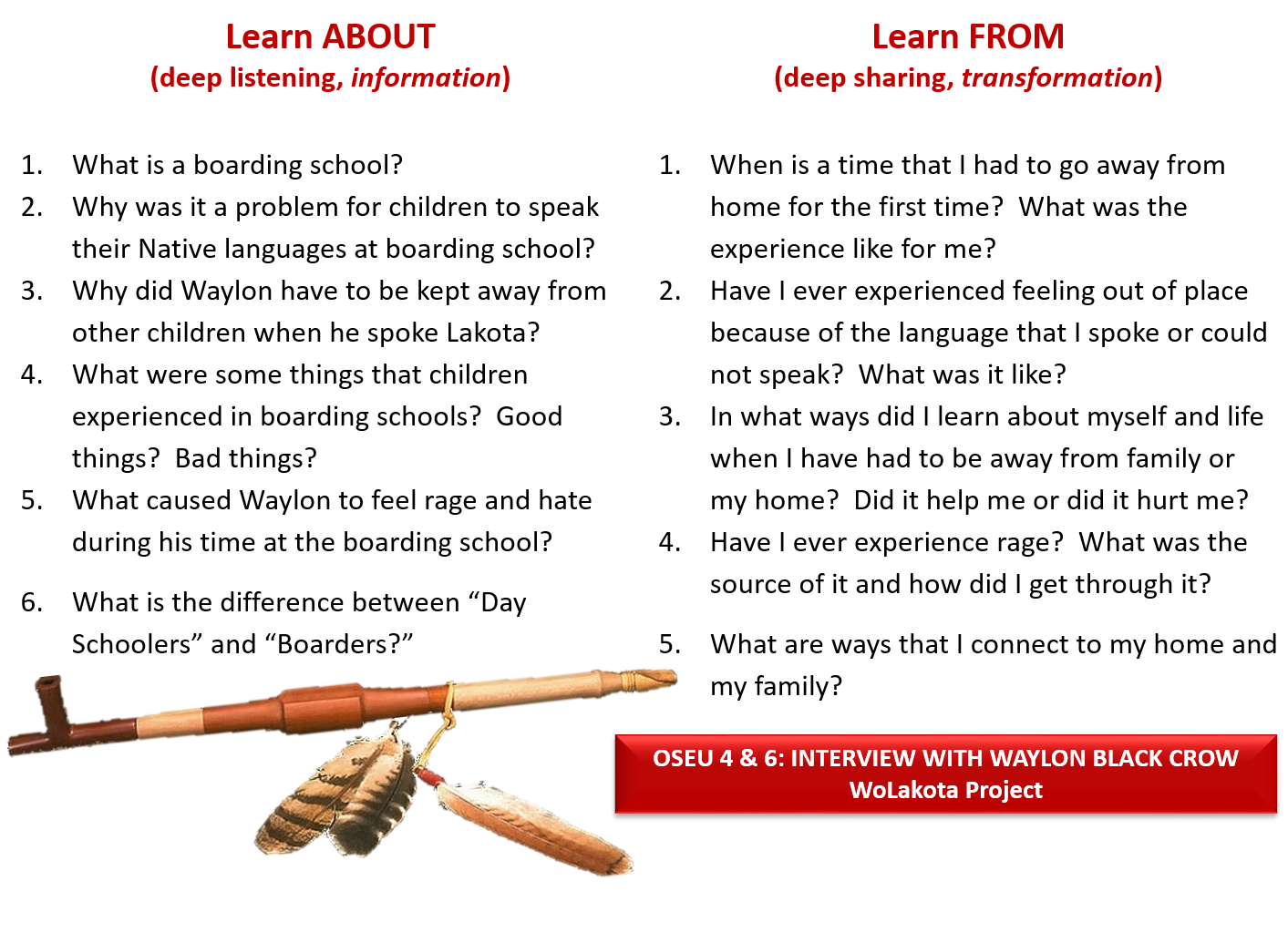
Learn About questions
What is a boarding school?
Why was it a problem for children to speak their Native languages at boarding school?
Why did Waylon have to be kept away from other children when he spoke Lakota?
What were some things that children experienced in boarding schools? Good things? Bad things?
What caused Waylon to feel rage and hate during his time at the boarding school?
What is the difference between “Day Schoolers” and “Boarders”?
Learn From questions
When is a time that I had to go away from home for the first time? What was the experience like for me?
Have I ever experienced feeling out of place because of the language that I spoke or could not speak? What was it like?
In what ways did I learn about myself and life when I have had to be away from my family or my home? Did it help me or did it hurt me?
Have I ever experienced rage? What was the source of it and how did I get through it?
What are the ways I connect to my home and my family?
Transcripts
Day Schoolers & Boarders - Waylon Black Crow - OSEU #6
Watch this interview on YouTubeBack in the day when I was a kindergarten, first and second grader in kindergarten, back in the day in the boarding school, we was really kind of in a hardship back in the day. Because all I knew was just my language. It was hard for me to view the other kids because we weren't allowed to talk our language but that's all I knew. So I was kept away from the other kids because that's all I spoke. And when they spoke back to me, they were taken away from me. They don't speak. So I was always kept with a grandma that spoke. Our grandma Agnes Lamont.
So she's the one that took me class to class and took me around. So made sure nobody else talked to me. But those were the bad parts. But the good parts were weekends we went on trips. Come up here to the Faces. Come up here. That's when they were first building this. We used to come up here for picnics, go swimming. And a good part about that was I met Robert F. Kennedy too back in the day. Shook his hands. So there's some good things about that. But it taught me a lot too. It taught me how to be independent.
Taught me to stand up for myself and always keep my area clean. So those are things that really taught me. Taught me some manners. But also taught me rage and taught me hate too. But that's another story. But other than that, as the time went on, things got better. I only seen my parents on Christmas. Maybe about a week. Easter about a week. And then again went back to the boarding school. On Sundays they'll dress us up. Suits and ties. And they'll send us to the church. So we were like 30, 40 of us walking to church downtown.
We'll meet at the four-way. Then we'll all split. Catholic, Episcopals, and Episcopalians were all split. When mass is over, we all meet at the four-way again. And we'll all go back to the dorm again. We had to stay together because they called the down people. They called them day scholars. The day scholars didn't like the borders. We was the borders. They didn't like the district people. They always threw rocks at us or something like that. So we always had to stick together and walk back to the boarding school again. But those were my younger days.
It was a hardship for me because I wasn't around my family too much. But it was kind of like a way where they winged me. Winged me from my family. It just brought a lot more out of me. A lot more anger and a lot more rage out of me. And as time went on, it just built in. And then when I did finally go home, I started going to ceremonies and sweat lodges again. And again, I found peace again. And nobody made fun of me or laughed at me again. And after that, I didn't want to go back to boarding school at all. But I grew out of that.
As time went, I grew out of that. I went back to my family. I stayed with them. And then as time went, I went back into high school. And then again, high school went back to boarding school. Everything was different then. Everything was different. And then I started going to boarding school again. And again, I was doing my culture. And this time, everything was different. All the people that made fun of me wanted to be Indian. So it was really different. Even to this day, they want to be Indian. So that was a really big change.
That's a really, really big change. Really big change. Because back in the day, when I was in that community doing what we did, I thought everybody else was doing it. I thought everybody, the whole reservation was doing it. But it wasn't. It's like my grandpa Crazy Horse said. He said, our own people can stab you in the back. So when I wrap up, like my brother, when I wrap up, my blanket has a left handprint on my back. So when I wrap up, nobody will stab me in the back. Grandpa Crazy Horse will protect me when I'm injured.
So that's the hardships in this way of life at boarding school. There's a good side to it and a bad side to it.
Some indexed text was extracted from scanned material. Check the original source for exact wording and spelling.
Source materials
Supplied transcript document. Text preserved as supplied; spellings and transcription uncertainties have not been corrected.
Some linked transcripts could not be indexed. See the source materials for those additional resources.