Interview · South Dakota · Faith Spotted Eagle · OSEU 3
Themes: Land & stewardship, Language & revitalization, Kinship & family, Education & learning, Treaties & sovereignty, Healing & resilience, Values & generosity, Listening & observation
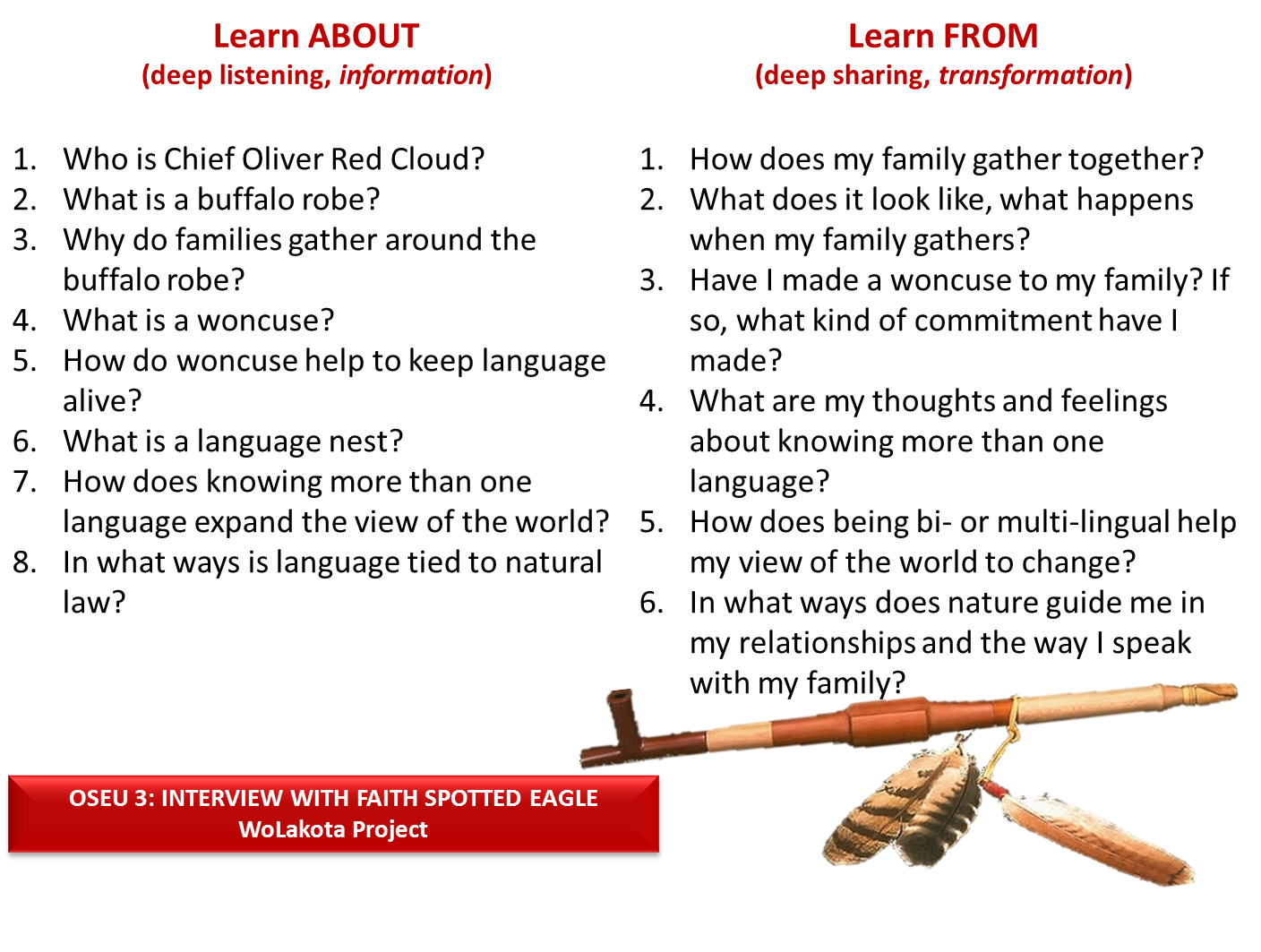
Learn About questions
Who is Chief Oliver Red Cloud?
What is a buffalo robe?
Why do families gather around the buffalo robe?
What is a woncuse?
How do woncuse help to keep language alive?
What is a language nest?
How does knowing more than one language expand the view of the world?
In what ways is language tied to natural law?
Learn From questions
How does my family gather together?
What does it look like, what happens when my family gathers?
Have I made a woncuse to my family? If so what kind of commitment have I made?
What are my thoughts and feelings about knowing more than one language?
How does being bi- or multi-lingual help my view of the world to change?
In what ways does nature guide me in my relationships and the way I speak with my family?
Transcripts
A Language Nest - Faith Spotted Eagle - OSEU 3
Watch this interview on YouTubeAbout six years ago, I went to a treaty meeting in Pine Ridge and heard Chief Oliver Red Cloud talking about the language. He said, “All of these people that are whining or complaining about the language not being saved. Here’s what I say to you.” He said, “When you leave here and go back to your living rooms at home, draw all of your family together. Just imagine it’s just like the buffalo robe that used to be in the tipi. Gather them up. Even though we criticize each other in the outside world…outside the tipi…about how we should teach the language…that’s your buffalo robe, your living room, your tipi…so you teach how you want in a good way.” So I thought, “Of course.
That’s what I should do. I don’t need this grand classroom.” So I went home and gathered up the family and some of the other relatives, the hunka relatives…the adopted relatives…and there were probably about thirty of us and we came together. And so, that night, we went around the circle and I asked everyone to make a woncuse, or a commitment to the language.
And my little grandson who was probably about two then…he was sitting on his father’s lap….and we went around the room…and of course he heard it thirty times because everybody said woncuse…LAKOTA word…so he heard the word woncuse…and by the time it got back to his father sitting there, he looked at him and he said, “Woncuse!” So he knew the word by the time it was thirty times. So I made the commitment that I would work with them. And I’ve learned from that. We called it a LAKOTA WORD, or a language nest. And the research, internationally, says that these language nests are really successful because they are intimate, non-judgmental, and very encouraging in a circle format. And so, I experimented with that. There were some things that I would have done differently…some things that I could have done better.
But, overall, it helped me overcome my historical trauma about the language. And I think it hopefully motivated the young relatives to go further in the language. And with my grandson, I only speak to him in the language. And so, he’s five years old, so I know he’s going to walk on with the language. And then the four languages…so why stop there? Yeah, that’s the lesson that he taught me. To give an example, I remember I was driving somewhere. I think I was going up to a meeting somewhere and he was sitting in my truck. He likes to drive around with me. And we’re driving along…and you talked about natural law…so he’s sitting there looking out the window…and he sees all the LAKOTA WORD, the geese, and they’re getting ready to go south. So he’s looking there, and I saw him watching that. He says, “LAKOTA PHRASE, what are those?” And I said, “LAKOTA PHRASE.” And he said, “Hmmm.” And then he said, “What are they doing? - LAKOTA PHRASE.” And so I explained the whole migration stuff to them…that our relatives are going to go south…but the weather is changing. So he’s sitting there like a little old grandpa…and he was only four years old then…and he looked out the window and he said, “You know, I never did see that in my whole life.” And he’s only four years old. And then he said some of it in Indian too. I think that kind of points out his world view is real large…and it’s tied to natural law.
Faith Spotted Eagle: [00:04:00] And his name is LAKOTA NAME, or pretty elk boy. So that’s his Indian name.
other thing that I’ve noticed…the people in Canada know this…when you’re bilingual or trilingual, your mindframe is different. We all know that. It expands your brain. He’s got such a view of the world that is so large. And he’s only five years old. So, I think it should be that we learn three or
Resource text
Additional Related Resources
Lakota Tokey Wounspe Language Curriculum
wnr
ws
NO
OSEU 3: INTERVIEW WITH FAITH SPOTTED EAGLE
WoLakota Project
From the current WoLakota source page:
A Language Nest
Faith Spotted Eagle
Transcript
(deep listening, information)
(deep listening, information)
Some indexed text was extracted from scanned material. Check the original source for exact wording and spelling.
Source materials
Supplied transcript document. Text preserved as supplied; spellings and transcription uncertainties have not been corrected.