Resource · South Dakota · OSEU 4
Themes: Land & stewardship, Kinship & family, Identity & belonging, Storytelling & oral tradition, Education & learning, Boarding schools & assimilation, Spirituality & ceremony, Values & generosity, Culture & continuity, Arts & expression, Community & responsibility, Economy & livelihoods, Listening & observation, Children & young people, Intergenerational learning
Resource text
Learning Question Pages for classroom use:
Click on each title below to find interviews accompanied by “Learn About” and “Learn From” questions for use in classrooms, in small groups or for deeper personal exploration of each video.
Not all videos are accompanied by questions.
Sinakaki Hewakiye: Song & Translation by Earl Bullhead
Family is Always There with Lowell Amiotte
Using Kinship Terms with Vernon Ashley
Son of His Gray Horses with Vernon Ashley
“Day Schoolers” and “Boarders” with Waylon Black Crow
NEW!
At the Trading Post with Grandfather with Sidney Byrd
Caring for the Cemetery with Sidney Byrd
Rose Pumpkinseed (boarding school story) with Sidney Byrd
Hunka Relatives with Stephanie Charging Eagle
Traditional Lakota Gender Roles with Stephanie Charging Eagle
Sacredness & Children with Jace DeCory
Kinship Ways with Victor Douville
NEW!
Caring for Parents & Grandparents with Irene Eagle Thunder-Skunk
Intro & Family with April Fallis
Mother is With Me with April Fallis
Becoming Grandmother with April Fallis
“Boyfriends” with April Fallis
Feeling New Again with April Fallis
Kinship and Etiquette with Gladys Hawk
The Story of Commitment with Duane Hollow Horn Bear
Traditional Kinship Roles with Drs. Johnson & Eastman
The Story of Bear Butte and Cekpapi (twins) with Velma Kills Back
Mitakuye Oyasin with Joseph Marshall III
Cousins and Relatives with Donald Montileaux
Showing Rather Than Telling with Whitney Rencountre
Braveheart Society with Faith Spotted Eagle
Great, Great Grandparents with Delores Taken Alive
Appreciating Life and Family with Delores Taken Alive
Traditional Teaching Style with Delores Taken Alive
Family Introduction with Jesse Taken Alive
Being Thankful for Elders with Jesse Taken Alive
Kinship Systems with Lydia Whirlwind Soldier
NEW!
I Owe A Lot to My Grandmother with Janelle Williams
Oceti Sakowin
Essential Understanding 4 Extended Description
The Seven Council Fires maintained an organized government with each Council Fire autonomous, yet with an allegiance that unites the seven tribes in a cohesive relationship. These open, egalitarian, classless and cooperative tribes formed for the collective good, for nation building, preserving identity, ethnic solidarity and cohesiveness. Tribal life includes a philosophy of life, history, cultural and social rules, rituals, ceremonies, traditions, social organization and democratic government.
The Seven Council Fire’s social structure has significant social and kinship distinctions that are divided into four cooperative units. A
tiwahe
, which is the nuclear family, includes a mother, father, children and grandparents. The
tiospaye
which is the extended family, consists of three or four generations includes uncles, aunts, and cousins, children of brothers, sisters and cousins. The
tiospaye
is very similar to a community with many relatives and other members who are invited to join them. The
oyate
is the entire tribal group including those in a
tiwahe
,
tiospaye, ospaye
and
oyate. We
wotakuye
is the extended families, the blood relatives. The
hunka kagagapi
is the adoption or making of relatives.
Tiospaye
is the identifying of spiritual clanship.
Oyanke
means Dakota community and
oyate
is the tribal identity.
To the Seven Council Fires, kinship is one of the most important concepts. This strong close-knit kinship system is filled with respect and cooperation that binds tribal members together as a collective unit, and is theoretically all-inclusive. This is central as it is the foundation for a sound development of a stable society. This social structure has significant social distinctions among individuals that establish a strong cultural and ethnic identity.
It is believed that it takes a village to raise a child. Adults in the
tiospaye
have the social responsibility for the upbringing of all village children. Children are still taught the importance of sibling relationships, responsibilities and role behaviors within the family and within the tribe. Positive behaviors are modeled to create and encourage a favorable character and to demonstrate core values that foster an emotional climate for healthy child development. The child is expected to imitate the positive behaviors of their relatives. One must always be a good relative.
The close kinship system cultivates specialized interaction between children and adults. Each individual has a valued role in the family that is instilled from birth. The rules imposed by kinship were many. The rules of etiquette include using kinship terms when speaking to others. It is considered rude to plunge into conversation without using the polite term of kinship. The kinship system continuously gives children lessons and examples of good behavior, independence, problem solving, family and tribal responsibility, courage, generosity, fortitude and wisdom.
This solid foundation creates high expectations, a strong family and tribal bond, unity and identity. It is a philosophy of “we,” cohesion of interconnectedness and not a belief that an individual’s needs are more important than the needs of the whole. This social structure ensures that every person contributes to the moral and physical well-being of the tribe.
The
Oceti Sakowin
kinship system not only creates a nation with a strong moral structure, but creates a philosophy linking kinship components to spiritual beliefs that embraces the world around them. The concept of ‘
Mitakuye Oyasin’
teaches respect for the earth and all life forms and to become stewards of the land.
The people of the Seven Council
F
ires fitted every detail of existence together in the village for
the people, for all living things, and resp
e
ct for the environment through kinship. (L.Whirlwind Soldier 2012)
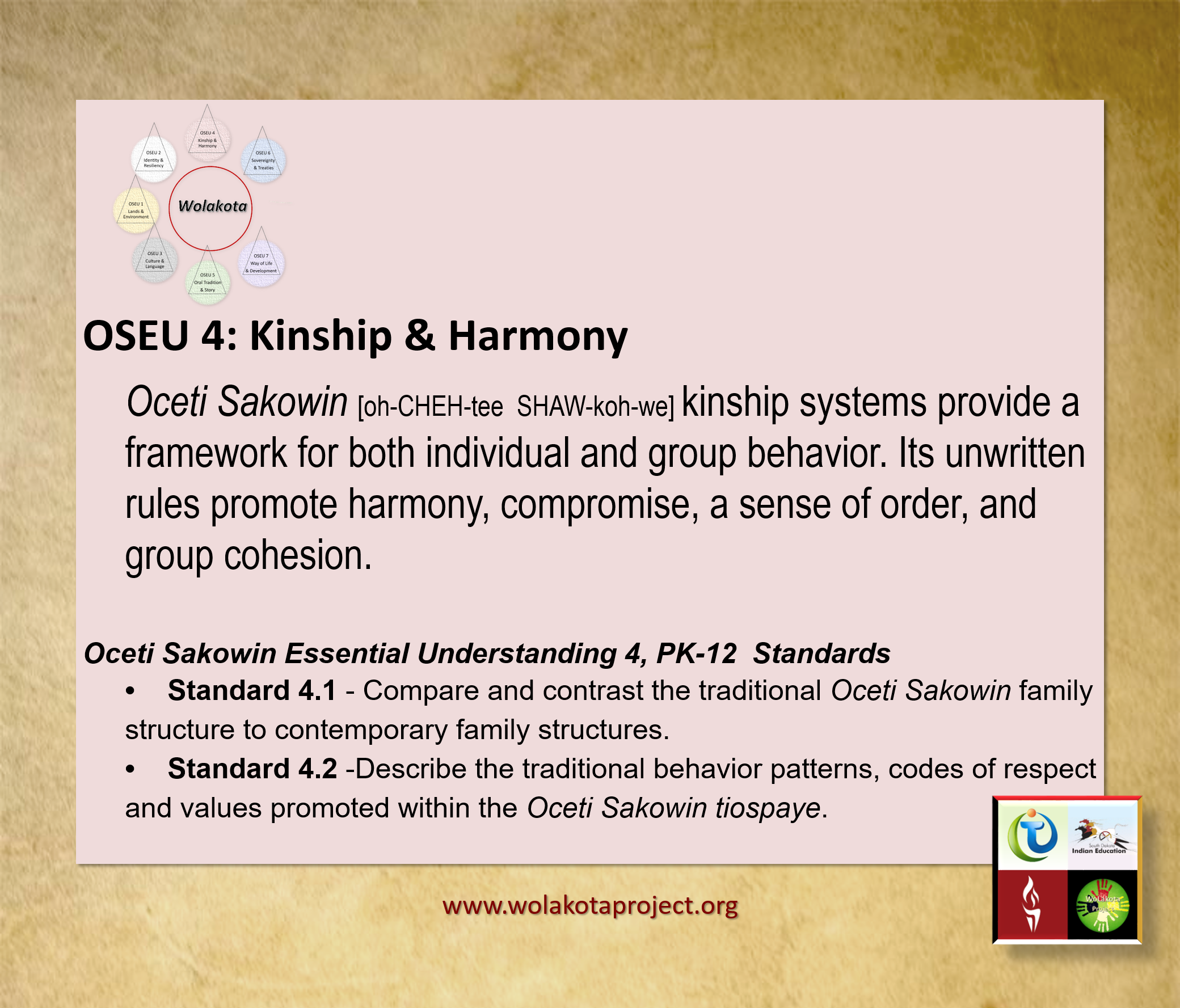
Wolakota
OSEU 4: Kinship & Harmony
Oceti Sakowin oh-cHEH-tee shaw-KOH-we] kinship systems provide a
framework for both individual and group behavior. Its unwritten
rules promote harmony, compromise, a sense of order, and
group cohesion.
Oceti Sakowin Essential Understanding 4, PK-12 Standards
¢ Standard 4.1 - Compare and contrast the traditional Oceti Sakowin family
structure to contemporary family structures.
¢ Standard 4.2 -Describe the traditional behavior patterns, codes of respect
and values promoted within the Oceti Sakowin tiospaye.
www.wolakotaproject.org
Some indexed text was extracted from scanned material. Check the original source for exact wording and spelling.
Source materials
- Open source material
- Sinakaki Hewakiye: Song & Translation by Earl Bullhead
- Family is Always There with Lowell Amiotte
- Using Kinship Terms with Vernon Ashley
- Son of His Gray Horses with Vernon Ashley
- Open source material
- Open source material
- “Day Schoolers” and “Boarders” with Waylon Black Crow
- At the Trading Post with Grandfather with Sidney Byrd
- Caring for the Cemetery with Sidney Byrd
- Rose Pumpkinseed (boarding school story) with Sidney Byrd
- Hunka Relatives with Stephanie Charging Eagle
- Open source material
- Traditional Lakota Gender Roles with Stephanie Charging Eagle
- Open source material
- Sacredness & Children with Jace DeCory
- Open source material
- Kinship Ways with Victor Douville
- Open source material
- Caring for Parents & Grandparents with Irene Eagle Thunder-Skunk
- Intro & Family with April Fallis
- Mother is With Me with April Fallis
- Becoming Grandmother with April Fallis
- “Boyfriends” with April Fallis
- Feeling New Again with April Fallis
- Kinship and Etiquette with Gladys Hawk
- Open source material
- The Story of Commitment with Duane Hollow Horn Bear
- Traditional Kinship Roles with Drs. Johnson & Eastman
- Open source material
- The Story of Bear Butte and Cekpapi (twins) with Velma Kills Back
- Mitakuye Oyasin with Joseph Marshall III
- Open source material
- Cousins and Relatives with Donald Montileaux
- Showing Rather Than Telling with Whitney Rencountre
- Braveheart Society with Faith Spotted Eagle
- Great, Great Grandparents with Delores Taken Alive
- Appreciating Life and Family with Delores Taken Alive
- Traditional Teaching Style with Delores Taken Alive
- Family Introduction with Jesse Taken Alive
- Being Thankful for Elders with Jesse Taken Alive
- Open source material
- Kinship Systems with Lydia Whirlwind Soldier
- I Owe A Lot to My Grandmother with Janelle Williams