Interview · South Dakota · Victor Douville · OSEU 5
Themes: Land & stewardship, Kinship & family, Identity & belonging, Storytelling & oral tradition, Education & learning, Spirituality & ceremony, Values & generosity, Culture & continuity, Arts & expression, Listening & observation
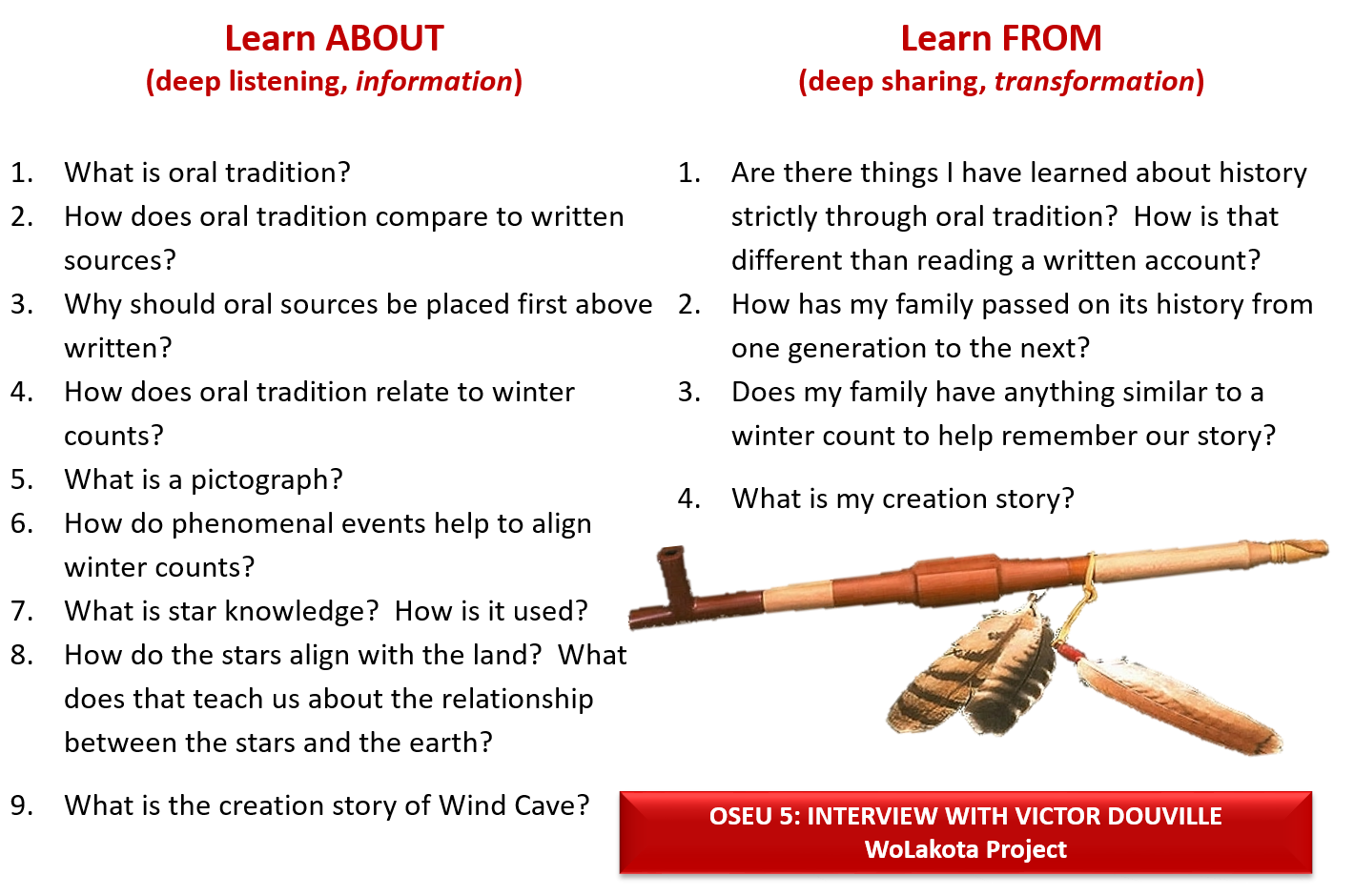
Learn About questions
What is oral tradition?
How does oral tradition compare to written is that sources?
Why should oral sources be placed first above written?
How does oral tradition relate to winter counts?
What is a pictograph?
How do phenomenal events help to align winter counts?
What is star knowledge? How is it used?
How do the stars align with the land? What does that teach us about the relationship between the stars and the earth?
What is the creation story of Wind Cave? Pate Hanlin taint hitee
Learn From questions
Are there things | have learned about history strictly through oral tradition? How is that different than reading a written account?
How has my family passed on its history from one generation to the next?
Does my family have anything similar to a winter count to help remember our story?
What is my creation story?
Transcripts
Oral Tradition- Victor Douville - OSEU #5
Watch this interview on YouTubeOral tradition is one of the things I grew up with. My intention was to learn as much oral tradition as I could. And I found that also once I learned about that, then I'll go to the next step, which is to look at the other side, which is the written side, which is reading books to be able to balance those. The first mistake I made was to rely on written sources. When I was going to school, I read when I came to teach at the university in 1970. And by 1980, I began to realize that I'm going about it the wrong way.
I should be able to set the oral source as the foremost. I've been doing the other one, written sources. I couldn't find any written sources back then, so I switched the other way and found that oral sources also lead to interpreting words, semantics and etymology, which is looking at the root words. And there you can find the true meaning of it. So that is what we're looking at, integrating that oral tradition. And oral tradition also leads to winter counts. Pictograph writing is a way that we educate, and there's a thousand words in there.
You look at that, and so pictograph writings were the source of telling events, but also is for telling one's age. So winter count originally spiraled out. So you take the last one and you count down how old you are, and then you recognize the event that 100 horses were stolen from crows. That was the day I was born. And also you better be careful with the winter counts as part of oral tradition because sometimes the news passes slow.
But one thing that we figured out is if you match them with phenomenal events, like the Halley's Comet, you can fix a date there when the stars fell. Then you've got a date you can also date all at once, before and after. And winter counts are powerful because they can also tell a weather change within our tribes. If you look at the oldest calendars, Brownhat did one that goes back to the 1770s in America or 1600s.
From there you can track what happens in the events, and you can put together like the certain people that his tribal members in bands against Assiniboines. And if each of the winter counts say the same, they know there's a war. The war that was fought around 1680 to 1700. So if you isolate and put them, they know there's a great war at that time with the Assiniboines and then the Cree fighting in northern divisions. In the southern division you find an intense war with the Omaha's, which would bring in the Roseland and the Oglala's.
So those tell us of events that happened. And you could take those and match them with the dates, that expedition of Lewis and Clark, and you know when they arrived and we can set those dates. There's also some real sophisticated things in oral tradition, like the star knowledge, looking at what the stars tell. Like the emergence of the Chinshasha Ipujie, which is a dried willow constellation, were conjoined with the sun. They said it happened 16 B.C. So we put on computer track it on 16 B.C. right on.
So we realized that the ceremony stemmed from there. So oral tradition tells that. We're trying to figure out. The elders said the sun dance began a long time ago when the sun entered at Matrotipla, which is the Devil's Tower constellation. When they tracked that on a computer using the observatories, they found that it was 3,600 years ago in the 1980s. So it gave us a way of now pursuing the ceremonies that began. So next month the sun will enter Harney Peak, where the seven little girls constellation, and we know that those ceremonies will begin.
And how do we know that? It's an equinox when the Chinshasha Ipujie, or dried willow constellation, starts coming up from the horizon and the sun will follow it. It's a heliocal rise, we call it, and perhaps the sun will blot off the other.
In a matter of seconds when it comes up, you have to know the position and when it sets, we know that it follows. So we know in the middle way, that's where it crosses. So things like that, that are medicinally taught. So those oral traditions were used to rebuild ceremonies that we do today. So oral tradition is powerful, and it's no different in the non-Indian world of the floods. It's of Schliemann's discovery of Troy. He read Troy in Homer's stories.
Eventually, Homer gave detailed information about the terrain and geography, and that's where he went. And not only covered one, but ten cities. That's a powerful oral tradition. And when they date them, it came to date when the walls matched four chariots, the width of them. And that's Troy. Whether there's a fight over a woman, we don't know yet. They talk about that too. But again, those are some things that we look at. One thing I also noticed in oral tradition is that our people are way ahead of non-Indian curve in asking where they originated.
So they said, let me think. Anthropologists said 10 years ago, 10,000 years ago, no one knows. But when you ask a Lakota, a traditional grounded one, where do you come from? Wind Cave, the Black Hills. They won't tell the date of that, because the date is the time when humans were being formed. So it's powerful that everybody knows where it comes from. So oral tradition, sometimes we can build on that. And be able to, out of that, to bring out the things that match the scientific studies.
So I'm locked out now to look at oral tradition and written sources, try to match them as closely as you can. And you strengthen oral tradition that way. And then you also will qualify on the non-Indian side, because you have a reference. So today we're now engaged in the oral sources match with the written. And now we're beginning the course of citations, which the non-Indian world understands only when you write books and history. They understand, and without that, they'll throw you out of the building.
Resource text
Learn ABOUT Learn FROM
(deep listening, information) (deep sharing, transformation)
What is oral tradition? 1. Are there things | have learned about history
How does oral tradition compare to written strictly through oral tradition? How is that
sources? different than reading a written account?
Why should oral sources be placed first above 2. How has my family passed on its history from
written? one generation to the next?
How does oral tradition relate to winter 3. Does my family have anything similar to a
counts? winter count to help remember our story?
What is a pictograph?
4. What is my creation story?
How do phenomenal events help to align
winter counts?
What is star knowledge? How is it used?
How do the stars align with the land? What
does that teach us about the relationship
between the stars and the earth?
What is the creation story of Wind Cave? OSEU 5: INTERVIEW WITH VICTOR
WoLakota Project
From the current WoLakota source page:
Oral Tradition
Victor Douville
Transcript
(deep listening, information)
(deep listening, transformation)
Some indexed text was extracted from scanned material. Check the original source for exact wording and spelling.
Source materials
Supplied transcript document. Text preserved as supplied; spellings and transcription uncertainties have not been corrected.
Additional source transcripts
Oral Tradition
Oral Tradition - Victor Douville - OSEU #5
Oral tradition is one of the things I grew up with. My intention was to learn as much oral
tradition as I could. And I found that also once I learned about that, then I'll go to the
next step, which is to look at the other side, which is the written side, which is reading
books to be able to balance those. The first mistake I made was to rely on written
sources. When I was going to school, I read when I came to teach at the university in
1970. And by 1980, I began to realize that I'm going about it the wrong way.
I should be able to set the oral source as the foremost. I've been doing the other one,
written sources. I couldn't find any written sources back then, so I switched the other
way and found that oral sources also lead to interpreting words, semantics and
etymology, which is looking at the root words. And there you can find the true meaning
of it. So that is what we're looking at, integrating that oral tradition. And oral tradition
also leads to winter counts. Pictograph writing is a way that we educate, and there's a
thousand words in there.
You look at that, and so pictograph writings were the source of telling events, but also is
for telling one's age. So winter count originally spiraled out. So you take the last one and
you count down how old you are, and then you recognize the event that 100 horses
were stolen from crows. That was the day I was born. And also you better be careful
with the winter counts as part of oral tradition because sometimes the news passes
slow.
But one thing that we figured out is if you match them with phenomenal events, like the
Halley's Comet, you can fix a date there when the stars fell. Then you've got a date you
can also date all at once, before and after. And winter counts are powerful because they
can also tell a weather change within our tribes. If you look at the oldest calendars,
Brownhat did one that goes back to the 1770s in America or 1600s.
From there you can track what happens in the events, and you can put together like the
certain people that his tribal members in bands against Assiniboines. And if each of the
winter counts say the same, they know there's a war. The war that was fought around
1680 to 1700. So if you isolate and put them, they know there's a great war at that time
with the Assiniboines and then the Cree fighting in northern divisions. In the southern
division you find an intense war with the Omaha's, which would bring in the Roseland
and the Oglala's.
So those tell us of events that happened. And you could take those and match them
with the dates, that expedition of Lewis and Clark, and you know when they arrived and
we can set those dates. There's also some real sophisticated things in oral tradition, like
the star knowledge, looking at what the stars tell. Like the emergence of the Chinshasha
Ipujie, which is a dried willow constellation, were conjoined with the sun. They said it
happened 16 B.C. So we put on computer track it on 16 B.C. right on.
So we realized that the ceremony stemmed from there. So oral tradition tells that. We're
trying to figure out. The elders said the sun dance began a long time ago when the sun
entered at Matrotipla, which is the Devil's Tower constellation. When they tracked that
on a computer using the observatories, they found that it was 3,600 years ago in the
1980s. So it gave us a way of now pursuing the ceremonies that began. So next month
the sun will enter Harney Peak, where the seven little girls constellation, and we know
that those ceremonies will begin.
And how do we know that? It's an equinox when the Chinshasha Ipujie, or dried willow
constellation, starts coming up from the horizon and the sun will follow it. It's a heliocal
rise, we call it, and perhaps the sun will blot off the other.
In a matter of seconds when it comes up, you have to know the position and when it
sets, we know that it follows. So we know in the middle way, that's where it crosses. So
things like that, that are medicineally taught. So those oral traditions were used to
rebuild ceremonies that we do today. So oral tradition is powerful, and it's no different in
the non-Indian world of the floods. It's of Schliemann's discovery of Troy. He read Troy
in Homer's stories.
Eventually, Homer gave detailed information about the terrain and geography, and that's
where he went. And not only covered one, but ten cities. That's a powerful oral tradition.
And when they date them, it came to date when the walls matched four chariots, the
width of them. And that's Troy. Whether there's a fight over a woman, we don't know yet.
They talk about that too. But again, those are some things that we look at. One thing I
also noticed in oral tradition is that our people are way ahead of non-Indian curve in
asking where they originated.
So they said, let me think. Anthropologists said 10 years ago, 10,000 years ago, no one
knows. But when you ask a Lakota, a traditional grounded one, where do you come
from? Wind Cave, the Black Hills. They won't tell the date of that, because the date is
the time when humans were being formed. So it's powerful that everybody knows where
it comes from. So oral tradition, sometimes we can build on that. And be able to, out of
that, to bring out the things that match the scientific studies.
So I'm locked out now to look at oral tradition and written sources, try to match them as
closely as you can. And you strengthen oral tradition that way. And then you also will
qualify on the non-Indian side, because you have a reference. So today we're now
engaged in the oral sources match with the written. And now we're beginning the course
of citations, which the non-Indian world understands only when you write books and
history. They understand, and without that, they'll throw you out of the building.
But it's really interesting, because when I started working for the University of San
Diego, we were not a college unto ourselves. We were a satellite of Black Hills State.
They took us in and gave us a presentation. But they said, you have to use textbooks in
your class. You can't use oral tradition unless it's backed up by text. So I couldn't say we
come from Black Hills, of course, oral sources. They'd jump all over me.
So when the Black Hills claim came, and when we formed the bill for the restoration of
parts of the Black Hills, star knowledge became important. Because remember I told
you that they could prove by precession that our people came from Black Hills 36,000
years ago, 1616 B.C.? So where is that written there? It's confirmed by writing. So in
1980, when the Supreme Court said that the Black Hills were taken, now we must give
compensation. In 1984, the star knowledge came. It gave us some strength in
confirming our presence there.
And the government said we were never there. You were there in the 1700s. By that, we
proved that. Now I was doing the breakdance and backflip, because now I can say that.
I can cite the source. So that was really, to me, that was the high point. That we're able
to see oral tradition now overcome what they dismiss as hearsay in the courtroom.