Interview · South Dakota · Velma Kills Back · OSEU 4
Themes: Kinship & family, Storytelling & oral tradition, Values & generosity, Listening & observation, Children & young people
Learn About questions
Where and what is Bear Butte?
What are Cekpapi?
What is Haneblecia?
In what ways do stories like this help us to understand place and time and ourselves better?
Learn From questions
Do you have stories or legends related to your origin or special places in your life? Who shared them with you?
How do stories impact the way we see the world or our place in the world?
do you have a story that has been passed down in your family?
Have you ever prayed or hoped for something that you received? Something that you didn’t receive?
Transcripts
Velma Kills Back - Bear Butte and Cekpapi - OSEU #4
Watch this interview on YouTubeBear Butte is the home of Cekpapi. Cekpapi are twins, they're children. And the bear, the reason why it's called Bear Butte, is this bear had a twin, and the bear was waiting for his twin brother. And the twin brother said, wait here, lay still, I'll be right back, he said. And the twin brother left. The twin brother was looking for his mom. And so he said, I'm going to go look for my mom. He said, I'm going to go look for our mom, he said, so stay here, lay still.
And so the bear lay down, and he waited and he waited, and his twin brother never did come back. And so he became petrified. And so it is said that Bear Butte is the home of the Cekpapi, meaning twins. I know of people that have gone and did humblecha up there, and they would hear like kids running. And I heard this from six different people, and they said they heard kids running. And it's like they were running and running, they're all laughing, they're all running. And they were coming off the hill, running.
And so he said, you know, they always say, well, there's Cekpapi up there. And so it's said that a girl, this girl and her husband were praying and praying for a child, and it was just disheartening to them that they couldn't have a child. Here this grandma told him, he said, Matropaha Hichayape, meaning go to the Bear Butte. He said, and you go over there. And he said, you will have a child. But she said, they heard you crying for a child, but you will have two. And they were all excited.
And so the girl and her husband went up there, the woman and her husband went up there. And they prayed. And they prayed to God and to Tekashla. And they told him, Wakaya Jevaji Onchimpi, meaning we want a child. He said, Ash Ongoke, but we couldn't. He said, Tekashla Onyake Onchimpi. He said, God, we want you to help us. And here this little tiny cub was coming up, and the woman got scared. And she stood behind her husband, and the cub stood so far. And the cub talked, and he said, why are you scared of me? He said, Dakpe Komakpahe. Miyecho, miyecho.
He said, you're the one that's calling me. He said, I'm here. And he turned around, and he looked back again. There was a little boy that was standing there. And the girl, or the woman, went towards the bear. That turned into a boy. She kept on walking. And then he was gone. So again, the woman cried and cried. Here another one over here said, it was a bear. It was a girl. That cub said, said it twice, why are you crying? She said, I'm here. She said, I'm going with you. So the woman got scared. He said, no, you can't.
You can't go with me.
She said, she said, the people are going to say something if you go with me. And so the girl cub said, well, then why are you crying then? If you don't want people to say something. She said, Dakwe, dakwe achahe. Oyate ki, takyak tahantanash. Dakwe ahi he. She said, if you think that the people are going to say something, then why are you here? And so the dad said, Hiya, hiya chungshi. Meaning, no daughter. Niikongalak. He said, you're going to come home with us. And so they started walking. And this, and this girl cub was walking behind them.
And here, all of a sudden, the boy said, ah, ah, ah. Tokilahe, he said. He was laughing. He looked at the girl and he said, Tokilahe, where are you going? She said, I'm going home with them. And here the boy said, Taachiki iwangayo. He said, he said, search their mind. Chili, you need it in the front office? Chili's in the front office. If you're ready. If they're ready, he said. And the girl said, Ha, wana, wana, wanaxto. He said, is it ready? They're ready now. And so the boy, again, just tumbled off that hill and made a big noise.
So both of them stopped. And they looked down and they said, Heewo. The dad said, Heewo. Taachiki wana. He said, come back now. So he just started laughing and he started walking back up there. And they followed him. And they were really busy talking. And all of a sudden they were gone. And they got back into their wagon and they left.
And the girl was, the woman was just crying and crying. She said, dakwe he chamo he. He said, why did I do that? What did I say? They couldn't come back with me. And so the dad said, Heewo.
He said, no, don't worry about that. And here, here she had twins, a boy and a girl. So they called one Matromi, who was the girl, and then Matro was the boy. So that's the story of the Bear Butte and how it became the Bear Butte. And so my mother always says, when you're pregnant, don't go up there.
Resource text
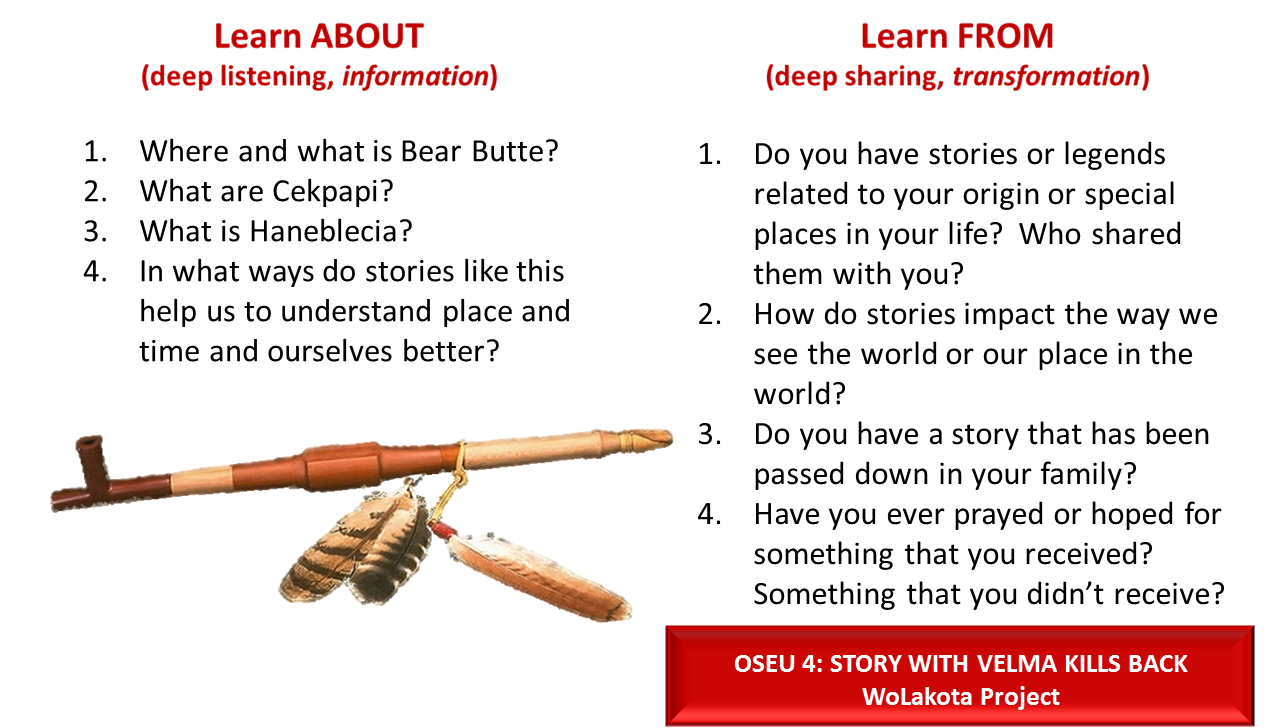
Learn ABOUT Learn FROM
(deep listening, information) (deep sharing, transformation)
1. Where and what is Bear Butte? 1. Do you have stories or legends
2. What are Cekpapi? related to your origin or special
3. What is Haneblecia? places in your life? Who shared
4. In what ways do stories like this them with you?
help us to understand place and 2. How do stories impact the way we
time and ourselves better? see the world or our place in the
world?
3. Do you have a story that has been
passed down in your family?
4. Have you ever prayed or hoped for
something that you received?
Something that you didn’t receive?
OSEU 4: STORY WITH VELMA KILLS BACK
WoLakota Project
From the current WoLakota source page:
The Story of Bear Butte and Cekpapi
Velma Kills Back
Transcript
(deep listening, information)
(deep listening, information)
Some indexed text was extracted from scanned material. Check the original source for exact wording and spelling.
Source materials
Supplied transcript document. Text preserved as supplied; spellings and transcription uncertainties have not been corrected.