Interview · South Dakota · Stephanie Charging Eagle · OSEU 1
Themes: Land & stewardship, Kinship & family, Identity & belonging, Education & learning, Spirituality & ceremony, Values & generosity, Economy & livelihoods, Listening & observation
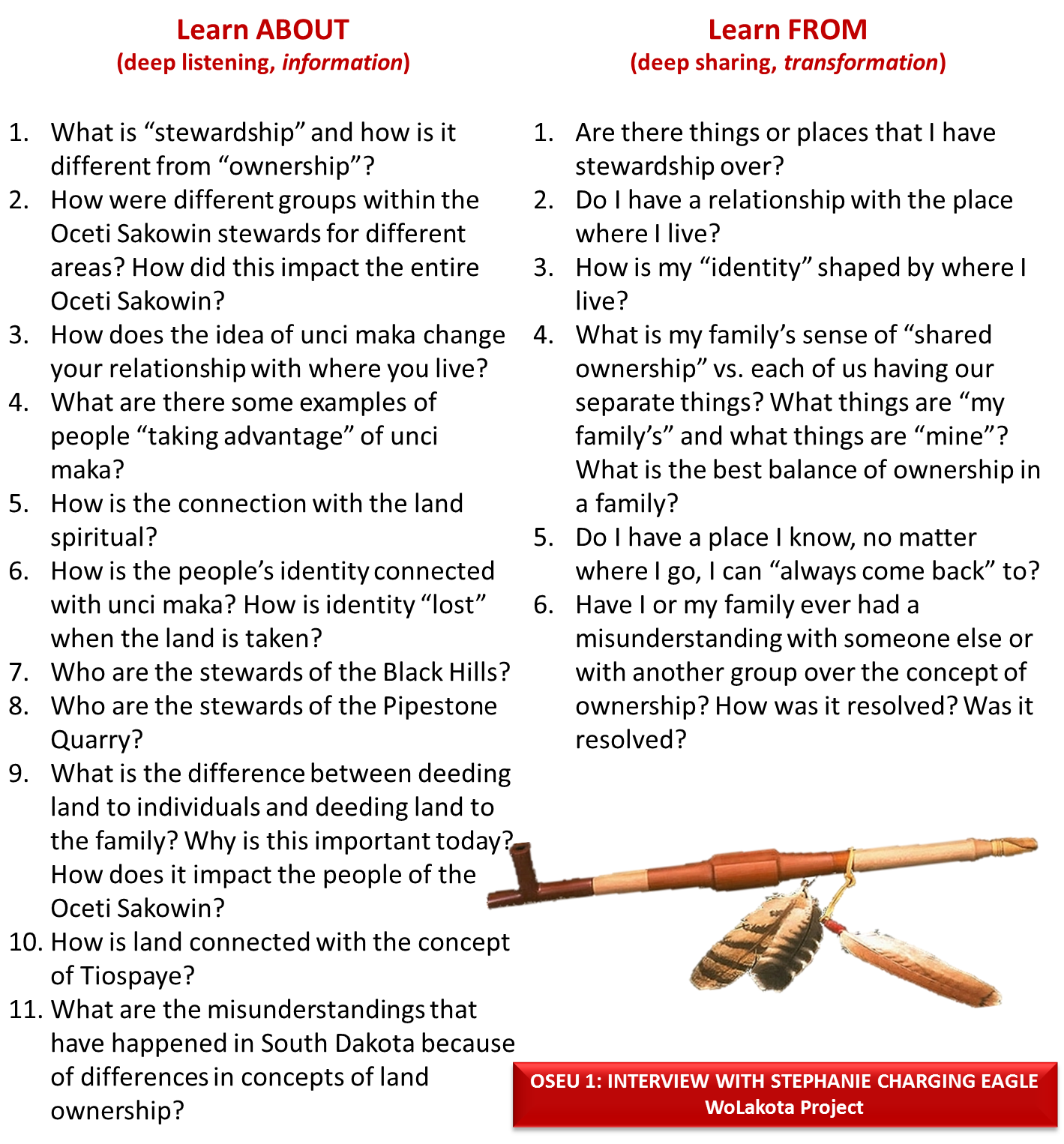
Learn About questions
1. What is “stewardship” and how is it different from “ownership”?
2. How were different groups within the Oceti Sakowin stewards for different areas? How did this impact the entire Oceti Sakowin?
3. How does the idea of unci maka change your relationship with where you live?
4. What are there some examples of people “taking advantage” of unci maka?
5. How is the connection with the land spiritual?
6. How is the people’s identity connected with unci maka? How is identity “lost” when the land is taken?
7. Who are the stewards of the Black Hills?
8. Who are the stewards of the Pipestone Quarry?
9. What is the difference between deeding land to individuals and deeding land to the family? Why is this important today?, How does it impact the people of the Oceti Sakowin?
10. How is land connected with the concept of Tiospaye?
11. What are the misunderstandings that have happened in South Dakota because of differences in concepts of land ownership?
Learn From questions
1. Are there things or places that I have stewardship over?
2. Do I have a relationship with the place where I live?
3. How is my “identity” shaped by where I live?
4. What is my family’s sense of “shared ownership” vs. each of us having our separate things? What things are “my family’s” and what things are “mine”? What is the best balance of ownership in a family?
5. Do I have a place I know, no matter where I go, I can “always come back” to?
6. Have I or my family ever had a misunderstanding with someone else or with another group over the concept of ownership? How was it resolved? Was it resolved?
Transcripts
Stewardship and the Land
Watch this interview on YouTubeStewardship and the Land - Stephanie Charging Eagle - OSEU #1
Stewardship that the land is not owned, but that there are stewards. And we as Lakota, the Oceti Sakowin people, are stewards of the land and that everything that we have that we are able to do to be comes from that land, that environment. So whether you live in this geographical location or over here, each one represents that land and how you are a steward to that land, meaning you take care of it, but also you understand that everything in that and Unci Maka, Mother Earth, is there for your use and not to take advantage to use more than you need to. And that understanding land became very important because as long as you have a place that you call your own, you have that connection and it's very spiritual. And so when we talk about land, we have that connection to the land that was the spiritual part of it. And we needed to. We wanted our younger generation, the generations to come, to understand that we fight for this land because it's who we are.
If we don't have that land base, if we don't have that land and we don't take care of it, then we will be lost without that land, without Unci Maka, that connection. And when we did the essential understandings, we wanted to emphasize that the spirituality, the connection with that, the stewardship of the Oceti Sakowin. To the land, whether it's the Black Hills or whether it's one of the sites with the Dakota people. That is our connection to the land. When we have land like deeded land in the family, it's left to the family because that means that the home is there.
We hang on to that land because that is where our home is and that's our connection as a tiospaye, a tiwahe to that land, to that place. You can go anywhere, but you always know you come back. And that's what the Black Hills is to the people, to our Lakota people. That's what the like the Pipestone Quarries in Minnesota are to the Dakota people there. That's their land base. We wouldn't fight for that as Lakota people because that is their land. And it's just that type of essential understanding, that type of understanding. But most importantly, today, legally, we have to be knowledgeable to provide that awareness that land is not about owning it, but to have this understanding to allow or encourage our non-native neighbors and citizens of South Dakota to understand that when we fight for our land, it's not because we want to own it or to be greedy. But that we are merely, we are merely practicing our rights to that land because that is our connection. Just like when they own pay money for an acre of land and they can use it for whatever reason, you cannot take that away from them and they will fight you for it, you know, and that's the same concept of land for us. So, so, you know, our… I think with the standards with essential understandings, we wanted our students of South Dakota to understand why land is so important to us.
Resource text
. How is land connected with the concept
OSEU 1: INTERVIEW WITH STEPHANIE CHARGING EAGLE
WoLakota Project
Some indexed text was extracted from scanned material. Check the original source for exact wording and spelling.
Source materials
Transcripts from supplied documents and the current WoLakota source pages. Text preserved as published.