Interview · South Dakota · Lydia Whirlwind Soldier · OSEU 3
Themes: Language & revitalization, Kinship & family, Education & learning, Boarding schools & assimilation, Healing & resilience, Spirituality & ceremony, Values & generosity, Culture & continuity, Community & responsibility, Listening & observation, Children & young people, Humor & play
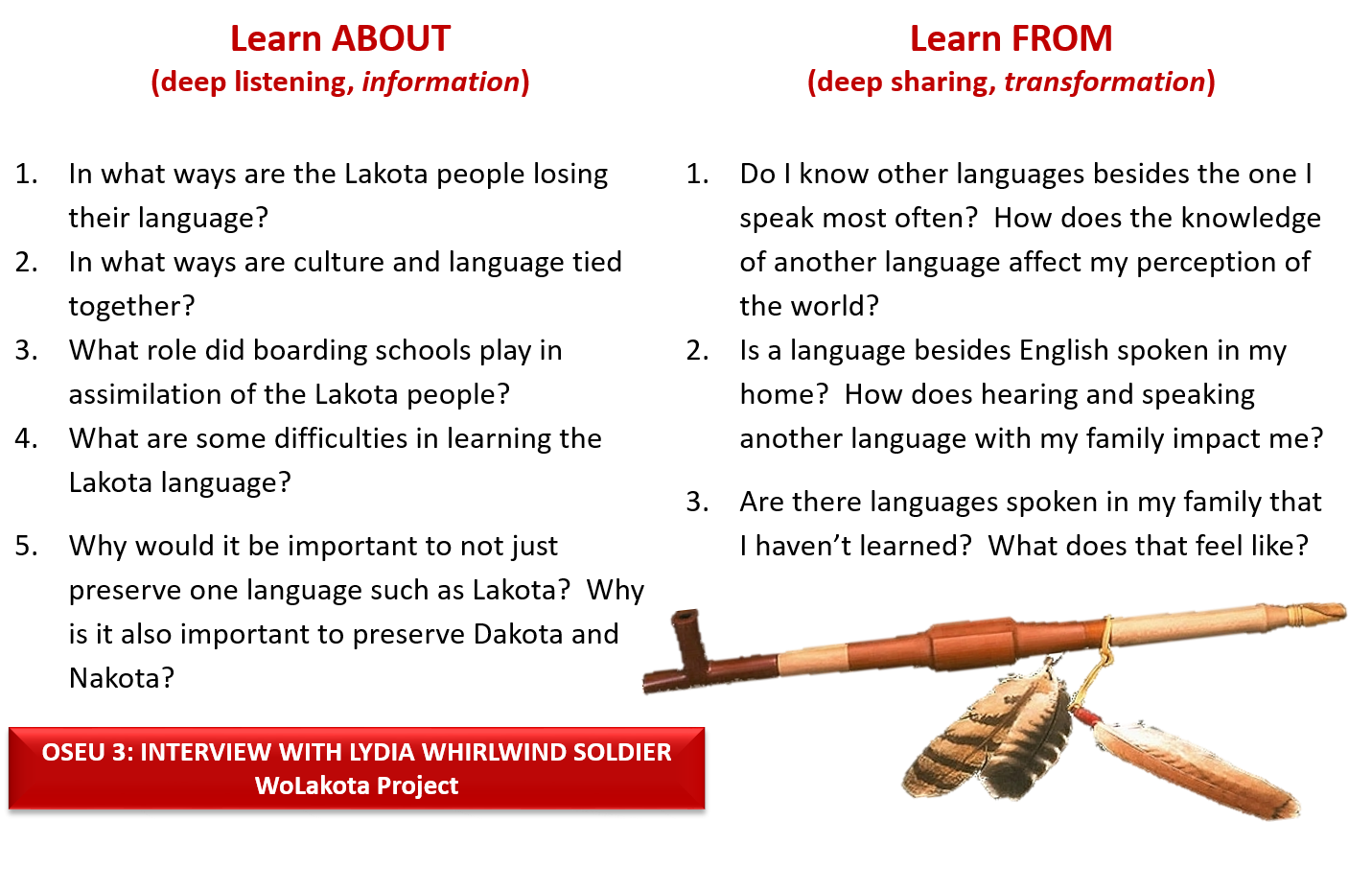
Learn About questions
In what ways are the Lakota people losing their language?
In what ways are culture and language tied together?
What role did boarding schools play in assimilation of the Lakota people?
What are some difficulties in learning the Lakota language?
Why would it be important to no just preserve one language such as Lakota? Why is it also important to preserve Dakota and Nakota?
Learn From questions
Do I know other languages besides the one I speak most often? How does the knowledge of another language affect my perception of the world?
Is a language besides English spoken in my home? How does hearing and speaking another language with my family impact me?
Are there languages spoken in my family that I haven’t learned? What does that feel like?
Transcripts
Language Loss - Lydia Whirlwind Soldier - OSEU #3
Watch this interview on YouTubeOne of the most important things is that we are losing our language. Our language is ingrained in our cultures and our culture is ingrained in our language. If we lose our language, we’re going to lose quite a bit.
So we’re concerned about our language loss. Most of our families are teaching the traditions and participating in ceremonies and all of that. Because of the boarding school system and the way that we were raised in boarding schools, we couldn’t speak our language. The whole idea of assimilation was forced upon us. There was a lot lost. Those families that didn’t reinforce it when the children went home…Fortunately, I was really lucky because I stepped right back into a community whose first language was Lakota. And everyone spoke Lakota. I stepped right back into that community of people for three months out of the year. I was able to retain my language.
Through my language, I was able to retain my culture and my traditions. Many schools are offering language classes. They are during very short periods of time. If you have one hour of language a week, it’s practically…just learning nouns…you don’t know conservational language.
Thought and philosophy blends into that…your values…your treatment of people…all of that is entwined. We can’t just preserve one. We have to preserve them all.
Resource text
From the current WoLakota source page:
Language Loss
Lydia Whirlwind Soldier
Transcript
(deep listening, information)
(deep listening, information)
Some indexed text was extracted from scanned material. Check the original source for exact wording and spelling.
Source materials
Supplied transcript document. Text preserved as supplied; spellings and transcription uncertainties have not been corrected.
Additional source transcripts
Language Loss
Language Loss - Lydia Whirlwind Soldier - OSEU #3
One of the most important things is that we are losing our language. Our language is
ingrained in our cultures and our culture is ingrained in our language. If we lose our
language, we’re going to lose quite a bit.
So we’re concerned about our language loss. Most of our families are teaching the
traditions and participating in ceremonies and all of that. Because of the boarding
school system and the way that we were raised in boarding schools, we couldn’t speak
our language. The whole idea of assimilation was forced upon us. There was a lot lost.
Those families that didn’t reinforce it when the children went home…Fortunately, I was
really lucky because I stepped right back into a community whose first language was
Lakota. And everyone spoke Lakota. I stepped right back into that community of people
for three months out of the year. I was able to retain my language.
Through my language, I was able to retain my culture and my traditions. Many schools
are offering language classes. They are during very short periods of time. If you have
one hour of language a week, it’s practically…just learning nouns…you don’t know
conservational language.
Thought and philosophy blends into that…your values…your treatment of people…all of
that is entwined. We can’t just preserve one. We have to preserve them all.