Interview · South Dakota · Duane Hollow Horn Bear · OSEU 4
Themes: Land & stewardship, Kinship & family, Storytelling & oral tradition, Spirituality & ceremony, Values & generosity, Food & plants, Arts & expression, Listening & observation, Children & young people
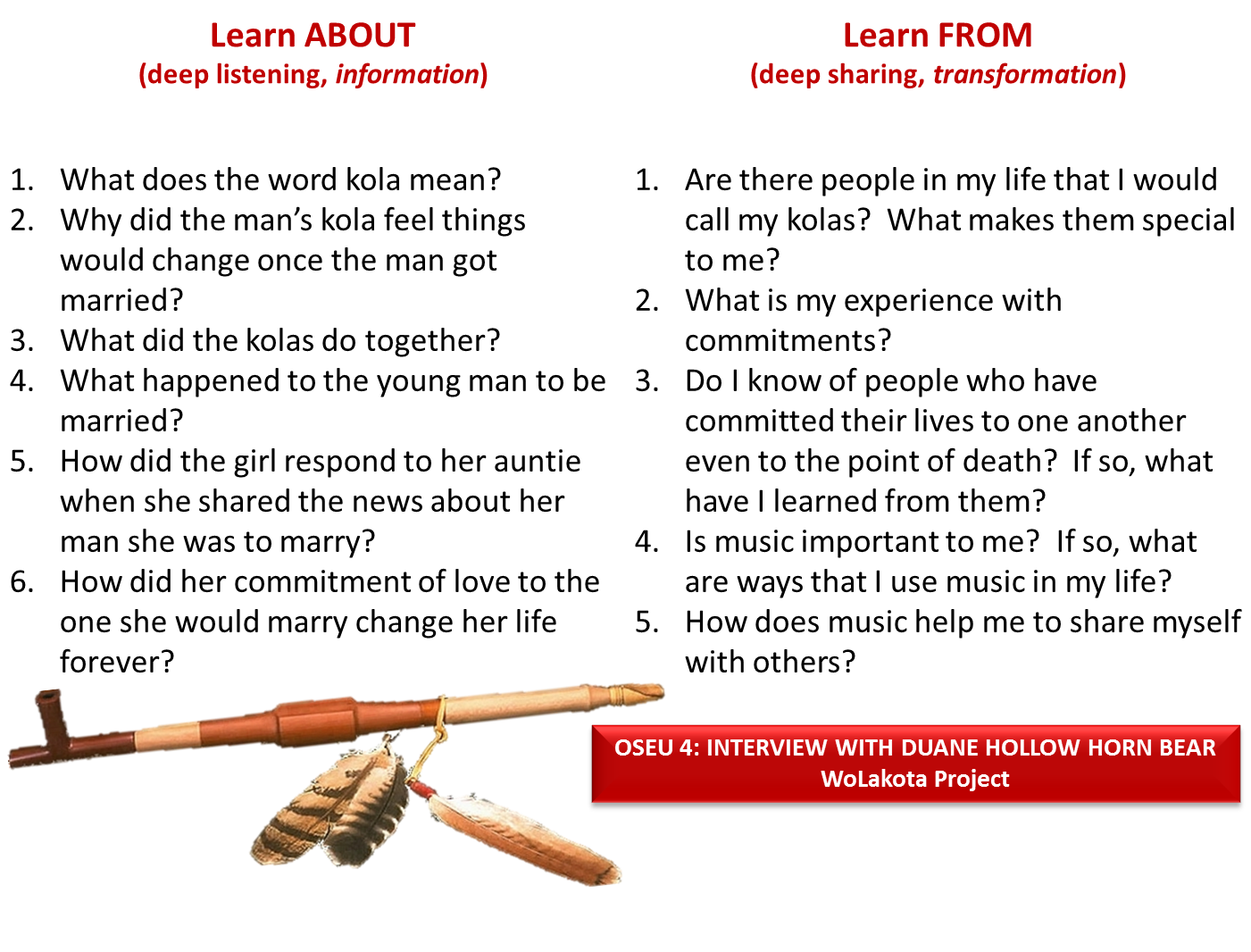
Learn About questions
What does the word kola mean?
What did the man’s kola feel things would change once the man got married?
What did the kolas do together?
What happened to the young man to be married?
How did the girl respond to her auntie when she shared the news about her man she was to marry?
How did her commitment of love to the one she would marry change her life forever?
Learn From questions
Are there people in my life that I would call kolas? What make them special to me?
What is my experience with commitments?
Do I know of people who have committed their lives to one another even to the point of death? If so, what have I learned from them?
Is music important to me? If so, that are ways that I use music in my life?
How does music help me to share myself?
Transcripts
The Story of Commitment - Duane Hollow Horn Bear - OSEU 4
Watch this interview on YouTubeCommitment in our families, our extended families, our tribe, our nation as a whole. Commitment. It talks about a story of two young people, two young, this young couple that fall deeply in love with each other, and the families come upon an agreement saying they may marry, they may marry each other, and so preparations begin. The young man's dowry is accepted.
The young girl, her family's all excited and they're helping her make her new teepee, the wedding dress, the fine white doe-skinned dress she's going to wear for the ceremony, and so as they are making preparation, this young man, his best friend. You know, in Lakota, we use a word when we say kola. This word kola means one who is very similar to me. He's just like me.
Today we use this word to mean anybody we call a friend, but it used to be reserved for two young boys who grew up with each other, who went swimming together, went hunting together, horseback riding, and did everything. They were inseparable. They say in our history, you would be very fortunate if you had one kola in your lifetime, someone who is very similar to you, who likes to do the same things you do.
Well, this man's kola came to him and said, you made a very good choice.
You're going to be getting married, but you know, when you get married, we won't get to do the things we used to. We won't be able to go hunting together, go out and go on pony raids. We won't have time for each other anymore. You're going to be married.
What do you say we go on one more, one more pony raid before you get married? One more, for old time's sake.
So the young man says, yeah, yeah, let's do it.
So they get some more of their companions and they go off. The girl is at home, continuing to make preparations for that wedding day. While these young men go off, they encounter some enemy. And in the skirmish, in the battle, the young man who is to be married, is killed. So when they're bringing his body back, a runner comes back ahead, brings word, the young man who was to be married has been killed. An auntie goes to the young girl in the tipi and gives her the news.
But she sits just quietly, continues to sew. The auntie goes out. The people are waiting.
What did she say? She didn't say anything. Maybe she didn't hear you. Go and tell her again. So she goes, did you hear what I said? The young man you were going to wed has died. The young girl continues to sew.
The auntie goes out. The people, what did she say? Nothing. I think she is in too much shock.
What are we going to do? A few minutes later, the girl emerges from the tipi and she walks towards the people. And she's dressed in that beautiful white doe-skinned dress. She walks by the people and she walks to the edge of camp over there and she turns.
She turns and she begins to sing this song. And as she sings, she starts dancing. And she dances back, backwards and backwards.
And they were living high above on the bluff.
She dances off of that cliff and she falls to her death.
In the words to her songs, there was this man that I cherished very deeply. He is in need with me. I am going to go and be with him. She had committed herself to this young man and a commitment of love to that one. She couldn't live without him. We still sing those songs today, such as at our Sundance ceremony, reminding us that commitment to one another.
When you choose someone in your life, you make that commitment forever. Forever.
These stories we share, we still tell them today to carry on and live those type of commitments amongst our people. Songs remind us. We sing songs of love. We sing songs of war to remind us of our lives, how we live out here on the land.
Thank you.
Resource text
OSEU 4: INTERVIEW WITH DUANE HOLLOW HORN BEAR
; WoLakota Project
“as
From the current WoLakota source page:
The Story of Commitment
Duane Hollow Horn Bear
Transcript
(deep listening, information)
(deep listening, information)
Some indexed text was extracted from scanned material. Check the original source for exact wording and spelling.
Source materials
Supplied transcript document. Text preserved as supplied; spellings and transcription uncertainties have not been corrected.
Additional source transcripts
The Story of Commitment
The Story of Commitment - Duane Hollow Horn Bear -
OSEU 4
Commitment in our families, our extended families, our tribe, our nation as a whole.
Commitment. It talks about a story of two young people, two young, this young couple
that fall deeply in love with each other, and the families come upon an agreement
saying they may marry, they may marry each other, and so preparations begin. The
young man's dowry is accepted.
The young girl, her family's all excited and they're helping her make her new teepee, the
wedding dress, the fine white doe-skinned dress she's going to wear for the ceremony,
and so as they are making preparation, this young man, his best friend. You know, in
Lakota, we use a word when we say kola. This word kola means one who is very similar
to me. He's just like me.
Today we use this word to mean anybody we call a friend, but it used to be reserved for
two young boys who grew up with each other, who went swimming together, went
hunting together, horseback riding, and did everything. They were inseparable. They
say in our history, you would be very fortunate if you had one kola in your lifetime,
someone who is very similar to you, who likes to do the same things you do.
Well, this man's kola came to him and said, you made a very good choice.
You're going to be getting married, but you know, when you get married, we won't get to
do the things we used to. We won't be able to go hunting together, go out and go on
pony raids. We won't have time for each other anymore. You're going to be married.
What do you say we go on one more, one more pony raid before you get married? One
more, for old time's sake.
So the young man says, yeah, yeah, let's do it.
So they get some more of their companions and they go off. The girl is at home,
continuing to make preparations for that wedding day. While these young men go off,
they encounter some enemy. And in the skirmish, in the battle, the young man who is to
be married, is killed. So when they're bringing his body back, a runner comes back
ahead, brings word, the young man who was to be married has been killed. An auntie
goes to the young girl in the tipi and gives her the news.
But she sits just quietly, continues to sew. The auntie goes out.
The people are waiting.
What did she say? She didn't say anything.
Maybe she didn't hear you. Go and tell her again. So she goes, did you hear what I
said? The young man you were going to wed has died. The young girl continues to sew.
The auntie goes out. The people, what did she say? Nothing. I think she is in too much
shock.
What are we going to do? A few minutes later, the girl emerges from the tipi and she
walks towards the people. And she's dressed in that beautiful white doe-skinned dress.
She walks by the people and she walks to the edge of camp over there and she turns.
She turns and she begins to sing this song. And as she sings, she starts dancing. And
she dances back, backwards and backwards.
And they were living high above on the bluff.
She dances off of that cliff and she falls to her death.
In the words to her songs, there was this man that I cherished very deeply. He is in
need with me. I am going to go and be with him. She had committed herself to this
young man and a commitment of love to that one. She couldn't live without him. We still
sing those songs today, such as at our Sundance ceremony, reminding us that
commitment to one another.
When you choose someone in your life, you make that commitment forever. Forever.
These stories we share, we still tell them today to carry on and live those type of
commitments amongst our people. Songs remind us. We sing songs of love. We sing
songs of war to remind us of our lives, how we live out here on the land.
Thank you.