Interview · South Dakota · Faith Spotted Eagle · OSEU 6
Themes: Kinship & family, Treaties & sovereignty, Values & generosity, Listening & observation
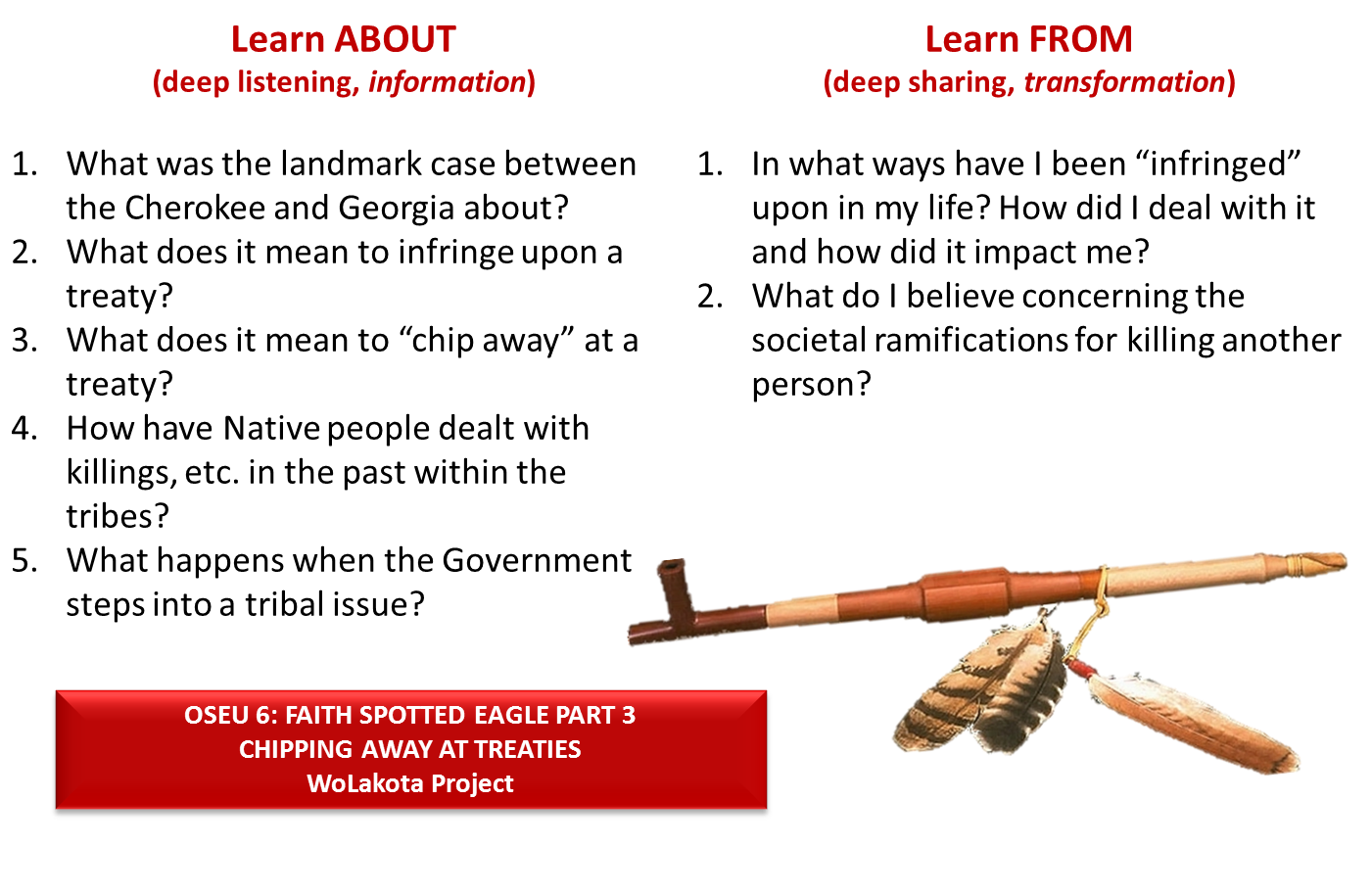
Learn About questions
What was the landmark case between the Cherokee and Georgia about?
What does it mean to infringe upon a treaty?
What does it mean to “chip away” at a treaty?
How have Native people dealt with killings, etc. in the past within the tribes?
What happens when the Government steps into a tribal issue?
Learn From questions
In what ways have I been “infringed” upon in my life? How did I deal with it and how did impact me?
what do I believe concerning the societal ramifications for killing another person?
Transcripts
Pt 3 Chipping Away at Treaties - Faith Spotted Eagle - OSEU 6
Watch this interview on YouTubeThere was a landmark case with the Cherokee in the state of Georgia. There was an actually non-Native man who lived on the Cherokee reserve or reservation, and he wanted to take up for the Cherokee, and he filed a suit. And the government actually ruled in favor of the Cherokee. But since that landmark case, these government federal rulings have come in, and they've impinged and reinterpreted treaty law, or not treaty law, but the standing of treaties. So like Worcester v. Georgia, Worcester was the
non-Native man.
When that decision was reached by a court, it said, okay, it affected this treaty. So this treaty began to shake over here. And so there's a strange, destructive relationship that evolved, and the government thinks it's a good relationship, but for us it's been destructive because it keeps chipping away at a treaty. And so that has happened throughout the years. Another one is Crow Dog v. Spotted Tail on the Rosebud Reservation.
We, in natural law, in the way we resolve conflicts in our society, if there was a killing, there was a certain way to settle it in the camp circle. There's many, many accounts. Auntie Ella Deloria talks about that in her books. She talks about 3 specific ways that were used to resolve when somebody had murdered someone else. So that happened when Crow Dog killed Spotted Tail. The families had come to an agreement that they were going to work it out, but the agents came in and they said, no, the law has to come in, American law has to come in.
So they made it punitive and they took it out of the camp and they made it, from that point in time with the Crow Dog, it went into federal law, the law began to change. And so it's been, again, a chipping away at the treaties.
Resource text
Learn ABOUT Learn FROM
(deep listening, information) (deep sharing, transformation)
What was the landmark case between = 1._:In what ways have | been “infringed”
the Cherokee and Georgia about? upon in my life? How did | deal with it
What does it mean to infringe upon a and how did it impact me?
treaty? 2. What do | believe concerning the
What does it mean to “chip away” at a societal ramifications for killing another
treaty? person?
How have Native people dealt with
killings, etc. in the past within the
tribes?
What happens when the Government —
steps intoa tribal issue? =
Po 3
OSEU 6: FAITH SPOTTED EAGLE PART 3
CHIPPING AWAY AT TREATIES
WoLakota Project
From the current WoLakota source page:
Chipping Away at Treaties
Faith Spotted Eagle
Transcript
(deep listening, information)
(deep listening, information)
Some indexed text was extracted from scanned material. Check the original source for exact wording and spelling.
Source materials
Supplied transcript document. Text preserved as supplied; spellings and transcription uncertainties have not been corrected.
Additional source transcripts
Chipping Away at Treaties
Pt 3 Chipping Away at Treaties - Faith Spotted Eagle -
OSEU 6
There was a landmark case with the Cherokee in the state of Georgia. There was an
actually non-Native man who lived on the Cherokee reserve or reservation, and he
wanted to take up for the Cherokee, and he filed a suit. And the government actually
ruled in favor of the Cherokee. But since that landmark case, these government federal
rulings have come in, and they've impinged and reinterpreted treaty law, or not treaty
law, but the standing of treaties. So like Worcester v. Georgia, Worcester was the
non-Native man.
When that decision was reached by a court, it said, okay, it affected this treaty. So this
treaty began to shake over here. And so there's a strange, destructive relationship that
evolved, and the government thinks it's a good relationship, but for us it's been
destructive because it keeps chipping away at a treaty. And so that has happened
throughout the years. Another one is Crow Dog v. Spotted Tail on the Rosebud
Reservation.
We, in natural law, in the way we resolve conflicts in our society, if there was a killing,
there was a certain way to settle it in the camp circle. There's many, many accounts.
Auntie Ella Deloria talks about that in her books. She talks about 3 specific ways that
were used to resolve when somebody had murdered someone else. So that happened
when Crow Dog killed Spotted Tail. The families had come to an agreement that they
were going to work it out, but the agents came in and they said, no, the law has to come
in, American law has to come in.
So they made it punitive and they took it out of the camp and they made it, from that
point in time with the Crow Dog, it went into federal law, the law began to change. And
so it's been, again, a chipping away at the treaties.