Interview · North Dakota · South Dakota · Gladys Hawk · OSEU 7 · NDNAEU 1
Themes: Land & stewardship, Education & learning, Values & generosity, Culture & continuity, Food & plants, Listening & observation, Humor & play, Intergenerational learning
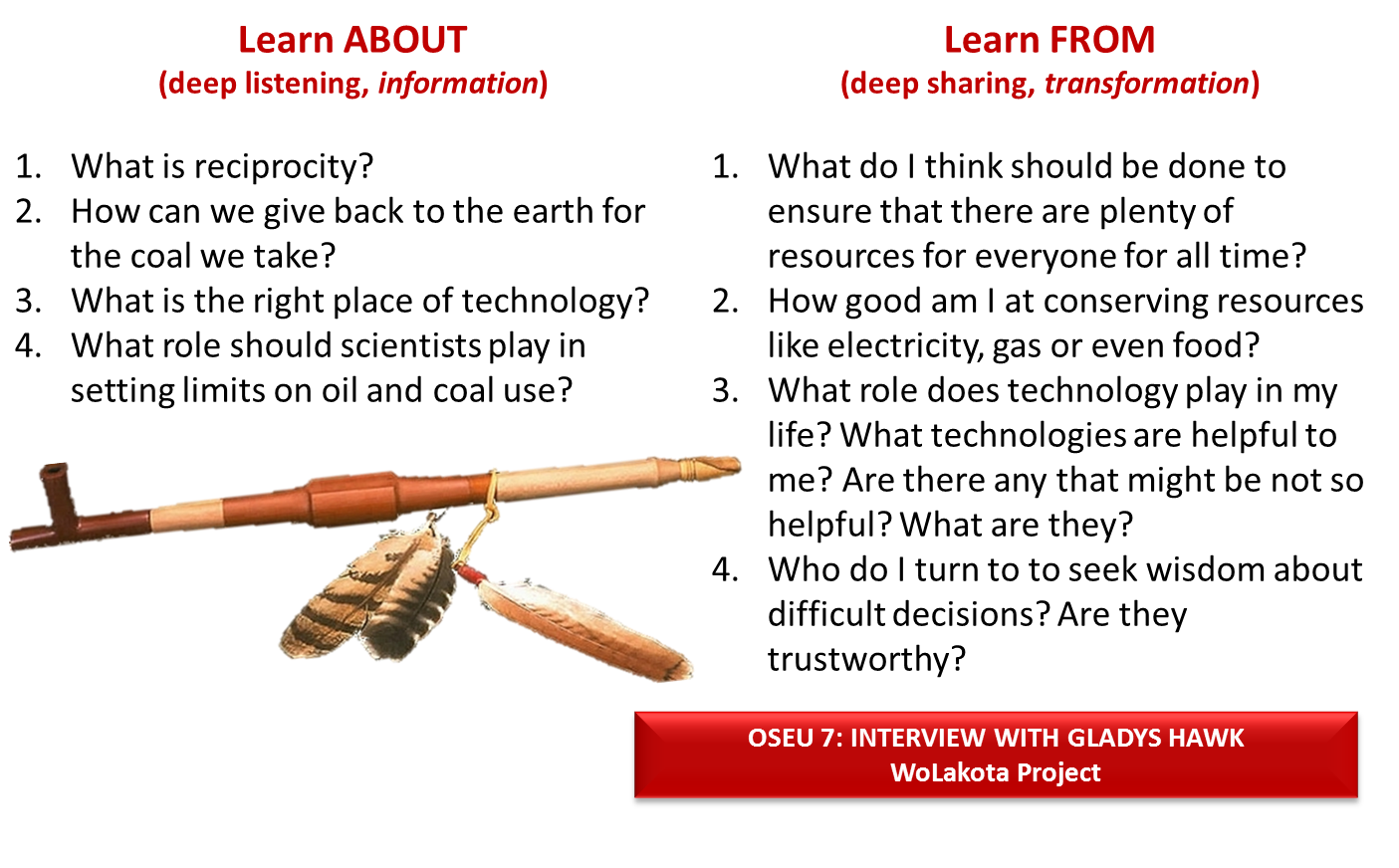
Learn About questions
1. What is reciprocity?
2. How can we give back to the earth for the coal we take?
3. What is the right place of technology?
4. What role should scientists play in setting limits on oil and coal use?
Learn From questions
1. What do I think should be done to ensure that there are plenty of resources for everyone for all time?
2. How good am I at conserving resources like electricity, gas or even food?
3. What role does technology play in my life? What technologies are helpful to me? Are there any that might be not so helpful? What are they?
4. Who do I turn to to seek wisdom about difficult decisions? Are they trustworthy?
Transcripts
Reciprocity with the Land - Gladys Hawk - OSEU 7
Watch this interview on YouTubeAs a people, everywhere, maybe we should kind of step back and see where we can make it better. Every day, there's a train track along where I live. Almost every other day, I see hundreds and hundreds of carloads of coal going east. And I always think, I wonder what they put back in place of that coal. Because that's reciprocity. We have to give back what we take from the earth. We're not doing that. And so we're experiencing all of this change, atmospheric changes that's coming. And we believe in a creator who made those for us.
And so when we take that belief and we're trying to live that way, and then we see all these new things happening around us, technology, we have to stop and to say, let's slow down here, what's going on? We have to make some kind of a, maybe we have to call on elders to say, what do you think we should do about this? Well, we don't have that kind of technology in our culture to do those kinds of changes. That's all coming. It's already coming. And the scientists are the ones that we should ask them to bring it out in the open.
Okay, we're going to cut you off right here. You want oil from the land. Okay, you can do this much. Take so many barrels today and wait another year. But that seems impossible because we need that oil, we need that gas to move, to go to work and do all of the things that we need to do, even to warm this building. Even our trees are gone.
We can't even burn wood anymore. It's against the law. We can't have fires. So what do we do? And so that's the question I will leave because I don't know the answer.
Resource text
Learn ABOUT Learn FROM
(deep listening, information) (deep sharing, transformation)
1. What is reciprocity? 1. What do | think should be done to
2. How can we give back to the earth for ensure that there are plenty of
the coal we take? resources for everyone for all time?
3. What is the right place of technology? 2. Howgood am| at conserving resources
4. What role should scientists play in like electricity, gas or even food?
setting limits on oil and coal use? 3. What role does technology play in my
life? What technologies are helpful to
me? Are there any that might be not so
helpful? What are they?
. Who do! turn to to seek wisdom about
difficult decisions? Are they
trustworthy?
OSEU ITERVIEW WITH GLADYS HAWK
WolLakota Project
From the current WoLakota source page:
Reciprocity with the Land
Gladys Hawk
Transcript
(deep listening, information)
(deep listening, information)
Teachings of Our Elders resource text:
NDNAEU Alignment:
Some indexed text was extracted from scanned material. Check the original source for exact wording and spelling.
Source materials
Supplied transcript document. Text preserved as supplied; spellings and transcription uncertainties have not been corrected.
Additional source transcripts
Reciprocity with the Land
Reciprocity with the Land - Gladys Hawk - OSEU 7
As a people, everywhere, maybe we should kind of step back and see where we can
make it better. Every day, there's a train track along where I live. Almost every other
day, I see hundreds and hundreds of carloads of coal going east. And I always think, I
wonder what they put back in place of that coal. Because that's reciprocity. We have to
give back what we take from the earth. We're not doing that. And so we're experiencing
all of this change, atmospheric changes that's coming. And we believe in a creator who
made those for us.
And so when we take that belief and we're trying to live that way, and then we see all
these new things happening around us, technology, we have to stop and to say, let's
slow down here, what's going on? We have to make some kind of a, maybe we have to
call on elders to say, what do you think we should do about this? Well, we don't have
that kind of technology in our culture to do those kinds of changes. That's all coming. It's
already coming. And the scientists are the ones that we should ask them to bring it out
in the open.
Okay, we're going to cut you off right here. You want oil from the land. Okay, you can do
this much. Take so many barrels today and wait another year. But that seems
impossible because we need that oil, we need that gas to move, to go to work and do all
of the things that we need to do, even to warm this building. Even our trees are gone.
We can't even burn wood anymore. It's against the law. We can't have fires. So what do
we do? And so that's the question I will leave because I don't know the answer.