Interview · South Dakota · Pearl Kennedy-Colombe · OSEU 1
Themes: Land & stewardship, Kinship & family, Education & learning, Values & generosity, Food & plants, Listening & observation, Children & young people
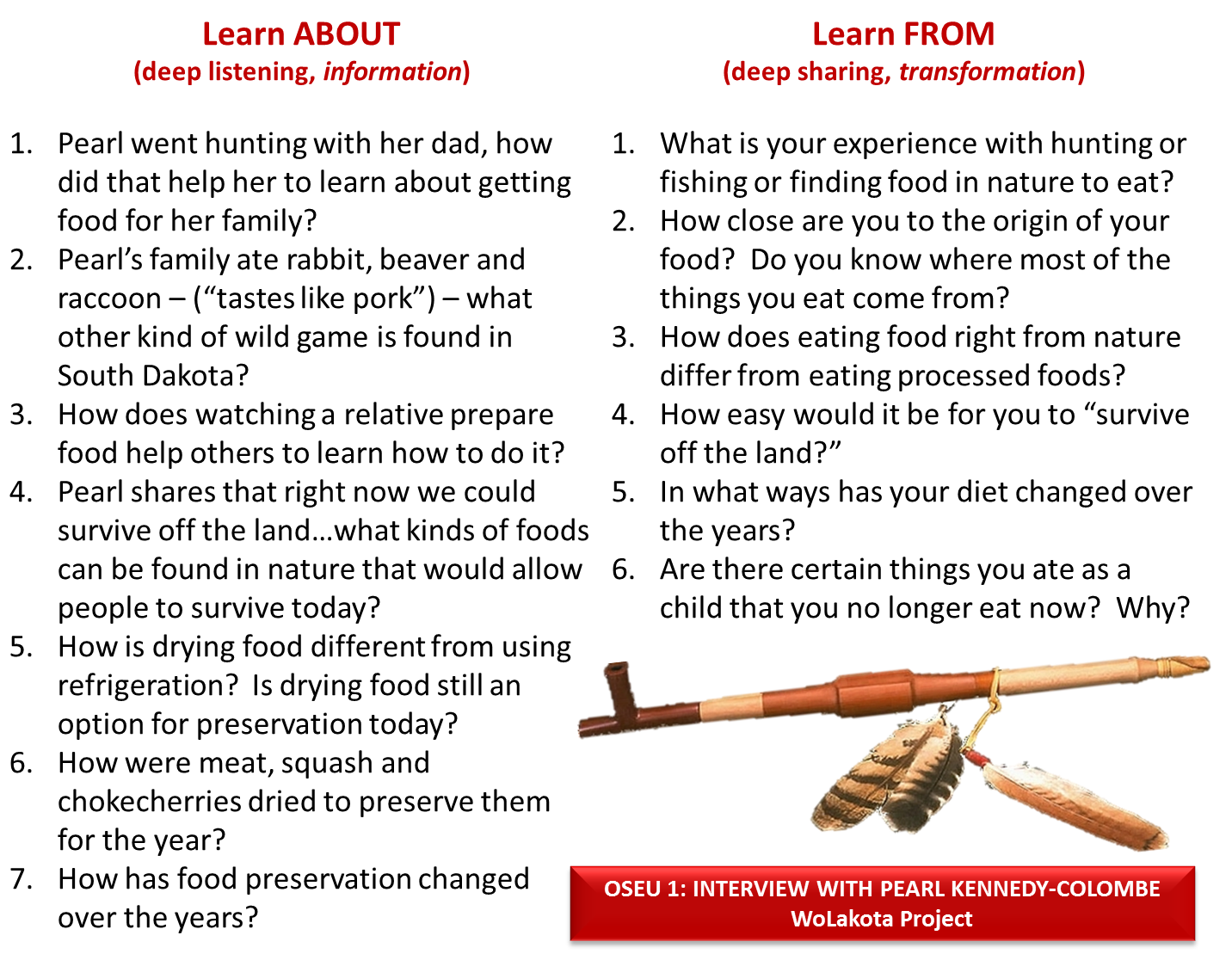
Learn About questions
1. Pearl went hunting with her dad, how did that help her to learn about getting food for her family?
2. Pearl’s family ate rabbit, beaver and raccoon — (“tastes like pork”) — what other kind of wild game is found in South Dakota?
3. How does watching a relative prepare food help others to learn how to do it?
4. Pearl shares that right now we could survive off the land…what kinds of foods can be found in nature that would allow people to survive today?
5. How is drying food different from using refrigeration? Is drying food still an option for preservation today?
6. How were meat, squash and chokecherries dried to preserve them for the year?
7. How has food preservation changed over the years?
Learn From questions
1. What is your experience with hunting or fishing or finding food in nature to eat?
2. How close are you to the origin of your food? Do you know where most of the things you eat come from?
3. How does eating food right from nature differ from eating processed foods?
4. How easy would it be for you to “survive off the land?”
5. In what ways has your diet changed over the years?
6. Are there certain things you ate as a child that you no longer eat now? Why?
Transcripts
Hunting with Dad - Pearl Kennedy-Colombe - OSEU #1
Watch this interview on YouTubeFrom the time I was seven, he would take me hunting because I had four sisters and we fought all the time. And I didn't like it where I was staying with my folks. So, I'd run away to my aunt's. And if, you know…Fort Thompson… we lived at a Catholic Church…and when you go across… we go across and down the hill to Old Fort. And my grandpa's brother lived over the hill, so I always stopped there. Grandpa Louie is big and tall, too. And I tell him, “I'm going to go down to Aunt Francis’, watch me, you know?”
So, I'd go across the bridge and I'd go out. It was about maybe three miles out… I'd walk out there to her house. Then I'd stay there for as long as I wanted to. And I did that ever since I was like four or five. And, you know, today, anybody have a four- or
five-year-old take off…you worry. I can’t imagine the worry. But I knew my way around. I went to Aunt Francis and I stayed there. But whenever I go back home, when I got older, I would hunt with my dad and we ate a lot of rabbit and we ate some… a couple of times we ate beaver… we ate raccoon.
It tastes like pork. Was just learning how to… I’d watch my Aunt Frances… whenever they get something like that. I'd watch her cook it. So then, you know, I caught on to the cooking, and then we went fishing a lot. So, like, right now, a person could survive on this land. We didn't need to run to the store for everything. Maybe they get potatoes.
And my Uncle Pete, he raised potatoes. My dad raised potatoes… we had the cellar and where we put those potatoes. We'd have potatoes for a long time, you know… as long as you don't shine the light on them. And we'd be able to keep our food so we didn't have refrigerators. And so everything is right. That's our way of survival is to dry our foods.
So when I was real little, I learned how to… I watched my aunt and my grandma… they sliced that meat and make it real thin… and then they'd hang it, you know. And the men folks would get the window poles and put them up. And so we could hang… hang the meat and dry it. There was many, many things that were dried, like squash. I never learned how to cook squash till I come here, but when they used to prepare a squash, they used the sew a string through it and hang it and dry it, you know… and use it whenever they need it.
Resource text
OSEU 1: INTERVIEW WITH PEARL KENNEDY-COLOMBE
WoLakota Project
Some indexed text was extracted from scanned material. Check the original source for exact wording and spelling.
Source materials
Supplied transcript document. Text preserved as supplied; spellings and transcription uncertainties have not been corrected.
Additional source transcripts
Hunting with Dad
Hunting with Dad - Pearl Kennedy-Colombe - OSEU
#1
From the time I was seven, he would take me hunting because I had four sisters and we
fought all the time. And I didn't like it where I was staying with my folks. So, I'd run away
to my aunt's. And if, you know…Fort Thompson… we lived at a Catholic Church…and
when you go across… we go across and down the hill to Old Fort. And my grandpa's
brother lived over the hill, so I always stopped there. Grandpa Louie is big and tall, too.
And I tell him, “I'm going to go down to Aunt Francis’, watch me, you know?”
So, I'd go across the bridge and I'd go out. It was about maybe three miles out… I'd
walk out there to her house. Then I'd stay there for as long as I wanted to. And I did that
ever since I was like four or five. And, you know, today, anybody have a four- or
five-year-old take off…you worry. I can’t imagine the worry. But I knew my way around. I
went to Aunt Francis and I stayed there. But whenever I go back home, when I got
older, I would hunt with my dad and we ate a lot of rabbit and we ate some… a couple
of times we ate beaver… we ate raccoon.
It tastes like pork. Was just learning how to… I’d watch my Aunt Frances… whenever
they get something like that. I'd watch her cook it. So then, you know, I caught on to the
cooking, and then we went fishing a lot. So, like, right now, a person could survive on
this land. We didn't need to run to the store for everything. Maybe they get potatoes.
And my Uncle Pete, he raised potatoes. My dad raised potatoes… we had the cellar
and where we put those potatoes. We'd have potatoes for a long time, you know… as
long as you don't shine the light on them. And we'd be able to keep our food so we
didn't have refrigerators. And so everything is right. That's our way of survival is to dry
our foods.
So when I was real little, I learned how to… I watched my aunt and my grandma… they
sliced that meat and make it real thin… and then they'd hang it, you know. And the men
folks would get the window poles and put them up. And so we could hang… hang the
meat and dry it. There was many, many things that were dried, like squash. I never
learned how to cook squash till I come here, but when they used to prepare a squash,
they used the sew a string through it and hang it and dry it, you know… and use it
whenever they need it.
And we had many different ways like chokecherries… we had to pound them and make
patties. So, we'd go down and get about three five-gallon buckets of cherries. And we
as kids would sit there and pound it because we like to eat them. And after we pounded
it, we like to eat them. And we'd make these trays of patties. They look like hamburgers,
great hamburgers, you know, And it would get done with that and they'd put them in a
sack and, you know, put it away. And they stayed dry.
The corn stayed right for as long as you need it. So, we had a way of preserving our
food. And there is… whenever they get fresh meat, we always had steaks and, you
know, soups… a lot of soup. And my grandpa had cattle. So, he was… he was
provide… he’d butcher. He gives some to my Aunt Francis and he’d give some to my
mother.
So, we always had meat. But since my dad worked at the road department and got
paid, we ate good. I don't remember a time when he was working that we went hungry.