Interview · South Dakota · Cheryl Medearis · Dottie LeBeau · OSEU 4
Themes: Land & stewardship, Language & revitalization, Kinship & family, Identity & belonging, Storytelling & oral tradition, Education & learning, Boarding schools & assimilation, Healing & resilience, Spirituality & ceremony, Values & generosity, Culture & continuity, Arts & expression, Community & responsibility, Listening & observation, Children & young people, Humor & play, Self-determination & leadership, Intergenerational learning
Learn About questions
Addressing OSEU 1
1. What is the Wolakota Project?
2. How can the WoLakota Project help in teacher education, science, math and social studies courses?
3. Why does education often not address the “Land Base”?
4. What are the reasons it’s important for children to learn to take care of the land?
5. Are there arguments that care for the land is not an important lesson for children to learn? What are those?
Addressing OSEU 2
1. How does OSEU 2 help students to know it’s okay for them to “be who they are?”
2. How many students feel that school “isn’t important” or that they “don’t fit it” in school? What’s being done to address these problems in our state? In our nation?
3. Is teaching more difficult today than ever before, and if it is, what makes it so?
4. How is educational “rigor” defined in our state? In our nation?
5. What are the stories from the Elders that fit with this understanding?
Addressing OSEU 3
1. What are the numbers concerning Native American representation in highly visible professions like acting, music, pro sports, politics etc?
2. Who is Fran Waln?
3. How many young native students are learning traditional practices like flute or drum or traditional song and dance? What efforts are being made to increase these opportunities?
4. Why have so many traditional practices been “lost” among the people of the Oceti Sakowin?
Addressing OSEU 4
1. How is the Lakota, Dakota, Nakota sense of community unique?
2. How is the Lakota, Dakota, Nakota sense of family or kinship unique?
3. How does a sense of community or relatedness impact learning in the classroom?
4. How might the classroom community needs of native students mirror and differ from those of non-native students?
Learn From questions
Addressing OSEU 1
1. What experiences have you had in school as a student or as a teacher that have addressed human beings’ relationship or responsibility toward the land?
2. What stores concerning respect and stewardship did you learn growing up?
3. How do you think the physical place where you grew up impacts your life work today?
4. To what degree should “care for the land” be a focus in the classes you teach? Why do you feel this way?
Addressing OSEU 2
1. Do you have a story of “walking away from school” or of not do doing so well in school? Have you ever shared it with your students?
2. Have you ever, or do you now feel like you “don’t fit” in some way? How does that impact the work you do?
3. Is there a specific “somebody” who impacted your life and decision to be a teacher? Who is that person and how did they impact you?
4. What might it mean to “meet students where they are at?” Do you have any stories about this fro your work as a teacher or educator?
Addressing OSEU 3
1. What things in today’s popular media (TV, music, sports, etc) do you identify with? do they “reflect” your identity or “shape” it or both? In what ways?
2. When you were a student (elementary, middle or high school years) what heroes or celebrities helped you shape your identity? Have those influences remained strong within you or have they changed?
3. What songs, stories, dances, practices, etc have shaped your sense of cultural identity?
4. Do you fall somewhere on a line from “traditional” to “assimilated” or in relation to the culture you grew up in? Where do you fall? How does that impact your interactions with others?
Addressing OSEU 4
1. Have you ever experienced a deep sense of community as a student or as a teacher? How was that created?
2. What experiences have you had in classrooms or workplaces with very little sense of community? How did that impact learning or productivity?
3. What have you done in your classroom that connected students with their families in some way? What were the successes? Were there some particular problems that arose? How did you deal with them?
4. Have you ever had one of your own children or grandchildren in your classroom? What did you learn from that?
5. Have you ever had siblings or close relatives as students in the same classroom? What are the particular benefits or challenges of that situation?
Transcripts
Addressing OSEU 4 with Cheryl Medearis
Watch this interview on YouTubeOne of the most important things to me as an educator and to work with future educators and to work with in-service teachers is to help them understand that sense of community and what is kinship. And maybe we're not related by blood, maybe your students are and aren't, but to build that strong community of learners and for students to go back and know who their relatives are and to understand who their families are.
And that's a real struggle in this day and age with families that are separated and split and children's names are changed in the court has had a devastating impact. So we have to really think about how we have students go back and know their story. I think that's one of the most powerful assignments that students have done in our class is write your story, tell your story. I do that as part of the class that I do... and it's like, oh really? And then as they get into it, it's a very happy time. There are a lot of tears shed.
They share that and they say, how would you do that in your classroom of third graders or fifth graders so that they can safely tell their story? Maybe not orally, maybe on paper, maybe in a play that they... that we all need to be proud of where we came from. So it's, again, a very important piece of building that community of learners and a safety net for all of us to feel within that understanding.
Addressing OSEU One with Cheryl Medearis
Watch this interview on YouTubeI really believe that the Wolakota Project has reinvigorated that piece. I think it is something that we use very strongly. I've shared that with not only our teacher education candidates, but also with our science and math and social studies instructors across the institution. We have a rich, beautiful land base, and very little in traditional education talks about that.
So the stories, the respect for the land, the respect for giving back to the land and being good stewards of that land is something that I have tried very hard in my position to share, because it's something I carry in my heart, you know, being raised in South Dakota and to help our young children see how important it is to take care of that land.
Addressing OSEU Two with Cheryl Medearis
Watch this interview on YouTubeTo me, that's one of the strongest of the essential understandings. To be able to give people and our children, our students, our students at the college, university level, the understanding that they are okay who they are and that they can learn and be whatever they want to be. And sometimes I sell them, but sometimes I do. I share my story of walking away from school because it wasn't important. My family moved from one area to the other in South Dakota, from one ranch community to another where I grew up.
I was accepted for who I was, although they sometimes thought I was strange because I lived with my grandparents because the rural school wasn't open at that time. It was like, don't you have a mom or dad? And to just go back and to share how school wasn't important to me. And I missed a lot of opportunities or was given a lot of opportunities, depending on how you look at it, walking away from school because I did not fit and I did not belong.
And then moving into the area of teacher education to really say it's somebody who made a difference in your life. And I really think that's why you've chosen the track to be a teacher, which is a tough job these days. Harder than it ever was when I was in a
K-12 classroom. So for them to try really diligently every day from when they greet students, when they walk in, until they leave that day to say, you are okay who you are and I'll meet you where you need to be met.
And still meet the rigor of all the standards and all the things that they have to do in the day of a school. So it's a huge balancing act that they have to do. But that's a very strong understanding and the stories from the elders that go with that one is powerful.
Addressing OSEU 3 with Cheryl Medearis
Watch this interview on YouTubeOne of the challenges I think we have for our Native youth is they don't see themselves a lot on TV. They don't see themselves in the music. They don't see themselves in all the things that are important, especially to upper elementary, middle school, high school students. The students on our reservation want to be anything but Indian. So I'm very thankful for every opportunity that they have to see the Frank Wands and that they see the students like performing today that are learning how to play the flute.
And as we do our Founders' Day celebration at Sinta Gleska every year, we see more and more drums with young students sitting around there. And I walk up and always try to personally thank the teachers or the mentors who are there with those students around those drums, teaching them the songs, teaching them that way of life. So it's something we have lost and have to really work hard in the educational setting to gain back, again, that cultural identity and to be proud of who they are and where they came from. And they are okay.
Resource text
Unit 1
What are the
Oceti Sakowin
Essential Understandings? (with a focus on 1, 2, 3 & 4)
If you haven’t already, you can download
the OSEU document here!
In this unit, you’ll be getting to know the first 4 Oceti Sakowin Essential Understandings through reading, viewing and reflecting upon the understandings themselves and video interviews with Dottie LeBeau, one of the original authors of the understandings, and Dr Cheryl Medearis, Dean of the College of Education at Sinte Gleska University established in Mission, SD by the Rosebud Sioux Tribe.
After reading each Understanding and its accompanying standards and viewing each set of introductions by Elder Dottie LeBeau and Dr Cheryl Medearis, use the survey links to journal reflectively about your initial sense of each of the Oceti Sakowin Essential Understandings.
Unit 1a:
Click Here to Complete the
“Understanding the OSEU” Survey on OSEU 1
Unit 1b:
Click Here to Complete the
“Understanding the OSEU” Survey on OSEU 2
Unit 1c:
Click Here to Complete the
“Understanding the OSEU” Survey on OSEU 3
Unit 1d:
Click Here to Complete the
“Understanding the OSEU” Survey on OSEU 4
To learn even more about each of the understandings, read the extended descriptions for each. These are included in
the OSEU document
itself, and can be found at the bottom of each of the WoLakota Project
OSEU Elder interview main pages
.
Next Unit:
Unit 2
Where and What are the WoLakota Project Elder Interviews… and How Do I Use Them?
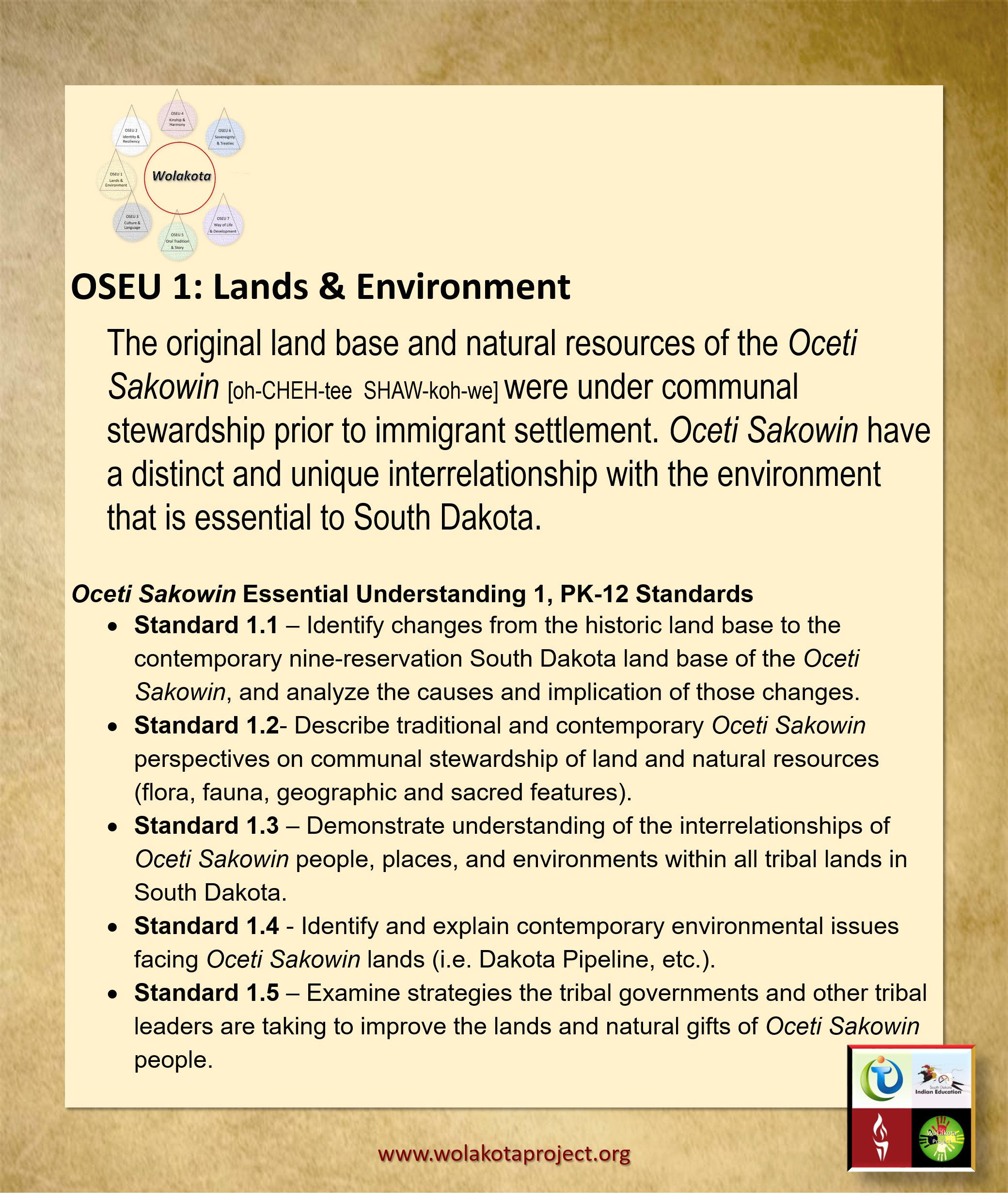
OSEU 1: Lands & Environment
The original land base and natural resources of the Oceti
SakOwin [oh-CHEH-tee SHAW-koh-we] Were under communal
stewardship prior to immigrant settlement. Oceti Sakowin have
a distinct and unique interrelationship with the environment
that is essential to South Dakota.
Oceti Sakowin Essential Understanding 1, PK-12 Standards
Standard 1.1 — Identify changes from the historic land base to the
contemporary nine-reservation South Dakota land base of the Oceti
Sakowin, and analyze the causes and implication of those changes.
Standard 1.2- Describe traditional and contemporary Oceti Sakowin
perspectives on communal stewardship of land and natural resources
(flora, fauna, geographic and sacred features).
Standard 1.3 — Demonstrate understanding of the interrelationships of
Oceti Sakowin people, places, and environments within all tribal lands in
South Dakota.
Standard 1.4 - Identify and explain contemporary environmental issues
facing Oceti Sakowin lands (i.e. Dakota Pipeline, etc.).
Standard 1.5 — Examine strategies the tribal governments and other tribal
leaders are taking to improve the lands and natural gifts of Oceti Sakowin
people.
cation
www.wolakotaproject.org
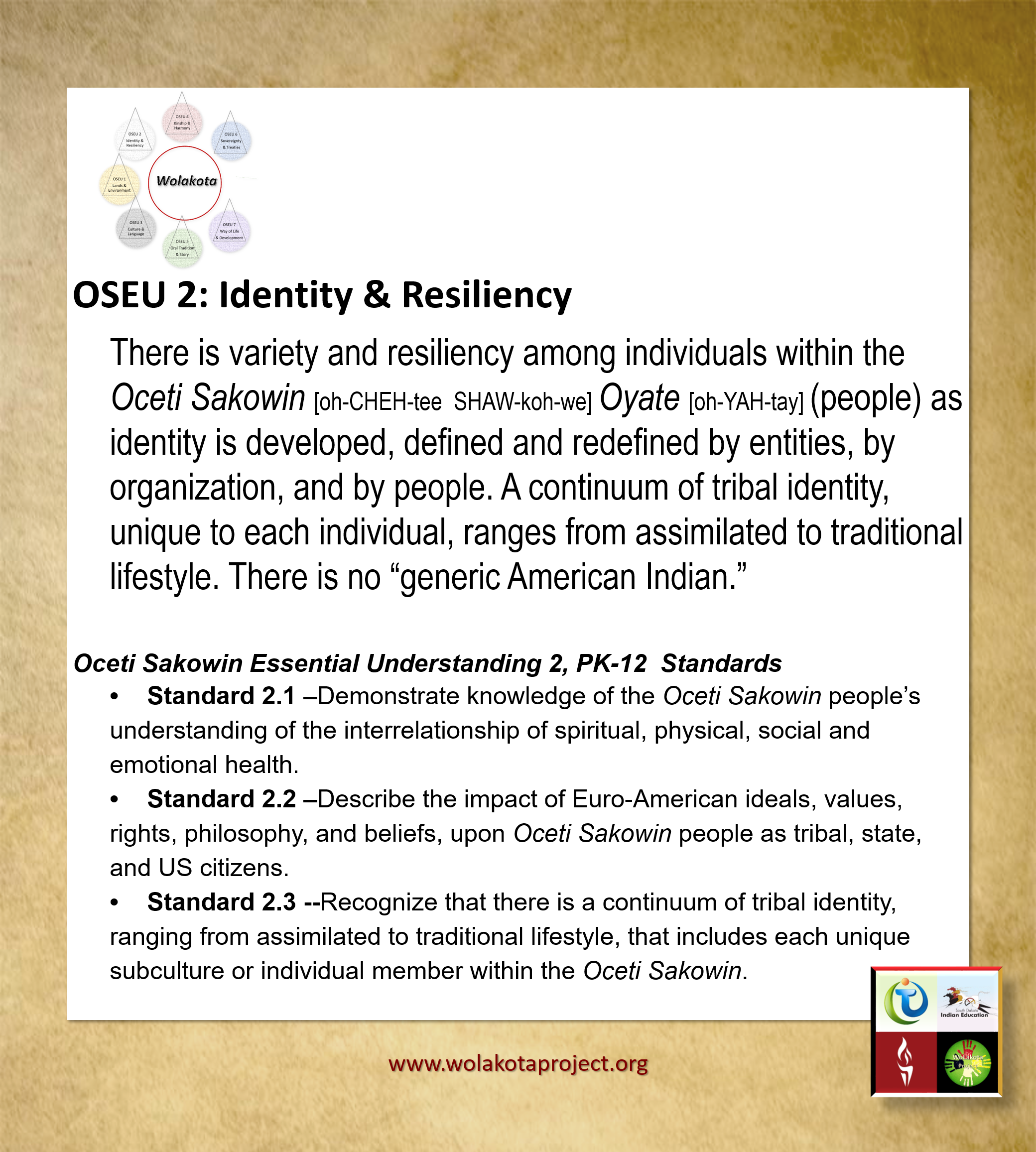
Oceti Sakowin Essential Understanding 2, PK-12 Standards
\ RE whee.) eke | yt" Yi S08 : > eo
‘4 Rote NW RS oF Keb kh
Me ta oe ; J . NL Ye a ae’
ip &
There is variety and resiliency among individuals within the
Oceti Sakowin {oh-CHEH-tee SHAW-koh-we] Oyate [oh-YAH-tay] (people) as
identity is developed, defined and redefined by entities, by
organization, and by people. A continuum of tribal identity,
unique to each individual, ranges from assimilated to traditional
lifestyle. There is no “generic American Indian.”
¢ Standard 2.1 —-Demonstrate knowledge of the Oceti Sakowin people’s
understanding of the interrelationship of spiritual, physical, social and
emotional health.
¢ Standard 2.2 —Describe the impact of Euro-American ideals, values,
rights, philosophy, and beliefs, upon Oceti Sakowin people as tribal, state,
and US citizens.
¢ Standard 2.3 --Recognize that there is a continuum of tribal identity,
ranging from assimilated to traditional lifestyle, that includes each unique
subculture or individual member within the Oceti Sakowin.
www.wolakotaproject.org
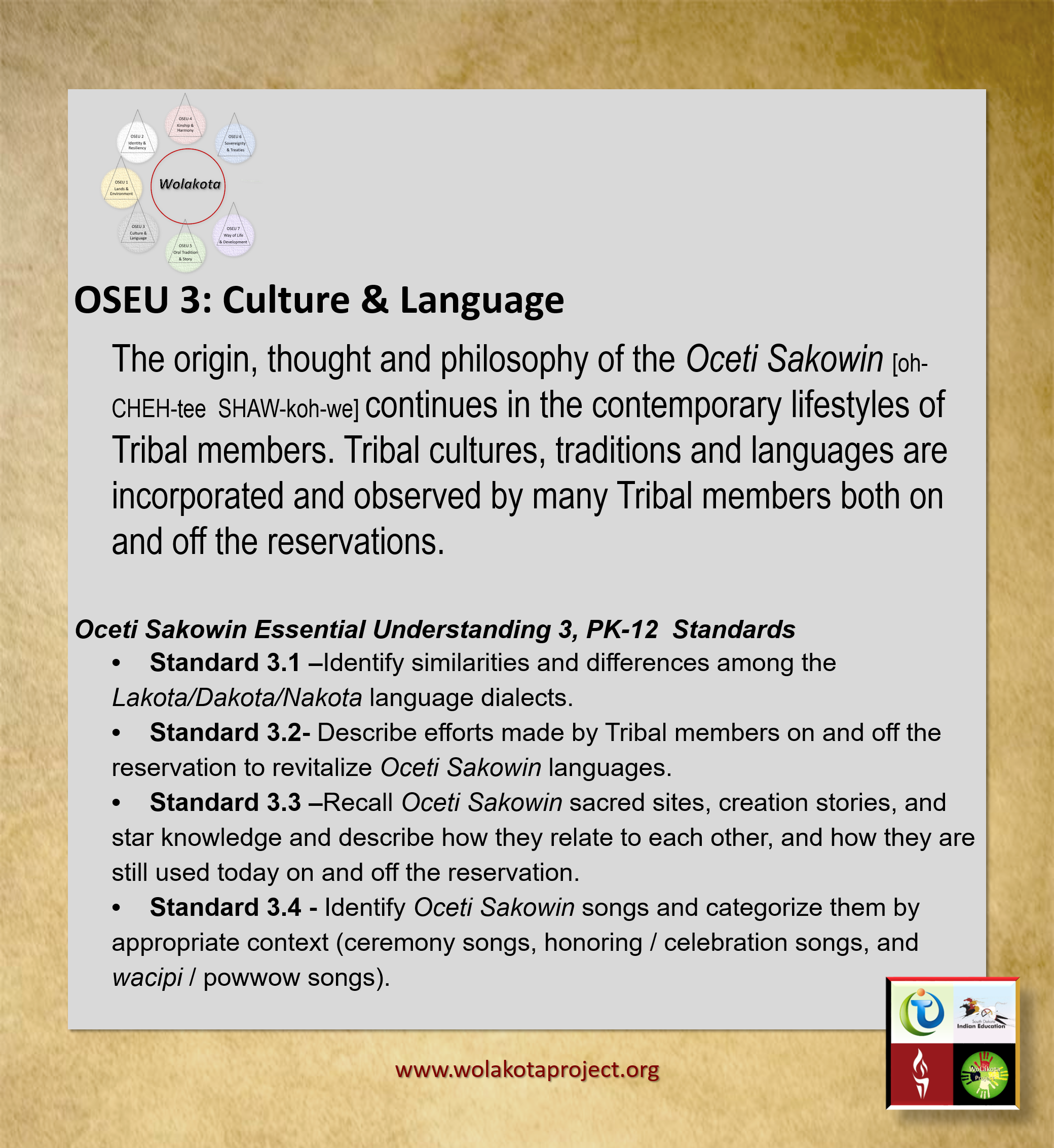
OSEU 3: Culture & Language
The origin, thought and philosophy of the Oceti Sakowin {ob-
CHEH-tee SHAW-koh-we] continues in the contemporary lifestyles of
Tribal members. Tribal cultures, traditions and languages are
incorporated and observed by many Tribal members both on
and off the reservations.
Oceti Sakowin Essential Understanding 3, PK-12 Standards
¢« Standard 3.1 —Identify similarities and differences among the
Lakota/Dakota/Nakota language dialects.
¢ Standard 3.2- Describe efforts made by Tribal members on and off the
reservation to revitalize Oceti Sakowin languages.
¢ Standard 3.3 —Recall Oceti Sakowin sacred sites, creation stories, and
star knowledge and describe how they relate to each other, and how they are
still used today on and off the reservation.
¢ Standard 3.4 - Identify Oceti Sakowin songs and categorize them by
appropriate context (ceremony songs, honoring / celebration songs, and
wacipi / powwow songs).
www.wolakotaproject.org
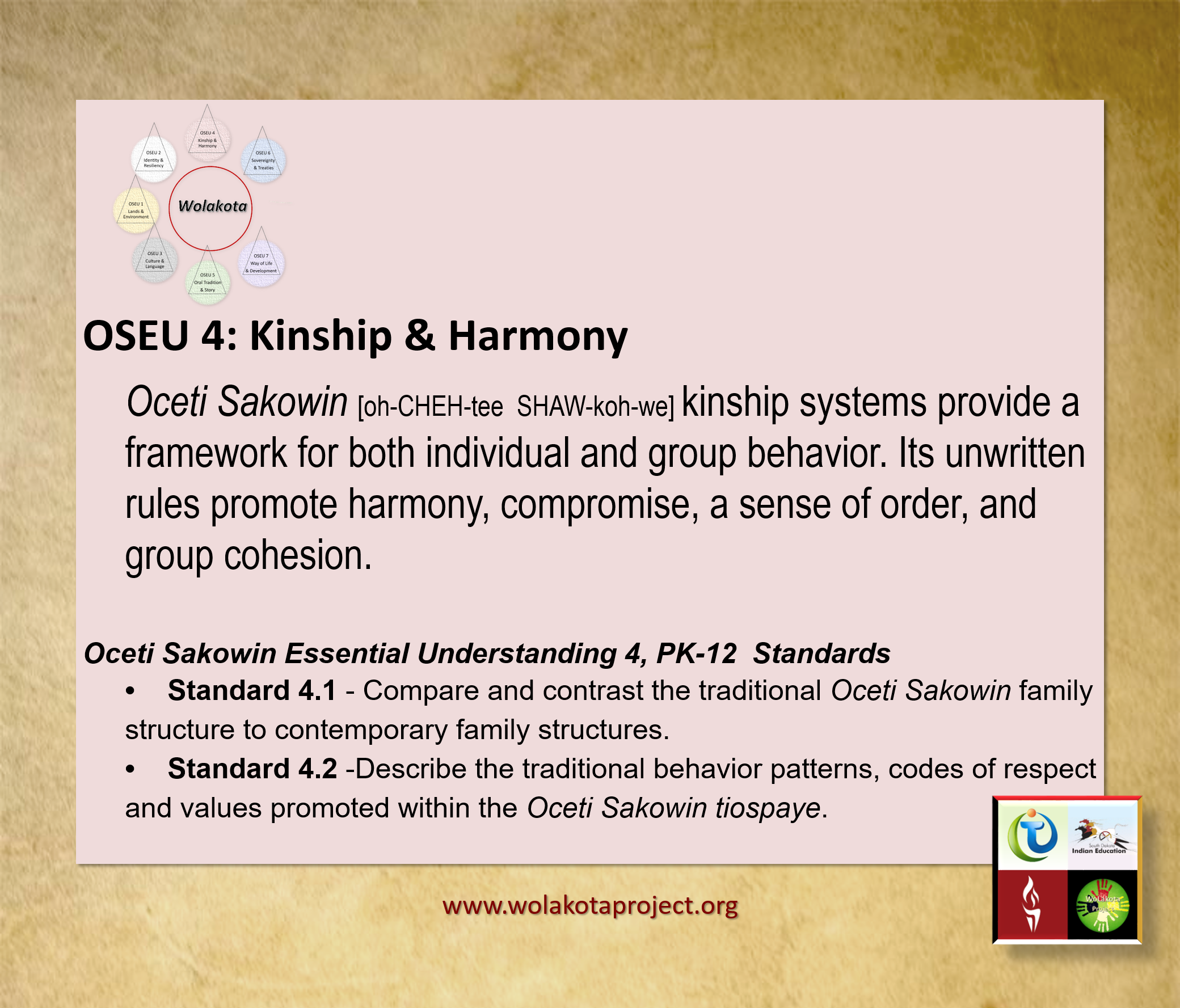
OSEU 4: Kinship & Harmony
Oceti Sakowin [oh-CHEH-tee SHAW-koh-we] Kinship systems provide a
framework for both individual and group behavior. Its unwritten
rules promote harmony, compromise, a sense of order, and
group cohesion.
Oceti Sakowin Essential Understanding 4, PK-12 Standards
e Standard 4.1 - Compare and contrast the traditional Oceti Sakowin family
structure to contemporary family structures.
e Standard 4.2 -Describe the traditional behavior patterns, codes of respect
and values promoted within the Oceti Sakowin tiospaye. ee) g- 9
www.wolakotaproject.org
Some indexed text was extracted from scanned material. Check the original source for exact wording and spelling.
Source materials
- the OSEU document here!
- Open source material
- Click Here to Complete the “Understanding the OSEU” Survey on OSEU 1
- Open source material
- Click Here to Complete the “Understanding the OSEU” Survey on OSEU 2
- Open source material
- Click Here to Complete the “Understanding the OSEU” Survey on OSEU 3
- Open source material
- Click Here to Complete the “Understanding the OSEU” Survey on OSEU 4
- the OSEU document
- OSEU Elder interview main pages
- Unit 2 Where and What are the WoLakota Project Elder Interviews… and How Do I Use Them?
- Watch Addressing OSEU 4 with Cheryl Medearis on YouTube
- Watch Addressing OSEU One with Cheryl Medearis on YouTube
- Watch Addressing OSEU Two with Cheryl Medearis on YouTube
- Watch Addressing OSEU 3 with Cheryl Medearis on YouTube
- Addressing OSEU 1 — original questions
- Addressing OSEU 2 — original questions
- Addressing OSEU 3 — original questions
- Addressing OSEU 4 — original questions
Supplied transcript document. Text preserved as supplied; spellings and transcription uncertainties have not been corrected.