Interview · South Dakota · Stephanie Charging Eagle · OSEU 5
Themes: Land & stewardship, Language & revitalization, Kinship & family, Storytelling & oral tradition, Education & learning, Values & generosity, Culture & continuity, Arts & expression, Economy & livelihoods, Listening & observation, Children & young people
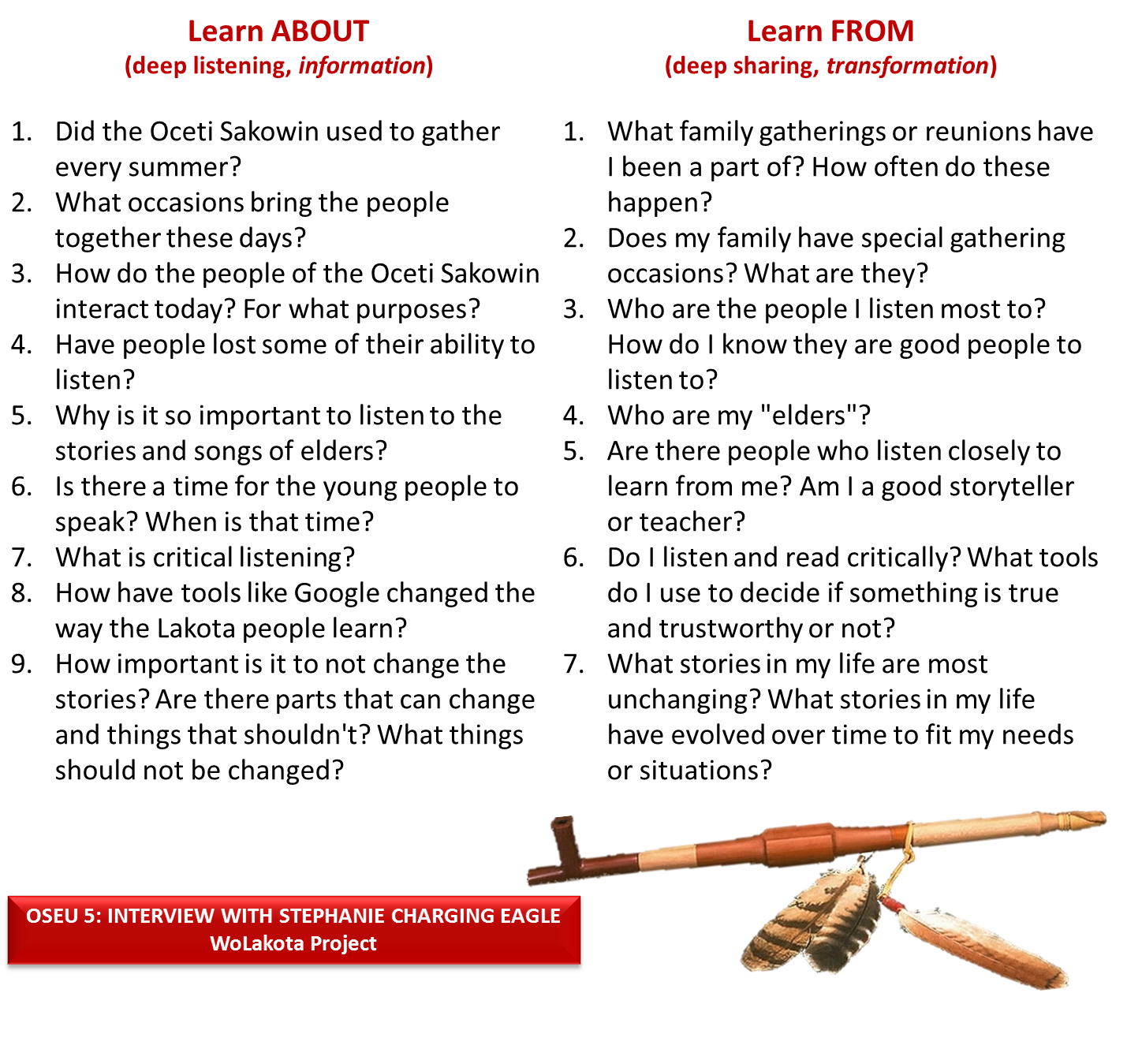
Learn About questions
Did the Oceti Sakowin used to gather every summer?
What occasions bring the people together these days?
How do the people of the Oceti Sakowin interact today? For what purposes?
Have people lost some of their ability to listen?
Why is it so important to listen to the stories and songs of elders?
Is there a time for the young people to speak? When is that time
What is critical listening?
How have tools like Google changed the way the Lakota people learn?
How important is it to not change the stories? Are there parts that can change and things that shouldn’t? What things should not be changed?
Learn From questions
What family gatherings or reunions have I been a part of? How often do these happen?
Does my family have special gathering occasions? What are they?
Who are the people I listen most to? Ho do I know they are good people to listen to?
Who are my “elders”?
Are there people who listen closely to learn from me? Am I a good storyteller or teacher?
Do I listen and read critically? What tools do I use to decide if something is true and trustworthy or not?
What stories in my life are most unchanging? What stories in my life have evolved over time to fit my needs or situations?
Transcripts
Being Able to Listen - Stephanie Charging Eagle - OSEU #5
Watch this interview on YouTubeOceti Sakowin is very much a dynamic group, and although we did not gather in the summertime for our annual gatherings, we still do, especially now with transportation, everything. We are able to gather in other places with families, but I would want my students to know that they are very much alive. The people on the Pine Ridge Reservation, the people on the Rosebud, Cheyenne River, they are all part of this Oceti Sakowin.
That would be the first objective of that understanding, is to know that Oceti Sakowin is not dead, that it's very much alive, just now in a different way. And so historically, the idea that Oceti Sakowin is this, it's not just a group, it's a whole sociological, cultural, political, economic group. And that we have ties to not just the land, but with each other. And that establishes a group of people who are very much alive.
And so that as a teacher, as an educator, that's what I hope, is that my students understand that these people over here from the Pine Ridge, the Oglalas, are related to these people from Minnesota, from Flandreau, Yankton. That they are all still related, even though they may not know each other, or know each other's language, they are still part of this group. Oath-telling was very important because you had to be able to... know cognitively what was important in that story, in what was being said.
So you had to listen.
And fortunately, we grew up in a time when we were told that if you're going to come to this gathering, you have to sit and listen. Next time, if you don't, next time you're staying home. That was it.
No argument.
There was no time out, nothing.
You stayed home. So if you were able to go to a gathering and you listened, you never talked while somebody was talking, but you listened. And what I was taught was that you always listen to a person when they're speaking, particularly if they're older than you, and they're in a position where they have respect, authority, whatever. If they're speaking, there is no way you should be talking or doing anything else. Your whole attention should be, the focus of your attention should be on what that person is saying.
The value of oral tradition, storytelling, language, whatever, is that you learn to listen, and you learn critically.
You listen critically, then later you ask questions, you research, or you Google it. But you know, oral tradition, I used to teach little kids language, taught them Lakota language, and I used stories a lot, the Iktomi stories, and I got really good.
The one thing I always had to remember is I could not change the story. I could pantomime along with it, or make all these weird sounds, sing if I have to, but with young children, I had the freedom to do that.
Nobody, they didn't say, they didn't get embarrassed for me or anything, and so I was able to do that. But as time went on, when they got into high school, the same story was told, they should be able to listen and say, hey, this storyteller changed some things.
They should be able to listen again critically to the story. Maybe it's more, it's entertaining still, but you still have to keep the important parts of the story in there. So there were some storytellers, just for that, they had that role.
Not everybody was a storyteller, but you still had to be able to listen, and if you're going to tell that story another time, make sure you get the story, the concept, everything of it, so that when you do tell it, it's accurate. And that's all part of that oral language, that oral tradition, is always listening and listening critically, and know what to do with the information that you receive.
Resource text
From the current WoLakota source page:
Being Able to Listen
Stephanie Charging Eagle
Transcript
(deep listening, information)
(deep listening, transformation)
Some indexed text was extracted from scanned material. Check the original source for exact wording and spelling.
Source materials
Supplied transcript document. Text preserved as supplied; spellings and transcription uncertainties have not been corrected.
Additional source transcripts
Being Able to Listen
Being Able to Listen - Stephanie Charging Eagle -
OSEU #5
Oceti Sakowin is very much a dynamic group, and although we did not gather in the
summertime for our annual gatherings, we still do, especially now with transportation,
everything. We are able to gather in other places with families, but I would want my
students to know that they are very much alive. The people on the Pine Ridge
Reservation, the people on the Rosebud, Cheyenne River, they are all part of this Oceti
Sakowin.
That would be the first objective of that understanding, is to know that Oceti Sakowin is
not dead, that it's very much alive, just now in a different way. And so historically, the
idea that Oceti Sakowin is this, it's not just a group, it's a whole sociological, cultural,
political, economic group. And that we have ties to not just the land, but with each other.
And that establishes a group of people who are very much alive.
And so that as a teacher, as an educator, that's what I hope, is that my students
understand that these people over here from the Pine Ridge, the Oglalas, are related to
these people from Minnesota, from Flandreau, Yankton. That they are all still related,
even though they may not know each other, or know each other's language, they are
still part of this group. Oath-telling was very important because you had to be able to...
know cognitively what was important in that story, in what was being said.
So you had to listen.
And fortunately, we grew up in a time when we were told that if you're going to come to
this gathering, you have to sit and listen. Next time, if you don't, next time you're staying
home. That was it.
No argument.
There was no time out, nothing.
You stayed home. So if you were able to go to a gathering and you listened, you never
talked while somebody was talking, but you listened. And what I was taught was that
you always listen to a person when they're speaking, particularly if they're older than
you, and they're in a position where they have respect, authority, whatever. If they're
speaking, there is no way you should be talking or doing anything else. Your whole
attention should be, the focus of your attention should be on what that person is saying.
The value of oral tradition, storytelling, language, whatever, is that you learn to listen,
and you learn critically.
You listen critically, then later you ask questions, you research, or you Google it. But you
know, oral tradition, I used to teach little kids language, taught them Lakota language,
and I used stories a lot, the Iktomi stories, and I got really good.
The one thing I always had to remember is I could not change the story. I could
pantomime along with it, or make all these weird sounds, sing if I have to, but with
young children, I had the freedom to do that.
Nobody, they didn't say, they didn't get embarrassed for me or anything, and so I was
able to do that. But as time went on, when they got into high school, the same story was
told, they should be able to listen and say, hey, this storyteller changed some things.
They should be able to listen again critically to the story. Maybe it's more, it's
entertaining still, but you still have to keep the important parts of the story in there. So
there were some storytellers, just for that, they had that role.
Not everybody was a storyteller, but you still had to be able to listen, and if you're going
to tell that story another time, make sure you get the story, the concept, everything of it,
so that when you do tell it, it's accurate. And that's all part of that oral language, that oral
tradition, is always listening and listening critically, and know what to do with the
information that you receive.