Interview · South Dakota · Sidney Byrd · OSEU 6
Themes: Land & stewardship, Kinship & family, Storytelling & oral tradition, Values & generosity, Food & plants, Economy & livelihoods, Listening & observation, Intergenerational learning
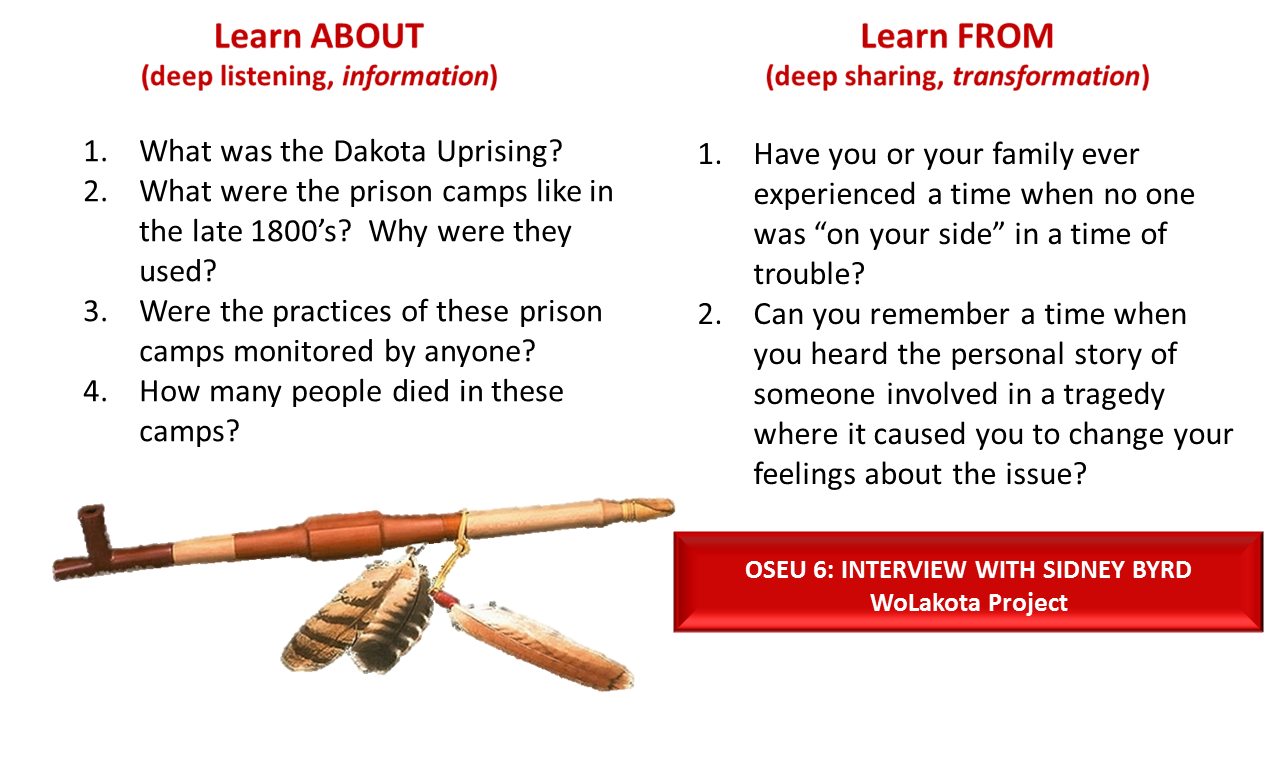
Learn About questions
What was the Dakota Uprising?
What were the prison camps like in the late 1800’s? Why were they used?
Were the practices of these prison camps monitored by anyone?
How many people died in these camps?
Learn From questions
Have you or your family ever experienced a time when no one was “on your side” in a time of trouble?
Can you remember a time when you heard the personal story of someone involved in a tragedy where it caused you to change your feelings about the issue?
Transcripts
The Dakota Uprising - Sidney Byrd - OSEU #6
Watch this interview on YouTubeHis father, my grandfather, great-grandfather, would have been one of those who was executed at Mankato. His Indian name was Wambalikiyan Hiyai, an eagle that flies along or flying by. He would have been executed, but he got a reprieve from Sergeant Lincoln, and he was sent to a prison camp in Davenport, Iowa. And what they fed them, slop, unfit for human consumption. No one cared. If they died, one less mouth to feed. Same thing. The other group was sent to Davenport, or to Fort Thompson. Came by steamship, and there was nothing there. Dismal place.
The soldiers raped the women, abused the young girls. No one, not a single one of those soldiers were ever brought to court martial for raping our women and abusing the young girls. None of them. Fed them slop. If they died, so much the better. Finally, one of them that had brought a rifle went out near what is now a town in South Dakota, found a small herd of buffalo, brought some meat back, and so they went on their last buffalo hunt, and they got meat, and they were able to sustain themselves. That group, many deaths, disease, no one cared.
Their hills were full of graves. Davenport the same way. My grandfather,
great-grandfather, told what happened. He said, soldiers went out, some of the farmers would bring, have the prisoners come out and do farm work. They enjoyed that because the farmers fed them good food. They got a good meal. They didn't get any money, but they ate good food, and that was worth it for them. for, Daniel Weston. That's where we got the name Weston. He told one of the soldiers could speak a few words in Indian.
He took the dipper and he banged it against the water pail. Money, money, money, water, water. Indians came, took that bucket and brought water. He took that dipper. Good, very good, very good. What he didn't know was that the Indians urinated in that water. That was the only way they could retaliate. Very good, very good. Finally, the two groups, after so many deaths and embarrassed Congress, decided to relocate them again. So the two groups were brought to a new reservation at Santee, Nebraska.
While they were bringing through New Ellum, one of the places that they had been attacked during the uprising, townspeople armed themselves, pickaxes, pitchforks, any kind of weapon. They attacked that wagon train, all the prisoners. One woman was so incensed, grabbed the baby from its nurse, his mother, bashed its head against the wheel and threw it back in. At that point, finally the soldiers, the militia, opened up. But not before many of them were injured, fatally injured, brought through.
Resource text
Additional Resources:
Elder Vernon Ashley’s interview on the Dakota Uprising
Visit the Dakota Prisoners of War page sponsored by the Minnesota Historical Society
Listen to the Minnesota Public Radio report on the work of translating the Dakota Prisoner of War letters
Explore the translation of this letter:
OSEU 6: INTERVIEW WITH SIDNEY BYRD
WoLakota Project
From the current WoLakota source page:
The Dakota Uprising
Sidney Byrd
Transcript
(deep listening, information)
(deep listening, information)
Some indexed text was extracted from scanned material. Check the original source for exact wording and spelling.
Source materials
- Open source material
- Elder Vernon Ashley’s interview on the Dakota Uprising
- Visit the Dakota Prisoners of War page sponsored by the Minnesota Historical Society
- Listen to the Minnesota Public Radio report on the work of translating the Dakota Prisoner of War letters
- Watch The Dakota Uprising - Sidney Byrd - OSEU #6 on YouTube
- Current WoLakota source page
- Transcript
Supplied transcript document. Text preserved as supplied; spellings and transcription uncertainties have not been corrected.
Additional source transcripts
The Dakota Uprising
The Dakota Uprising - Sidney Byrd - OSEU #6
His father, my grandfather, great-grandfather, would have been one of those who was executed at Mankato. His Indian name was Wambalikiyan Hiyai, an eagle that flies along or flying by. He would have been executed, but he got a reprieve from Sergeant Lincoln, and he was sent to a prison camp in Davenport, Iowa. And what they fed them, slop, unfit for human consumption. No one cared. If they died, one less mouth to feed. Same thing. The other group was sent to Davenport, or to Fort Thompson. Came by steamship, and there was nothing there. Dismal place.
The soldiers raped the women, abused the young girls. No one, not a single one of those soldiers were ever brought to court martial for raping our women and abusing the young girls. None of them. Fed them slop. If they died, so much the better. Finally, one of them that had brought a rifle went out near what is now a town in South Dakota, found a small herd of buffalo, brought some meat back, and so they went on their last buffalo hunt, and they got meat, and they were able to sustain themselves. That group, many deaths, disease, no one cared.
Their hills were full of graves. Davenport the same way. My grandfather, great-grandfather, told what happened. He said, soldiers went out, some of the farmers would bring, have the prisoners come out and do farm work. They enjoyed that because the farmers fed them good food. They got a good meal. They didn't get any money, but they ate good food, and that was worth it for them. for, Daniel Weston. That's where we got the name Weston. He told one of the soldiers could speak a few words in Indian.
He took the dipper and he banged it against the water pail. Money, money, money, water, water. Indians came, took that bucket and brought water. He took that dipper. Good, very good, very good. What he didn't know was that the Indians urinated in that water. That was the only way they could retaliate. Very good, very good. Finally, the two groups, after so many deaths and embarrassed Congress, decided to relocate them again. So the two groups were brought to a new reservation at Shanti, Nebraska.
While they were bringing through New Ellum, one of the places that they had been attacked during the uprising, townspeople armed themselves, pickaxes, pitchforks, any kind of weapon. They attacked that wagon train, all the prisoners. One woman was so incensed, grabbed the baby from its nurse, his mother, bashed its head against the wheel and threw it back in. At that point, finally the soldiers, the militia, opened up. But not before many of them were injured, fatally injured, brought through.