Resource · South Dakota · OSEU 3
Themes: Land & stewardship, Language & revitalization, Kinship & family, Identity & belonging, Storytelling & oral tradition, Education & learning, Healing & resilience, Spirituality & ceremony, Values & generosity, Culture & continuity, Food & plants, Arts & expression, Community & responsibility, Economy & livelihoods, Listening & observation, Children & young people, Intergenerational learning
Resource text
Learning Question Pages for classroom use:
Click on each title below to find interviews accompanied by “Learn About” and “Learn From” questions for use in classrooms, in small groups or for deeper personal exploration of each video.
Not all videos are accompanied by questions.
Wakatakiya Ahhintuwan Olowan: Song & Translation by Earl Bullhead
Lakota Language Study in South Dakota with Lowell Amiotte
The Army Language Censor with Sidney Byrd
Birth Story with Sidney Byrd
Life and Giving Thanks with Sidney Byrd
David Bald Eagle and the Loss of Identity, Values & Language
Kinship Terms with Stephanie Charging Eagle
Lakota Economics with Stephanie Charging Eagle
Second Language Learners with Stephanie Charging Eagle
Language & Identity with Jace DeCory
Relatives Teaching with Jace DeCory
Our Four Values with Victor Douville
NEW!
Without Grandma & Grandpa with April Fallis
Respect, Dancing & Pow Wows with April Fallis
Lakota New Year with Ricky Gray Grass
NEW!
Language & Culture Loss with Gladys Hawk
Dakota Language Revitalization with Drs. Johnson & Eastman
Learning Crafts from Grandmother with Pearl Kennedy-Colombe
Lakota, Dakota, Nakota Crafts with Pearl Kennedy-Colombe
The Gifts of Language & Heritage with Kevin Locke
Folk Arts with Kevin Locke
Lakota Every Day with Joseph Marshall III
The Musicality of the Lakota Language Donald Montileaux
A Place of Healing Within with Whitney Rencountre
A Language Nest with Faith Spotted Eagle
The Loss of Language with Eli Tail Sr.
NEW!
Parents, Grandparents & Education with Delores Taken Alive
Teaching Today’s Students with Delores Taken Alive
Story of Audrey (in Lakota and English) with Delores Taken Alive
Teaching Lakota Language with Delores Taken Alive
Living the Lakota Prophecy with Jesse Taken Alive
Lakota Language with Jesse Taken Alive
“Wolakota” with Jesse Taken Alive
Language Loss with Lydia Whirlwind Soldier
NEW!
Recording Elders to Save the Language with Janelle Williams
Oceti Sakowin
Essential Understanding 3 Extended Description
Oceti Sakowin
origin, thought and philosophy continues to be vibrant, strong and taught to the younger generation today. It is an abstract perspective of living in harmony with creation.
Oceti Sakowin
philosophy is embedded in the
Oceti Sakowin
language, in the origin stories, in the values and ethics, in the kinship system and social relationships, in the relationship with the environment and with all living things. It is a way of teaching the values of respect, honor, responsibility, positive family and personal relationships, humility, reciprocity, sharing and much more. This is a way of thinking about creation, the universe and the people.
The relationships among the people, the Creator, Mother Earth, and all of nature was, (and still is) significant in the lives of Native peoples. The
Oceti Sakowin Oyate
believe that all things are part of the great whole. As such, plants and animals become our relatives. Respect for plants and animals was, (and still is) shown by thanking the spirits of these elements for the gifts of themselves, which provide for the physical needs of the
Oyate
. The
Oceti Sakowin Oyate
hunted and gathered plants and animals for food and clothing, only when necessary. Nothing was wasted, as this would be disrespectful of the gifts given to sustain life. (Eastman, 1976; Standing Bear, 1975) (D.LeBeau 2012) “Only take from the land what it is willing to give.” Never take more and always give back in some way. Most indigenous people know and understand this concept.
Traditionally,
Oceti Sakowin
people express their traditions and reinforce this tightly woven relationship with the world through teachings, examples, ceremonies and prayers. It is integrated into ideas, experiences, wisdom, traditions, language and customs. This existential relationship with the environment has evolved through direct experience and contact through centuries of interaction with ecosystems and the environment at large.
In
Oceti Sakowin
cosmology, “everything in the natural world has relationships with every other thing and the total set of relationships makes up the natural world as we experience it” (Deloria, 1992). For that reason, the prayer–
Mitakuye Oyasin
—meaning “All my relatives.” We are all related and not only are we related, we are closely linked in a symbiotic relationship. This familial circle of life ties the
Oceti Sakowin
to all life forms– everything above, everything below, everything between. (V. Douville, 2010) (D.LeBeau 2012) To teach and understand that creatures, man, animals, birds, insects, reptiles, plants, water, and air are integral to the survival of the people and earth as we know it is the heart of the culture.
Mitakuye Oyasin
reflects the physical, mental, spiritual, emotional and intuitive relationship that the
Oceti Sakowin
has with all aspects and elements of the environment.
There is a clear distinction between spirituality and structured religion. Spirituality is an experience that is lived on a daily basis. There is no word for religion in the
Lakota, Dakota
, or
Nakota
language. It is “doing it in a good way, with dignity, integrity and honor, and with honesty.” (Ida Hildebrand)
In understanding
Oceti Sakowin
perspective we must teach all children to better understand, respect and honor the environment, natural resources and to work in collaboration, cooperation and to develop a partnership to preserve that which will sustain the coming generations. Acknowledgement and acceptance that there is wisdom in the traditional knowledge and teachings of indigenous people will teach children stronger and more comprehensive environment practices that could very well ensure their future. This is an opportunity to recognize similarities while honoring and respecting the differences in cultures, traditions and beliefs. (L. Whirlwind Soldier 2012)
S
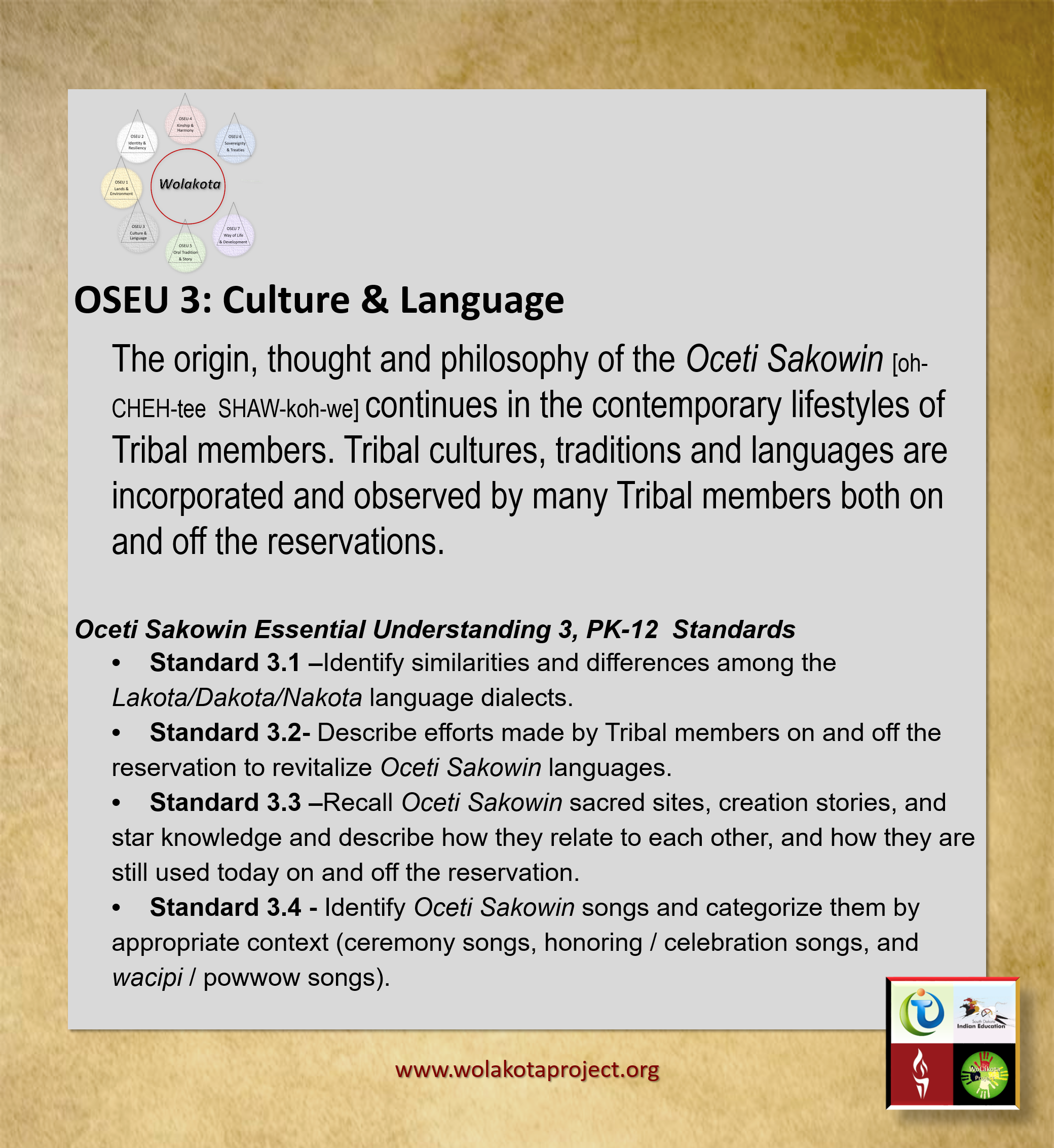
OSEU 3: Culture & Language
The origin, thought and philosophy of the Oceti Sakowin {on-
CHEH-tee shaw-KOH-we] Continues in the contemporary lifestyles of
Tribal members. Tribal cultures, traditions and languages are
incorporated and observed by many Tribal members both on
and off the reservations.
Oceti Sakowin Essential Understanding 3, PK-12 Standards
* Standard 3.1 —Identify similarities and differences among the
Lakota/Dakota/Nakota language dialects.
* Standard 3.2- Describe efforts made by Tribal members on and off the
reservation to revitalize Oceti Sakowin languages.
¢ Standard 3.3 —Recall Oceti Sakowin sacred sites, creation stories, and
star knowledge and describe how they relate to each other, and how they are
still used today on and off the reservation. |
* Standard 3.4 - Identify Oceti Sakowin songs and categorize them by
appropriate context (ceremony songs, honoring / celebration songs, and
wacipi / powwow songs).
www.wolakotaproject.org
Some indexed text was extracted from scanned material. Check the original source for exact wording and spelling.
Source materials
- Open source material
- Wakatakiya Ahhintuwan Olowan: Song & Translation by Earl Bullhead
- Lakota Language Study in South Dakota with Lowell Amiotte
- The Army Language Censor with Sidney Byrd
- Birth Story with Sidney Byrd
- Life and Giving Thanks with Sidney Byrd
- Open source material
- David Bald Eagle and the Loss of Identity, Values & Language
- Kinship Terms with Stephanie Charging Eagle
- Lakota Economics with Stephanie Charging Eagle
- Second Language Learners with Stephanie Charging Eagle
- Open source material
- Language & Identity with Jace DeCory
- Relatives Teaching with Jace DeCory
- Open source material
- Our Four Values with Victor Douville
- Without Grandma & Grandpa with April Fallis
- Respect, Dancing & Pow Wows with April Fallis
- Open source material
- Lakota New Year with Ricky Gray Grass
- Language & Culture Loss with Gladys Hawk
- Open source material
- Dakota Language Revitalization with Drs. Johnson & Eastman
- Open source material
- Learning Crafts from Grandmother with Pearl Kennedy-Colombe
- Lakota, Dakota, Nakota Crafts with Pearl Kennedy-Colombe
- Open source material
- The Gifts of Language & Heritage with Kevin Locke
- Folk Arts with Kevin Locke
- Lakota Every Day with Joseph Marshall III
- Open source material
- The Musicality of the Lakota Language Donald Montileaux
- A Place of Healing Within with Whitney Rencountre
- A Language Nest with Faith Spotted Eagle
- Open source material
- The Loss of Language with Eli Tail Sr.
- Parents, Grandparents & Education with Delores Taken Alive
- Teaching Today’s Students with Delores Taken Alive
- Story of Audrey (in Lakota and English) with Delores Taken Alive
- Teaching Lakota Language with Delores Taken Alive
- Living the Lakota Prophecy with Jesse Taken Alive
- Lakota Language with Jesse Taken Alive
- “Wolakota” with Jesse Taken Alive
- Open source material
- Language Loss with Lydia Whirlwind Soldier
- Recording Elders to Save the Language with Janelle Williams