Interview · South Dakota · Donald Montileaux · OSEU 7
Themes: Land & stewardship, Kinship & family, Storytelling & oral tradition, Education & learning, Values & generosity, Culture & continuity, Arts & expression, Listening & observation, Children & young people, Humor & play
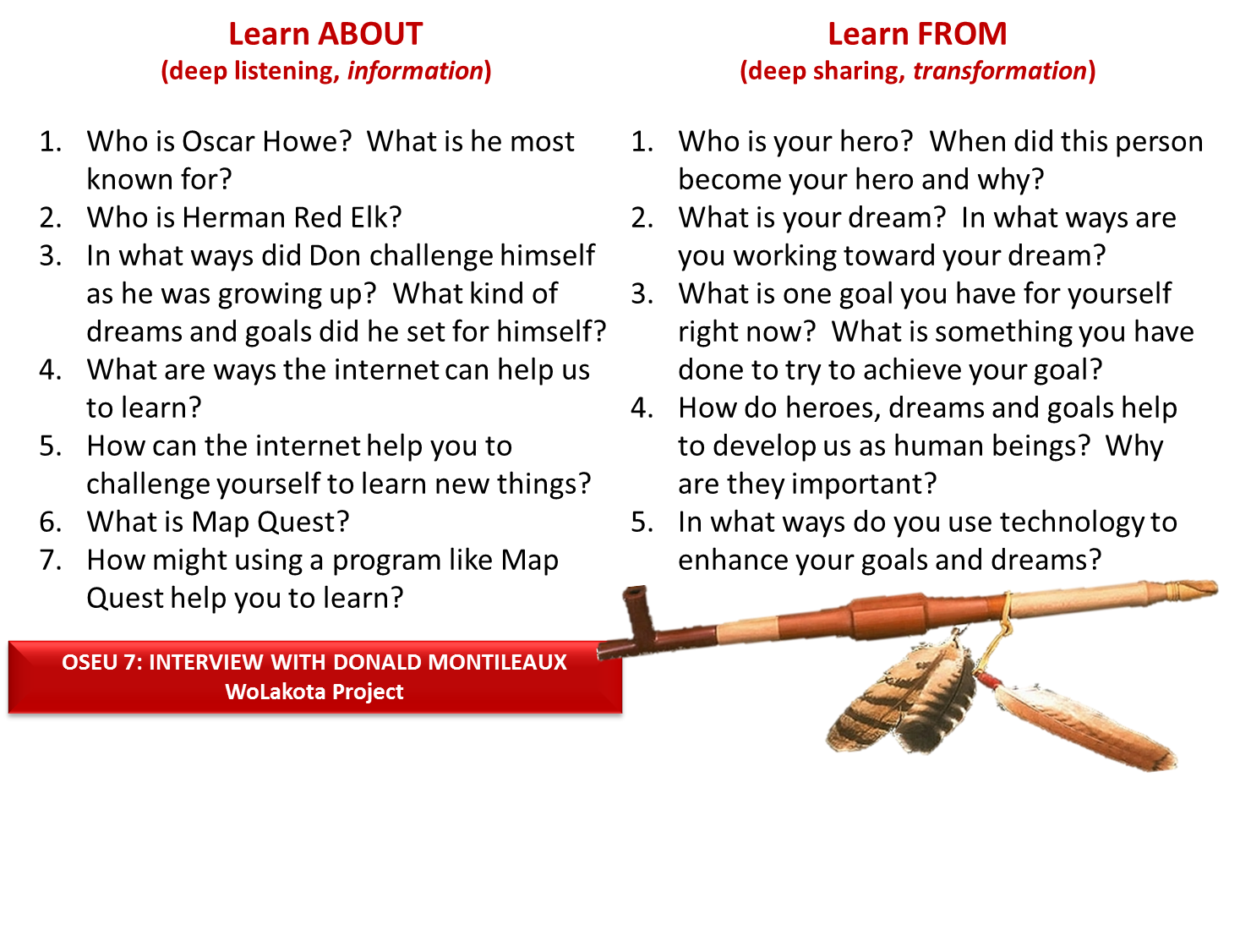
Learn About questions
What are ways the internet can help us
to learn?
How can the internet help you to challenge yourself to learn new things?
What is Map Quest?
How might using a program like Map Quest help you to learn?
Learn From questions
In what ways do you use technology to
enhance your goals and dreams?
Transcripts
Heroes & Technology with Donald Montileaux pt 2 - OSEU 7
Watch this interview on YouTubeThere's opportunities that exist now that we never had when I was young, you know, like I'm 67 years old. But I think, like, the internet, you know, and, like, the computers, and there's, you don't have to be stagnant, you don't have to be isolated, because with those tools that you have, you can be worldwide. I mean, I got a website that's worldwide, you know, and I didn't. It's not because I did it, it's because the technology that's available out there did it.
You know, so use it, utilize it, you know, you can go to your schools and get on it, you know. Don't just play the games, don't sit there and play games, challenge yourself to do something on it, you know, look at things. I travel the world, because I have MapQuest. I went to Rome last night, I was in Rome, you know, I've been on the street, because the technology's there to do it. And you can look around, you can say, wow, look at this. I mean, you can't see it or smell it, but you can see everything there.
I went to the Coliseum, and I stood in the middle of it, and went around it, you know. And I learned how to hook it up to my big screen TV, so I even have a better thing, you know. But those are things that's available now that we didn't have then. And the other thing that's available now is your own people, your own tribal people are sitting in there with you. Utilize them. Turn to that grandma, that grandpa, uncle, whatever, auntie, and speak Lakota. Talk to them. And they have a wealth of information that they can give you. It's not all in the book.
Some of it's just sitting on the prairie out there with them. So that's where I'm at.
Heroes & Technology - Donald Montileaux pt 1 OSEU #7
Watch this interview on YouTubeWhen I left the reservation, it was probably like in the 50s, you know, like 52, 53, 1952, 1953. When you're young, you never see anything. I never knew we were really poor. You know, I just thought, well, we don't have any bread today. You know, no big deal. But I guess we were. You know, as I look back, I know that we were poor and we had a hard time living and stuff like that. But with my education and when I came back, I wanted to be a teacher. I always wanted to be an art teacher. And I always had this one guy that I really admired.
His name was Oscar Howe. He was my hero. He was an art teacher at the University of South Dakota, professor. He had a family, which was really cool. I wanted to have a family. He lived in a real fine house. And he also was an artist. And that was my main thing. And Oscar, he portrayed everything I wanted to be. So he was my hero. And Herman Red Oak, he was my hero, too, because he had all these stories inside of him and everything attached. So I learned those things. I learned it really well. Now I go back to the reservation.
I circle back through organizations that sponsor me and they give me the opportunity to go down and do workshops and classes. And I challenge those kids that are down there just as much as I got challenged up here in high school to be better at what I try to be, to have a dream, to have a goal in life, and to do anything. I tell them, hey, I'm no different than you. I came from Kyle, South Dakota. When I left Kyle, there were probably 150 people. So my family left, so that meant there were 147. But today, there's quite a few more.
But the dream I always had was to be an artist, to be an art teacher, to have a family. And the other dream I always had when I was up here in Rapid City was every time we'd live down by the creek. And we'd go on Halloween and we'd go up to West Boulevard and we'd trick our treat. And we had good candy up there. Man, we'd come back, we'd have candy for weeks. Well, the other goal I had is I was going to live in Rapid City on West Boulevard. And I live in Rapid City on West Boulevard. You know, challenge yourself.
I challenge myself every day to do something better and bigger. But I take that dream and that philosophy down to the reservations, not only on Pine Ridge, but area reservations. And I challenge those people. And I don't care how old they are. I don't care if they're 40 or 50. They still have that desire to be something else. You can walk out, but you're going to be scared as hell, too, because you're leaving an environment that you're comfortable in. You got to leave that environment. But take that culture with you.
Take that dream and take it with you when you go. Don't let it go away. And that's what I live on. I live on that dream. I challenge myself. I dream big. And so far, I'm doing all right.
Resource text
OSEU 7: INTERVIEW WITH DONALD MONTILEAUX
WoLakota Project
From the current WoLakota source page:
Heroes & Technology Part 1
Donald Montileaux
Transcript
(deep listening, information)
(deep listening, transformation)
From the current WoLakota source page:
Heroes & Technology Part 2
Donald Montileaux
Transcript
(deep listening, information)
(deep listening, transformation)
Some indexed text was extracted from scanned material. Check the original source for exact wording and spelling.
Source materials
Supplied transcript document. Text preserved as supplied; spellings and transcription uncertainties have not been corrected.
Additional source transcripts
Heroes & Technology Part 1
Heroes & Technology - Donald Montileaux pt 1 OSEU
#7
When I left the reservation, it was probably like in the 50s, you know, like 52, 53, 1952,
1953. When you're young, you never see anything. I never knew we were really poor.
You know, I just thought, well, we don't have any bread today. You know, no big deal.
But I guess we were. You know, as I look back, I know that we were poor and we had a
hard time living and stuff like that. But with my education and when I came back, I
wanted to be a teacher. I always wanted to be an art teacher. And I always had this one
guy that I really admired.
His name was Oscar Howe. He was my hero. He was an art teacher at the University of
South Dakota, professor. He had a family, which was really cool. I wanted to have a
family. He lived in a real fine house. And he also was an artist. And that was my main
thing. And Oscar, he portrayed everything I wanted to be. So he was my hero. And
Herman Red Oak, he was my hero, too, because he had all these stories inside of him
and everything attached. So I learned those things. I learned it really well. Now I go
back to the reservation.
I circle back through organizations that sponsor me and they give me the opportunity to
go down and do workshops and classes. And I challenge those kids that are down there
just as much as I got challenged up here in high school to be better at what I try to be,
to have a dream, to have a goal in life, and to do anything. I tell them, hey, I'm no
different than you. I came from Kyle, South Dakota. When I left Kyle, there were
probably 150 people. So my family left, so that meant there were 147. But today, there's
quite a few more.
But the dream I always had was to be an artist, to be an art teacher, to have a family.
And the other dream I always had when I was up here in Rapid City was every time
we'd live down by the creek. And we'd go on Halloween and we'd go up to West
Boulevard and we'd trick our treat. And we had good candy up there. Man, we'd come
back, we'd have candy for weeks. Well, the other goal I had is I was going to live in
Rapid City on West Boulevard. And I live in Rapid City on West Boulevard. You know,
challenge yourself.
I challenge myself every day to do something better and bigger. But I take that dream
and that philosophy down to the reservations, not only on Pine Ridge, but area
reservations. And I challenge those people. And I don't care how old they are. I don't
care if they're 40 or 50. They still have that desire to be something else. You can walk
out, but you're going to be scared as hell, too, because you're leaving an environment
that you're comfortable in. You got to leave that environment. But take that culture with
you.
Take that dream and take it with you when you go. Don't let it go away. And that's what I
live on. I live on that dream. I challenge myself. I dream big. And so far, I'm doing all
right.
Heroes & Technology Part 2
Heroes & Technology with Donald Montileaux pt 2 -
OSEU 7
There's opportunities that exist now that we never had when I was young, you know, like
I'm 67 years old. But I think, like, the internet, you know, and, like, the computers, and
there's, you don't have to be stagnant, you don't have to be isolated, because with those
tools that you have, you can be worldwide. I mean, I got a website that's worldwide, you
know, and I didn't. It's not because I did it, it's because the technology that's available
out there did it.
You know, so use it, utilize it, you know, you can go to your schools and get on it, you
know. Don't just play the games, don't sit there and play games, challenge yourself to
do something on it, you know, look at things. I travel the world, because I have
MapQuest. I went to Rome last night, I was in Rome, you know, I've been on the street,
because the technology's there to do it. And you can look around, you can say, wow,
look at this. I mean, you can't see it or smell it, but you can see everything there.
I went to the Coliseum, and I stood in the middle of it, and went around it, you know.
And I learned how to hook it up to my big screen TV, so I even have a better thing, you
know. But those are things that's available now that we didn't have then. And the other
thing that's available now is your own people, your own tribal people are sitting in there
with you. Utilize them. Turn to that grandma, that grandpa, uncle, whatever, auntie, and
speak Lakota. Talk to them. And they have a wealth of information that they can give
you. It's not all in the book.
Some of it's just sitting on the prairie out there with them. So that's where I'm at.