Interview · South Dakota · Irene Eagle Thunder-Skunk · OSEU 7
Themes: Land & stewardship, Kinship & family, Storytelling & oral tradition, Values & generosity, Food & plants, Economy & livelihoods, Listening & observation, Children & young people, Humor & play
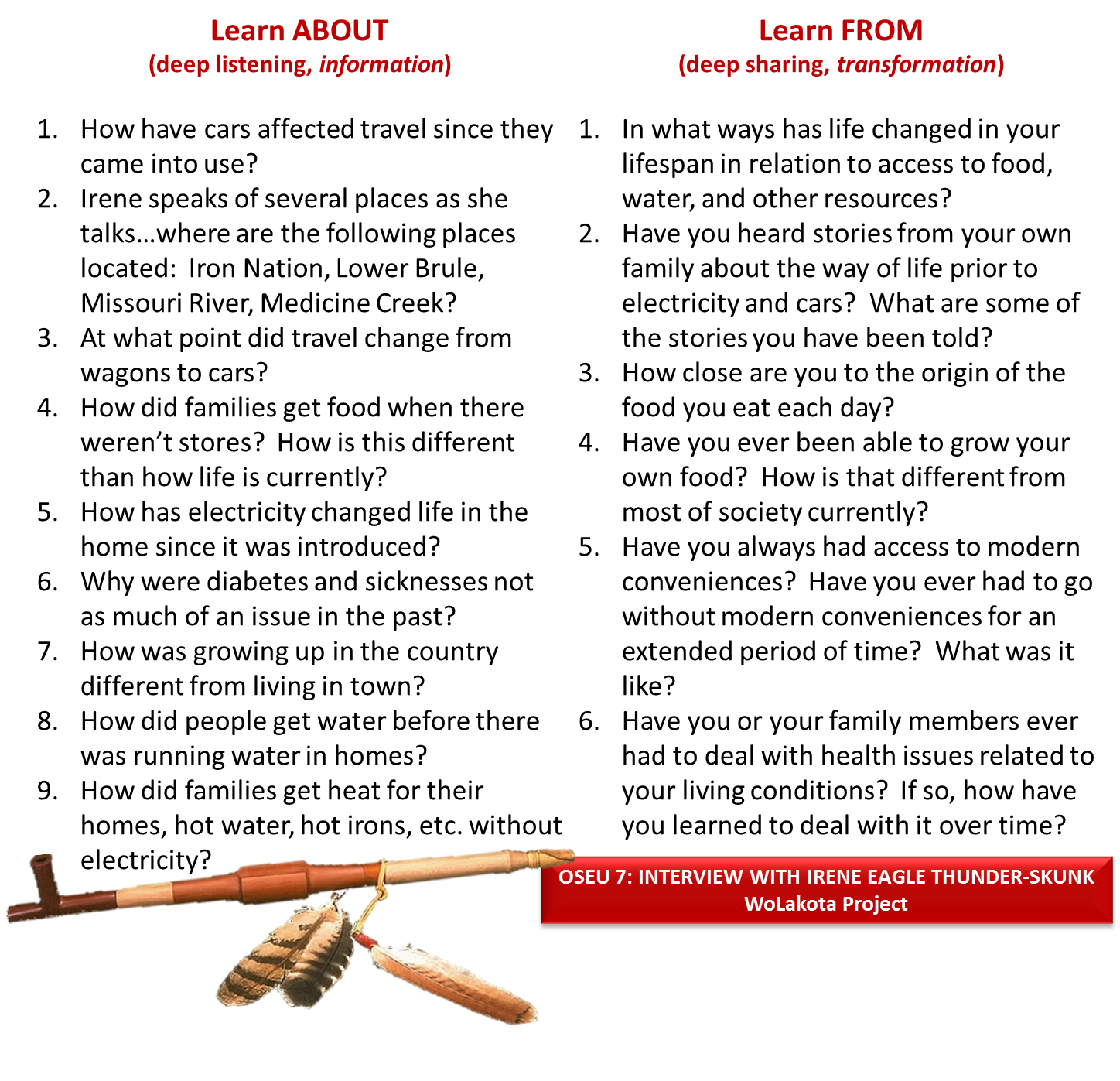
Learn About questions
How have cars affected travel since they
came into use?
Irene speaks of several places as she talks…where are the following places located: Iron Nation, Lower Brule, Missouri River, Medicine Creek?
At what point did travel change from wagons to cars?’
How did families get food when there weren’t stores? How is this different than how life is currently?
How has electricity changed life in the home since it was introduced?
Why were diabetes and sicknesses not as much of an issue in the past?
How was growing up in the country different from living in town?
How did people get water before there was running water in homes
How did families get heat for their homes, hot water, hot irons, etc. without electricity?
Learn From questions
In what ways has life changed in your
lifespan in relation to access to food,
water, and other resources?
Have you heard stories from your own family about the way of life prior to electricity and cars? What are some of the stories you have been told?
How close are you to the origin of the food you eat each day?
Have you ever been able to grow your own food? How is that different from most of society currently?
Have you always had access to modern conveniences? Have you ever had to go without modern conveniences for an extended period of time? What was it like?
Have you or your family members ever had to deal with health issues related to your living conditions? If so, how have you learned to deal with it over time?
Transcripts
Modern Conveniences - Irene Eagle Thunder-Skunk - OSEU 7
Watch this interview on YouTubeBut when we were, you know, when we were kids, now people, I've been saying that when my kids come back from college, I was telling them, my grandkids, I said, now when people want to go someplace, they have a brand new car and they have cash cards and everything, they jump in there and they go wherever they want to go.
Back in the days, we have to travel from our nation to Lord Blue. In the wintertime, in that wagon, our mom and dad and grandma and grandpa and us kids, and I said, we didn't, back in the days, there was no, everything was home cooked at home.
We had cows and chickens and like that, you know, so we have our own milk and stuff.
And our mom, my grandma, bakes bread and then we always have oatmeal and cornmeal, no such a thing as eggs or toast. We didn't have a refrigerator, we didn't have any lights, but we used the lantern.
But then I'll say, maybe it's the home cooked food that we had when we were kids.
Or my grandma wasn't diabetic, grandpa wasn't, my mom wasn't, our dad, none of us.
And then we live way out there and no doctors or nurses go over there. We're just practically on our own. But I could think back, none of us ever got sick where they had to rush us to the hospital or anything. Just once in a great while, we would come to Lord Blue to get usually all those aspirins and cough syrup.
But other than that, we always tell my kids, we don't, maybe it's this white man's food that's causing this diabetes and whatever.
All that sugar?
Yeah.
And no candy.
Like some people, they would, oh, you got any money? I gotta go to the store and buy pop and chips.
No such a thing. Once a month, we get, but back in the day, everything was cheap. Now it's too, everything's too expensive because they always give us 25 cents.
And pop, pop or juice was 25 cents.
And a sucker was 25 cents. A little tiny bag of popcorn was 25 cents. And a package of bubble gum was 25 cents. And a candy bar. All we needed, they gave us 25 cents.
And now you have to have 20, $30 to go to the store and buy pizza and sandwiches and all that stuff.
We didn't have anything like that in our days. We grew up,... I was about nine, 10 years old. And then we moved down to Lord Blue and it was sad.
When I go, when we drive towards Pierre and go to Cut-A-Cross Road, pass Madison Creek, there's houses still there.
That's where, that was all grandma's and mom's land. And she went and sold them. We moved down here. And Leola Peterson, she was a shaper. There was no dam then, so there was a creek.
And they live across the creek.
We lived around that side. So we go in the water and then go over there and then I play around with Leola. And then I practically grew up with her. We're about the same age. We go horseback, we chase them around, chase them.
Their dad always says, well, you gotta get help, Leola, help your brothers.
And we run around and chase the horses and then we catch them, we ride them, take the cows out to a different place. At night too, we come back, we have to close all the gates for him and make sure the hose is on for the water and all that stuff.
All the things we have to do, but no running water.
We have to run over there to the river. We have to go in a wagon to fill up the barrels and bring them back.
And we have to drink right out of the Missouri River. And then there was a pump up there, Artesian well. And now I said, I think people are lazy because your stove is right there, your fridge is there, you just turn on and turn your water on there.
We have to holler on the water and everything. And I'll say this, I'll say it again. Maxine is not here. She's small, but she got married. She's a gospel.
Her and I kind of grew up together too. And when something comes up like this and people might think, oh, Irene Skunk really likes to talk and brag.
But no, I said, I have somebody here that will, you know, bark for me. Because we kind of grew up together. And when her folks and grandma passed on, when she stayed with us, dad and mom was still living then.
And our dad started having heart trouble. So her and I, we had to chase the horses around and then we'll take them and we have to hook them up, drive all the way to the, they call it boat landing.
It's quite a ways from where we live. We filled up, we had to go to the water and fill up those two barrels and bring them back. And then we go across the road to a dam to get dam water to wash clothes.
We have to heat water to wash dishes.
And if we want to iron a coal, we have to heat our iron on the stove. And there's no, there's nothing, everything was all, no lights and no running water. We had to haul it on with. Wintertime, we'll go down below and that's when the folks were gone and we were there by ourselves, my sister and I and Maxine.
Just before dark, we go down there and there's a big old cotton tree that will have an ax. We knock all the barks off of that tree.
We'll put them in a gun and sacks and we have to bring them back. And then we go pick, clean, lay or fire. There's no heat at night when the stove goes out because when our dad was living, he used to throw a big old block in the stove. But when we were by ourselves, we just practically slept without heat all night.
Resource text
OSEU 7: INTERVIEW WITH IRENE EAGLE THUNDER-SKUNK
From the current WoLakota source page:
Modern Conveniences
Irene Eagle Thunder-Skunk
Transcript
(deep listening, information)
(deep listening, transformation)
Some indexed text was extracted from scanned material. Check the original source for exact wording and spelling.
Source materials
Supplied transcript document. Text preserved as supplied; spellings and transcription uncertainties have not been corrected.