Interview · South Dakota · Duane Hollow Horn Bear · OSEU 1
Themes: Land & stewardship, Storytelling & oral tradition, Spirituality & ceremony, Values & generosity, Food & plants, Listening & observation
Learn About questions
1. Does everyone in the Oceti Sakowin know their otiwote?
2. How does knowing your otiwote connect you in a special way with makoce—the earth?
3. What are some of the stories about why Crazy Horse fought for the Black Hills?
4. How is the idea of otiwote “spiritual”?
5. Do people of the Oceti Sakowin always know their otiwote? Is there a specific time they learn of it?
6. Why is it so important for elders to pass on the wisdom?
7. What’s the difference between seeing the earth as your mother and owning it?
8. How is the Black Hills a wizipan, a container?
9. What did the people of the Oceti Sakowin use from the Black Hills for shelter, food and medicine?
10. What does it mean to have a relationship with makoce?
11. How do people “give back” to the earth?
Learn From questions
1. Do I know the specific place where I was born?
2. Do I have a special relationship to that place?
3. Are there places that I have a special relationship with? Where are they? Why do I have a special relationship with them?
4. Are there special places I’d be willing to fight for?
5. Who are the people I learn wisdom from?
6. How would it change me to think less about owning something, and more about having a relationship with it?
7. What things might be easier to see in “relational” ways than in “ownership” ways? What makes the difference?
8. Are there things I treat in “ownership” ways that I could try seeing more relationally? What might I learn from that?
9. Do I have a place or a person or some other thing that is my “wizipan” ora container for all I need? Where, whom or what is it?
10. What might happen if people feel like they have no wizipan, or that their wizipan is empty?
11. Are there ways that I “give back” to some place, person or thing that acts as my wizipan?
Transcripts
Otiwote, Makoce & Wizipan - Duane Hollow Horn Bear - OSEU 1
Watch this interview on YouTubeI had started to talk to you about…a word… a word that says Otiwote. Each one of us came into this world through the sacredness of water. When your mother's water breaks… and it is your time to come into this world. When that water touches this earth… and your after birth is ceremonially spiritually taken care of in the proper way, you have a very deep connection with Makoce, the Earth, Mother Earth. You have that connection with her… Otiwote talks about that little place where you were born… where your water touched the earth. This little Rapid Creek that goes through the beautiful black Hills… was Crazy Horse’s Otiwote. He was born near Rapid Creek here in the Black Hills. The stories of why… and how he fought to keep the Black Hills or many. But the bottom spiritual line is… is Otiwote. This was his location, his spiritual connection to the Black Hills. I have been fortunate enough to have Otiwote on the western edge of our reservation. Today is where I was brought into this world through the sacredness of my mother's water… where I touched the earth. I've always felt fortunate that my elders were willing to share with me… to give me their insights on life. The wisdom… share their wisdom with me to pass on. We have elders that remind us constantly. These are ours to pass on. We don't want to take them to the grave with us. We must ensure that they pass on. So, the story of our Otiwote and what it means… what these places mean to us. Our connection to the land… We don't own it. It's our mother. It gives everything to us. This special place here, the Black Hills… we refer to it as Wizipan…which means a container. You could be out on the prairie… very hungry, homeless, sick… If you come into this place, the Black Hills, this container that contained everything that you needed to live… the shelter was here, the food, the medicines, everything was here. It was our container. So, as you grow and you learn the history of your people, dream as your ancestors did, that this is your mother. Make a relationship with her. Keep that relationship beautiful and strong. She will take care of you all the way to the end. But it's your job also to give back.
Resource text
Additional Related Resources
The Sacred Black Hills: An Ethnohistorical Review
10.
11.
OSEU 1: INTERVIEW WITH DUANE HOLLOW HORN BEAR
WoLakota Project
Some indexed text was extracted from scanned material. Check the original source for exact wording and spelling.
Source materials
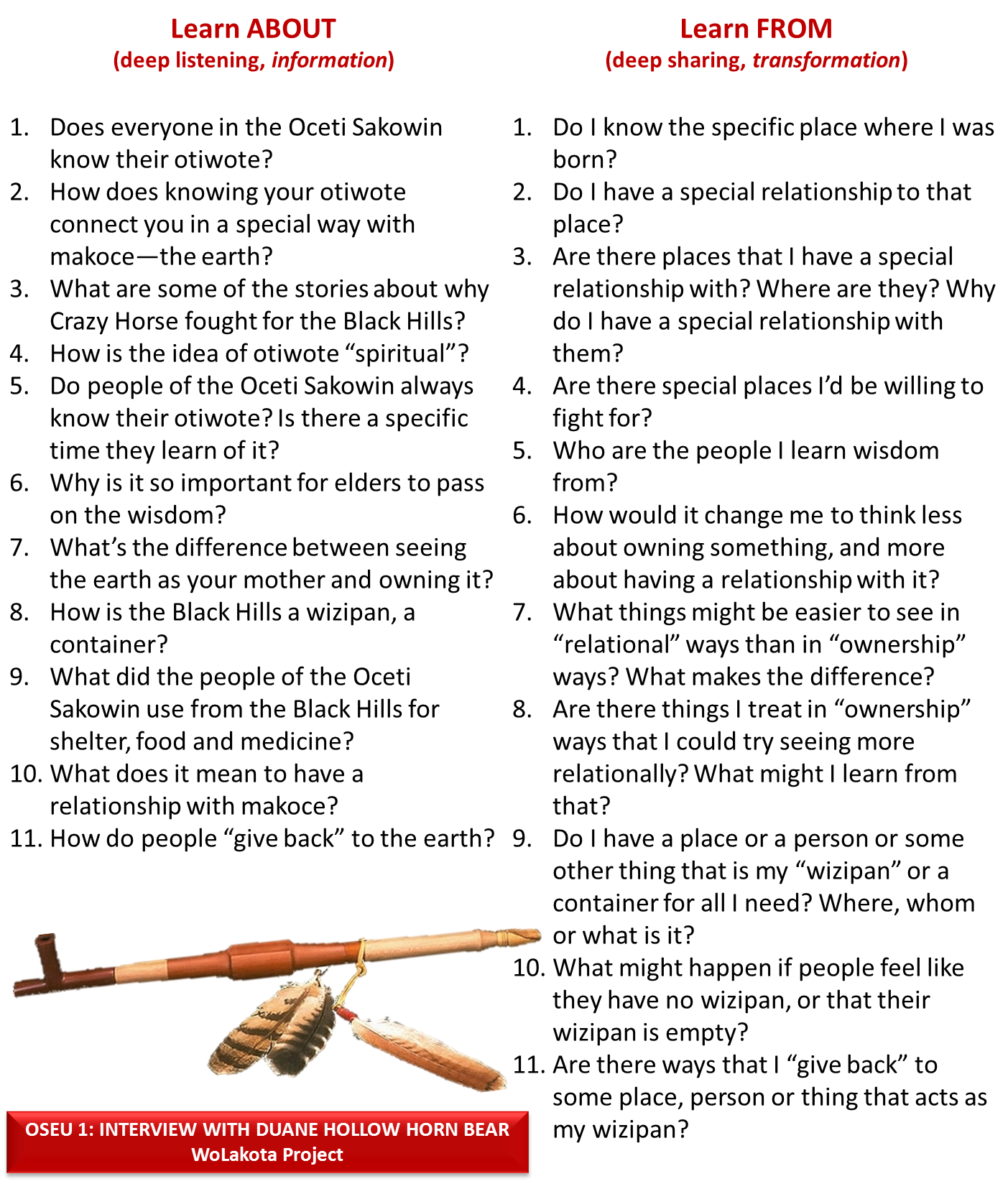
Supplied transcript document. Text preserved as supplied; spellings and transcription uncertainties have not been corrected.
Additional source transcripts
Otiwote, Makoce, and Wizipan
Otiwote, Makoce & Wizipan - Duane Hollow Horn Bear - OSEU 1
I had started to talk to you about…a word… a word that says Otiwote. Each one of us came into this world through the sacredness of water. When your mother's water breaks… and it is your time to come into this world. When that water touches this earth… and your after birth is ceremonially spiritually taken care of in the proper way, you have a very deep connection with Makoce, the Earth, Mother Earth. You have that connection with her… Otiwote talks about that little place where you were born… where your water touched the earth. This little Rapid Creek that goes through the beautiful black Hills… was Crazy Horse’s Otiwote. He was born near Rapid Creek here in the Black Hills. The stories of why… and how he fought to keep the Black Hills or many. But the bottom spiritual line is… is Otiwote. This was his location, his spiritual connection to the Black Hills. I have been fortunate enough to have Otiwote on the western edge of our reservation. Today is where I was brought into this world through the sacredness of my mother's water… where I touched the earth. I've always felt fortunate that my elders were willing to share with me… to give me their insights on life. The wisdom… share their wisdom with me to pass on. We have elders that remind us constantly. These are ours to pass on. We don't want to take them to the grave with us. We must ensure that they pass on. So, the story of our Otiwote and what it means… what these places mean to us. Our connection to the land… We don't own it. It's our mother. It gives everything to us. This special place here, the Black Hills… we refer to it as Wizipan…which means a container. You could be out on the prairie… very hungry, homeless, sick… If you come into this place, the Black Hills, this container that contained everything that you needed to live… the shelter was here, the food, the medicines, everything was here. It was our container. So, as you grow and you learn the history of your people, dream as your ancestors did, that this is your mother. Make a relationship with her. Keep that relationship beautiful and strong. She will take care of you all the way to the end. But it's your job also to give back.