Interview · South Dakota · Jace DeCory · OSEU 5
Themes: Kinship & family, Storytelling & oral tradition, Education & learning, Values & generosity, Culture & continuity, Listening & observation, Children & young people, Intergenerational learning
Learn About questions
What is a “Wasicu way” of seeing?
Why is it important to honor multiple versions of stories or ways of understanding?
How do you decide if a grandparent or elder story is just “different” or is actually “incorrect”?
Learn From questions
What are the unique “ways of seeing” that I or my family have? Am I aware of them?
Do I tend to see the differing perspectives of others as “wrong” or simply as “different”? What are the implications of these two attitudes?
What strategies for understanding do I take when I get differing perspectives from multiple trustworthy sources? How do I go about arriving at my own opinion, decision or choice?
Transcripts
Appreciating Multiple Versions of Stories - Jace DeCory - OSEU 5
Watch this interview on YouTubeMany of the teachings that we have of Lakota people are from our grandparents and our great-grandparents that have been handed down. And they may be a little different than other Lakota people, which is okay. That's fine. Because the more teachings we have, I feel the better. And some of my students will say, well, isn't that in conflict with what you said? And I say, well, maybe if you look at it in a Wasicu way, an Indian way, a
non-native way, then maybe it is. But for us, it's only adding to the knowledge.
It's another way of looking at whatever that is. And so I say, don't be confused, because this is the teachings of this person. This is my teaching. And they're both right. And so sometimes it's a little confusing to our young people, because they might say, well, my grandpa said this, or my grandma said this. And so the teacher should say, well, yeah, you're right. Hold that knowledge. That's good. You know, affirm that with young people. Because it is right. To them, it is right.
And then they can say, and we have another grandparent here, and this is how this grandparent looks at that. And so that's what I say to my grandkids as well, because they're learning other things in the school system, and they come back with all these different notions. And so making sense out of the world today is wonderful, I think, because it provides a whole cultural diversity, a whole bag of information, all different kinds.
Resource text
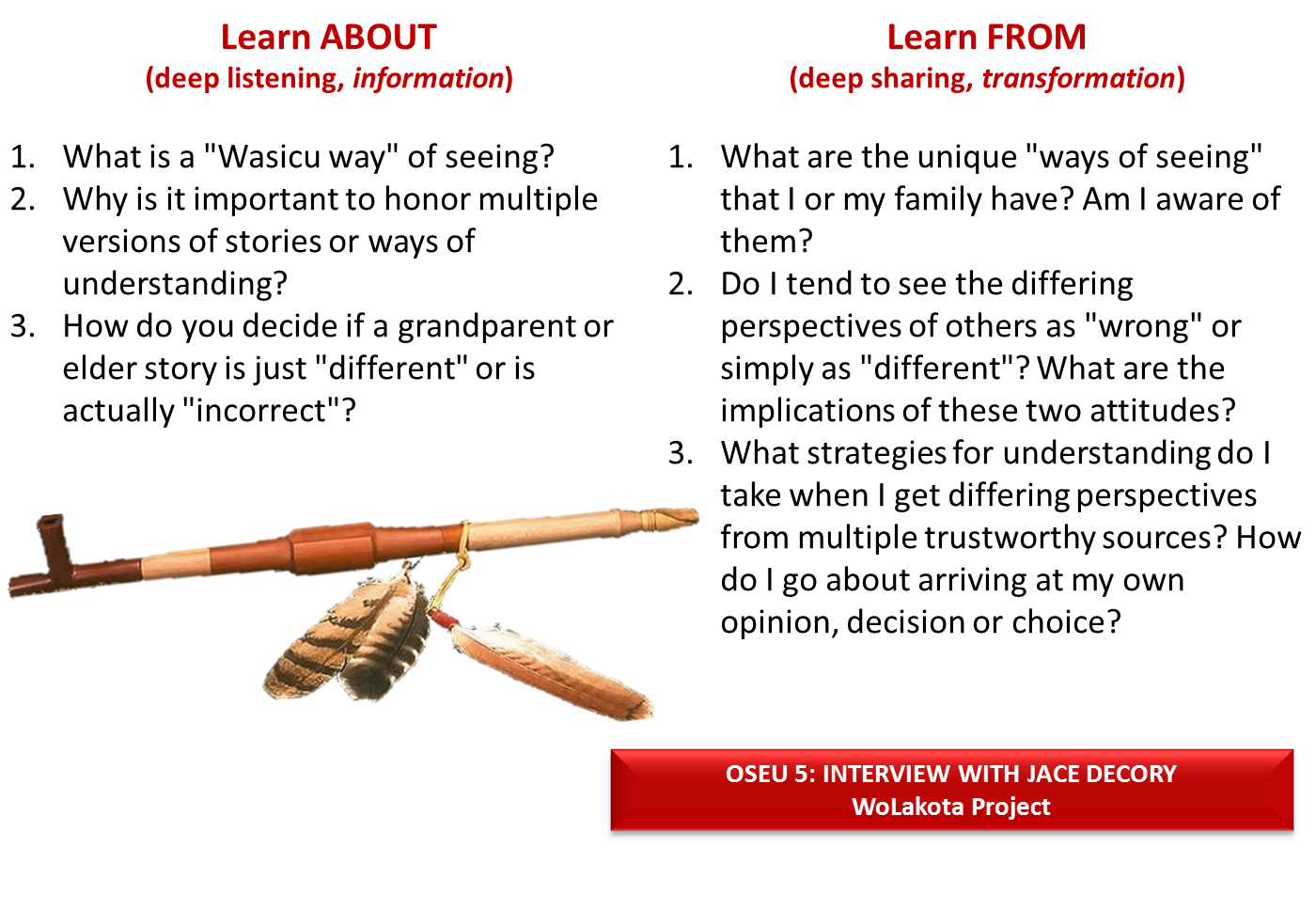
Learn ABOUT Learn FROM
(deep listening, information) (deep sharing, transformation)
1. What is a "Wasicu way" of seeing? 1. What are the unique "ways of seeing"
2. Why is it important to honor multiple that | or my family have? Am | aware of
versions of stories or ways of them?
understanding? 2. Dol tend to see the differing
3. Howdo you decide if a grandparent or perspectives of others as "wrong" or
elder story is just "different" or is simply as "different"? What are the
actually "incorrect"? implications of these two attitudes?
3. What strategies for understanding do |
take when | get differing perspectives
from multiple trustworthy sources? How
do | go about arriving at my own
opinion, decision or choice?
OSEU 5: INTERVIEW WITH JACE DECORY
WolLakota Project
From the current WoLakota source page:
Appreciating Multiple Versions of Stories
Jace DeCory
Transcript
(deep listening, information)
(deep listening, transformation)
Some indexed text was extracted from scanned material. Check the original source for exact wording and spelling.
Source materials
Supplied transcript document. Text preserved as supplied; spellings and transcription uncertainties have not been corrected.
Additional source transcripts
Appreciating Multiple Versions of Stories
Appreciating Multiple Versions of Stories - Jace
DeCory - OSEU 5
Many of the teachings that we have of Lakota people are from our grandparents and our
great-grandparents that have been handed down. And they may be a little different than
other Lakota people, which is okay. That's fine. Because the more teachings we have, I
feel the better. And some of my students will say, well, isn't that in conflict with what you
said? And I say, well, maybe if you look at it in a Wasicu way, an Indian way, a
non-native way, then maybe it is. But for us, it's only adding to the knowledge.
It's another way of looking at whatever that is. And so I say, don't be confused, because
this is the teachings of this person. This is my teaching. And they're both right. And so
sometimes it's a little confusing to our young people, because they might say, well, my
grandpa said this, or my grandma said this. And so the teacher should say, well, yeah,
you're right. Hold that knowledge. That's good. You know, affirm that with young people.
Because it is right. To them, it is right.
And then they can say, and we have another grandparent here, and this is how this
grandparent looks at that. And so that's what I say to my grandkids as well, because
they're learning other things in the school system, and they come back with all these
different notions. And so making sense out of the world today is wonderful, I think,
because it provides a whole cultural diversity, a whole bag of information, all different
kinds.