Resource · South Dakota · OSEU 1
Themes: Land & stewardship, Kinship & family, Storytelling & oral tradition, Education & learning, Treaties & sovereignty, Healing & resilience, Spirituality & ceremony, Values & generosity, Culture & continuity, Food & plants, Arts & expression, Community & responsibility, Self-determination & leadership, Intergenerational learning
Resource text
Learning Question Pages for classroom use:
Click on each title below to find interviews accompanied by “Learn About” and “Learn From” questions for use in classrooms, in small groups or for deeper personal exploration of each video.
Not all videos are accompanied by questions.
Hespa Olowan wan: Song and Translation by Earl Bullhead
Connections to Land and People with Lowell Amiotte
“Indian Foods” with Vernon Ashley
“The Law of Nature” with David Bald Eagle
Welcoming the Thunder Beings with Waylon Black Crow
NEW!
Praying with the Pipe with Sidney Byrd
Chokecherries with Sidney Byrd
Mint Tea with Sidney Byrd
Stewardship and the Land with Stephanie Charging Eagle
Emerging and Evolving as Relatives with Jace DeCory
How Does the Land Work for Us? with Victor Douville
NEW!
“Crooked Gut” with April Fallis
The Land as Grandmother with Gladys Hawk
This Land is Still Ours with Ricky Gray Grass
NEW!
Lakota New Year with Ricky Gray Grass
NEW!
Water is Life with Ricky Gray Grass
NEW!
“Otiwote” “Makoce” and “Wizipan” with Duane Hollow Horn Bear
S
tewardship of Mother Earth with Drs. Johnson & Eastman
“Hunting With Dad” with Pearl Kennedy-Colombe
Preventing the Concrete Jungle with Pearl Kennedy-Colombe
The Human Being Tribe with Kevin Locke
Hinhan Kaga & Seeing the Stars with Kevin Locke
Land As Free As Air with Joseph Marshall III
“I Always Come Home” with Donald Montileaux
Connected to the Land with Whitney Rencountre
Origins and Rites of Passage with Faith Spotted Eagle
Working Together for our Food with Delores Taken Alive
Respecting Mother Earth with Delores Taken Alive
The Story of Tobacco with Jesse Taken Alive
The Story of the Little Plant with Paul White Dress
Oceti Sakowin
Essential Understanding 1 Extended Description
Oceti Sakowin
(historically, known to some as the Sioux Nation) is a Native confederacy speaking three different dialects: the
Lakota,
Dakota
and
Nakota
. The
Lakota
are the largest of the three groups, composed of seven bands living primarily in South and North Dakota. The
Dakota
or
Santee
, composed of five bands live primarily in South Dakota, Minnesota and Nebraska. The
Nakota
, composed of three bands live primarily in South Dakota and Montana.
Native inhabitants of America did not have a concept of individual land ownership. This was an intrinsically foreign concept to the customs and beliefs of
Oceti Sakowin
.
Oceti Sakowin
land was enjoyed and used in common by all members of the tribe for survival and sustenance. Communal tenure was a principle and norm of each tribe who established boundaries in the territories on which they lived. They defended these boundaries from encroachment by other tribes and later by foreigners. Every member of the tribe born into the group had a lifelong right to live on that land and became a custodian to preserve and protect the land for the future generations.
Oceti Sakowin
were nomadic and moved from area to area in their territory when needs arose. Europeans brought with them laws governing private land ownership that conflicted with traditional tribal customs and communal land tenure. Land loss and the creation of reservations for
Oceti Sakowin
could be traced to the aftermath of European immigrant contact.
Immigrants continued to push west into
Oceti Sakowin
home lands resulting in wars and major battles. Treaties were signed, by tribes and the U.S. government, and subsequently broken mostly because of land issues. A government to government relationship was established to protect the rights and resources under tribal stewardship and is still supported by the United States Constitution.
Oceti Sakowin
tribal groups’ broad philosophical and holistic view on communal land enterprise and philanthropy continues. Sharing and giving for the benefit of all, are concepts that are deeply rooted in the culture of
Oceti Sakowin
. In the midst of great adversities, the resiliency of the
Oceti Sakowin
indicates a proud people, still living, and striving by their centuries old modes and manners through generations, keeps them the great people they are today. Communal practices, processes and land holdings are still an all-encompassing traditional culture of the
Oceti Sakowin
. (L. Whirlwind Soldier 2012)
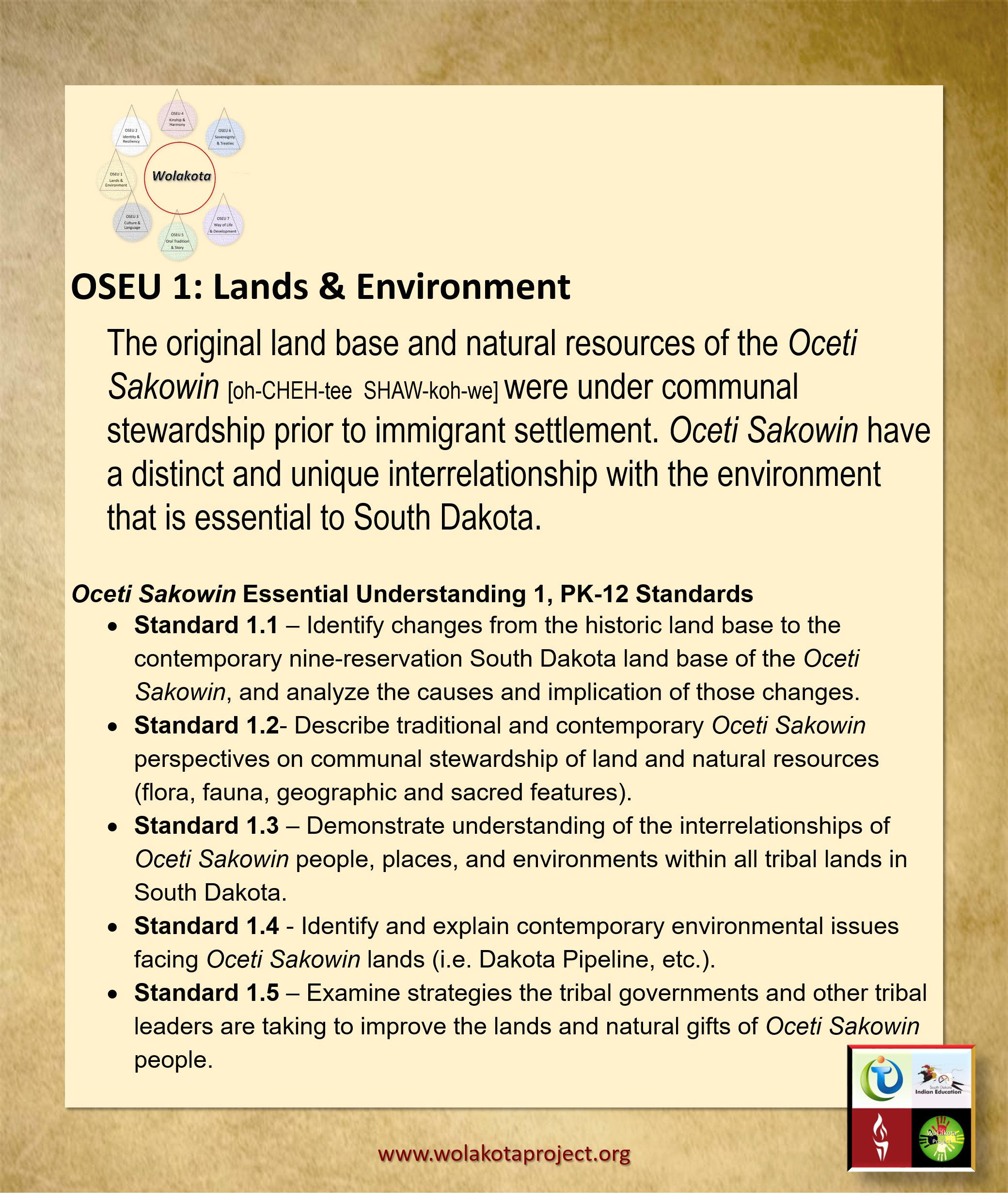
OSEU 1: Lands & Environment
The original land base and natural resources of the Oceti
Sakowin [oh-CHEH-tee shaw-KOH-we] Were under communal
stewardship prior to immigrant settlement. Oceti Sakowin have
a distinct and unique interrelationship with the environment
that is essential to South Dakota.
Oceti Sakowin Essential Understanding 1, PK-12 Standards
e Standard 1.1 — Identify changes from the historic land base to the
contemporary nine-reservation South Dakota land base of the Oceti
Sakowin, and analyze the causes and implication of those changes.
e Standard 1.2- Describe traditional and contemporary Oceti Sakowin
perspectives on communal stewardship of land and natural resources
(flora, fauna, geographic and sacred features).
e Standard 1.3 —- Demonstrate understanding of the interrelationships of
Oceti Sakowin people, places, and environments within all tribal lands in
South Dakota.
Standard 1.4 - Identify and explain contemporary environmental issues
facing Oceti Sakowin lands (i.e. Dakota Pipeline, etc.).
Standard 1.5 — Examine strategies the tribal governments and other tribal
leaders are taking to improve the lands and natural gifts of Oceti Sakowin
people.
Pad (Cl
www.wolakotaproject.org
Some indexed text was extracted from scanned material. Check the original source for exact wording and spelling.
Source materials
- Open source material
- Hespa Olowan wan: Song and Translation by Earl Bullhead
- Connections to Land and People with Lowell Amiotte
- “Indian Foods” with Vernon Ashley
- “The Law of Nature” with David Bald Eagle
- Open source material
- Welcoming the Thunder Beings with Waylon Black Crow
- Praying with the Pipe with Sidney Byrd
- Chokecherries with Sidney Byrd
- Mint Tea with Sidney Byrd
- Stewardship and the Land with Stephanie Charging Eagle
- Emerging and Evolving as Relatives with Jace DeCory
- Open source material
- How Does the Land Work for Us? with Victor Douville
- “Crooked Gut” with April Fallis
- The Land as Grandmother with Gladys Hawk
- Open source material
- This Land is Still Ours with Ricky Gray Grass
- Lakota New Year with Ricky Gray Grass
- Water is Life with Ricky Gray Grass
- “Otiwote” “Makoce” and “Wizipan” with Duane Hollow Horn Bear
- S
- Open source material
- tewardship of Mother Earth with Drs. Johnson & Eastman
- Open source material
- “Hunting With Dad” with Pearl Kennedy-Colombe
- Preventing the Concrete Jungle with Pearl Kennedy-Colombe
- Open source material
- The Human Being Tribe with Kevin Locke
- Hinhan Kaga & Seeing the Stars with Kevin Locke
- Land As Free As Air with Joseph Marshall III
- Open source material
- “I Always Come Home” with Donald Montileaux
- Connected to the Land with Whitney Rencountre
- Origins and Rites of Passage with Faith Spotted Eagle
- Working Together for our Food with Delores Taken Alive
- Respecting Mother Earth with Delores Taken Alive
- The Story of Tobacco with Jesse Taken Alive
- The Story of the Little Plant with Paul White Dress