Interview · South Dakota · Eli Tail Sr. · OSEU 6
Themes: Language & revitalization, Education & learning, Treaties & sovereignty, Values & generosity, Listening & observation, Self-determination & leadership
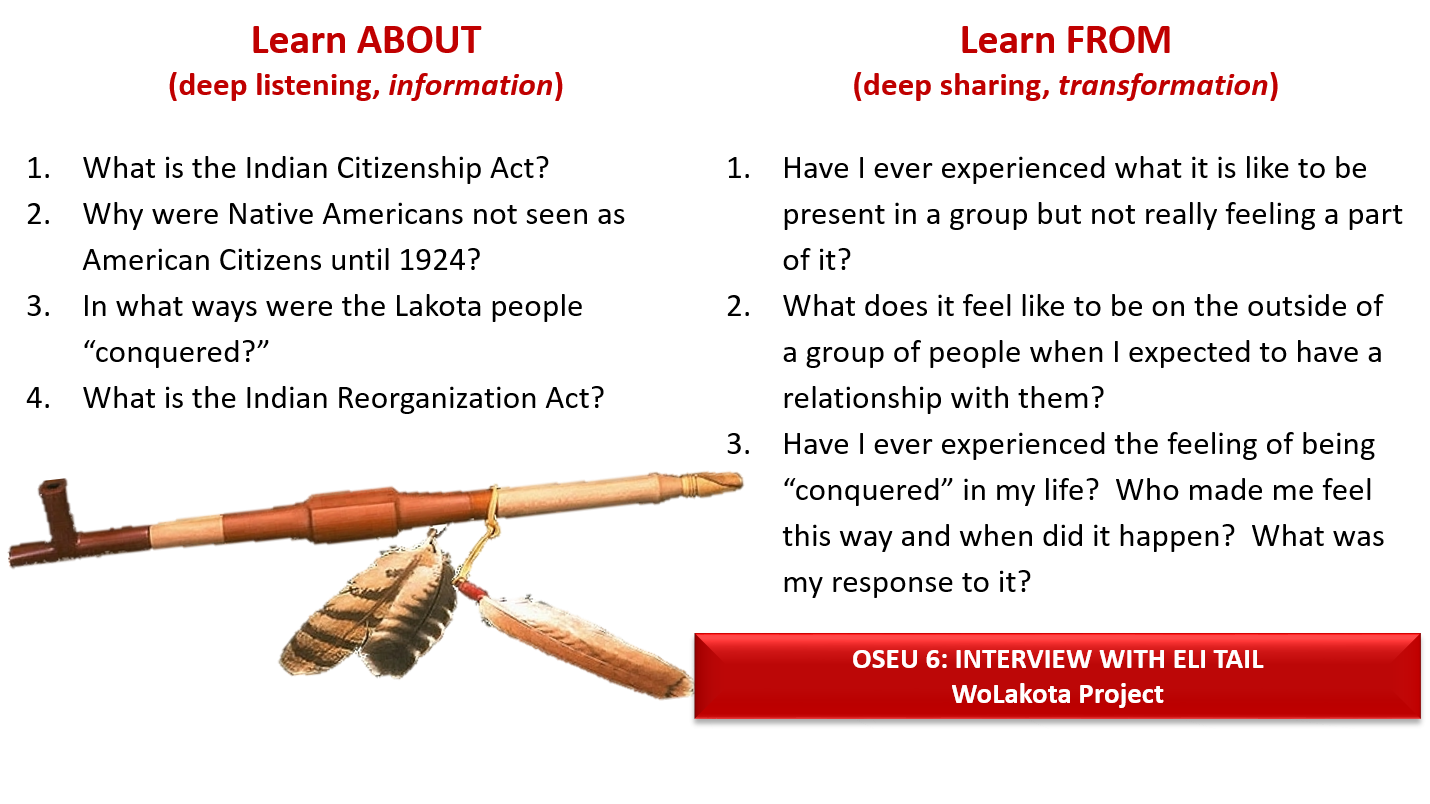
Learn About questions
What is the Indian Citizenship Act?
Why were Native Americans not seen as American Citizens until 1924?
In what ways were the Lakota people “conquered?”
What is the Indian Reorganization Act?
Learn From questions
Have I ever experienced what it is like to be present in a group but not really feeling a part of it?
What does it feel like to be on the outside of a group of people when I expected to have a relationship with them?
Transcripts
Citizenship Act - Eli Tail Sr. Indian - OSEU 6
Watch this interview on YouTubeActually, in 1924, it became legal. It's called the Indian Citizenship Act. We became Americans then. So, we have two identities. We are Lakota and we are Americans again. Then 10 years later, the 1934 Act, the tribal government, then the schools had to learn how to speak the English language. We are Lakota, but then when you're conquered, I guess you've got to learn whatever the language, whatever you own, it's gone. They owned it. We don't own it anymore. And there are a number of Pioneer Indian Reservations, number 344, POW Camp 344.
So, that's where our grandpas were. You can live here the rest of your life, I guess, but then it's not yours, it's ours. So, then we become Americans, Indian Citizenship Act, 1924. It's called the Indian Reorganization Act.
Resource text
Learn ABOUT Learn FROM
(deep listening, information) (deep sharing, transformation)
1. What is the Indian Citizenship Act? 1. Have | ever experienced what it is like to be
2. Why were Native Americans not seen as present in a group but not really feeling a part
American Citizens until 1924? of it?
3. In what ways were the Lakota people 2. What does it feel like to be on the outside of
“conquered?” a group of people when | expected to have a
4. What is the Indian Reorganization Act? relationship with them?
3. Have | ever experienced the feeling of being
“conquered” in my life? Who made me feel
this way and when did it happen? What was
my response to it?
as
Se, OSEU 6: INTERVIEW WITH ELI TAIL
; WoLakota Project
From the current WoLakota source page:
Indian Citizenship
Eli Tail Sr.
Transcript
(deep listening, information)
(deep listening, information)
Some indexed text was extracted from scanned material. Check the original source for exact wording and spelling.
Source materials
Supplied transcript document. Text preserved as supplied; spellings and transcription uncertainties have not been corrected.
Additional source transcripts
Indian Citizenship
Citizenship Act - Eli Tail Sr. Indian - OSEU 6
Actually, in 1924, it became legal. It's called the Indian Citizenship Act. We became
Americans then. So, we have two identities. We are Lakota and we are Americans
again. Then 10 years later, the 1934 Act, the tribal government, then the schools had to
learn how to speak the English language. We are Lakota, but then when you're
conquered, I guess you've got to learn whatever the language, whatever you own, it's
gone. They owned it. We don't own it anymore. And there are a number of Pioneer
Indian Reservations, number 344, POW Camp 344.
So, that's where our grandpas were. You can live here the rest of your life, I guess, but
then it's not yours, it's ours. So, then we become Americans, Indian Citizenship Act,
1924. It's called the Indian Reorganization Act.