Interview · South Dakota · Joseph Marshall III · OSEU 2
Themes: Land & stewardship, Kinship & family, Identity & belonging, Storytelling & oral tradition, Education & learning, Healing & resilience, Values & generosity, Culture & continuity, Food & plants, Arts & expression, Listening & observation, Intergenerational learning
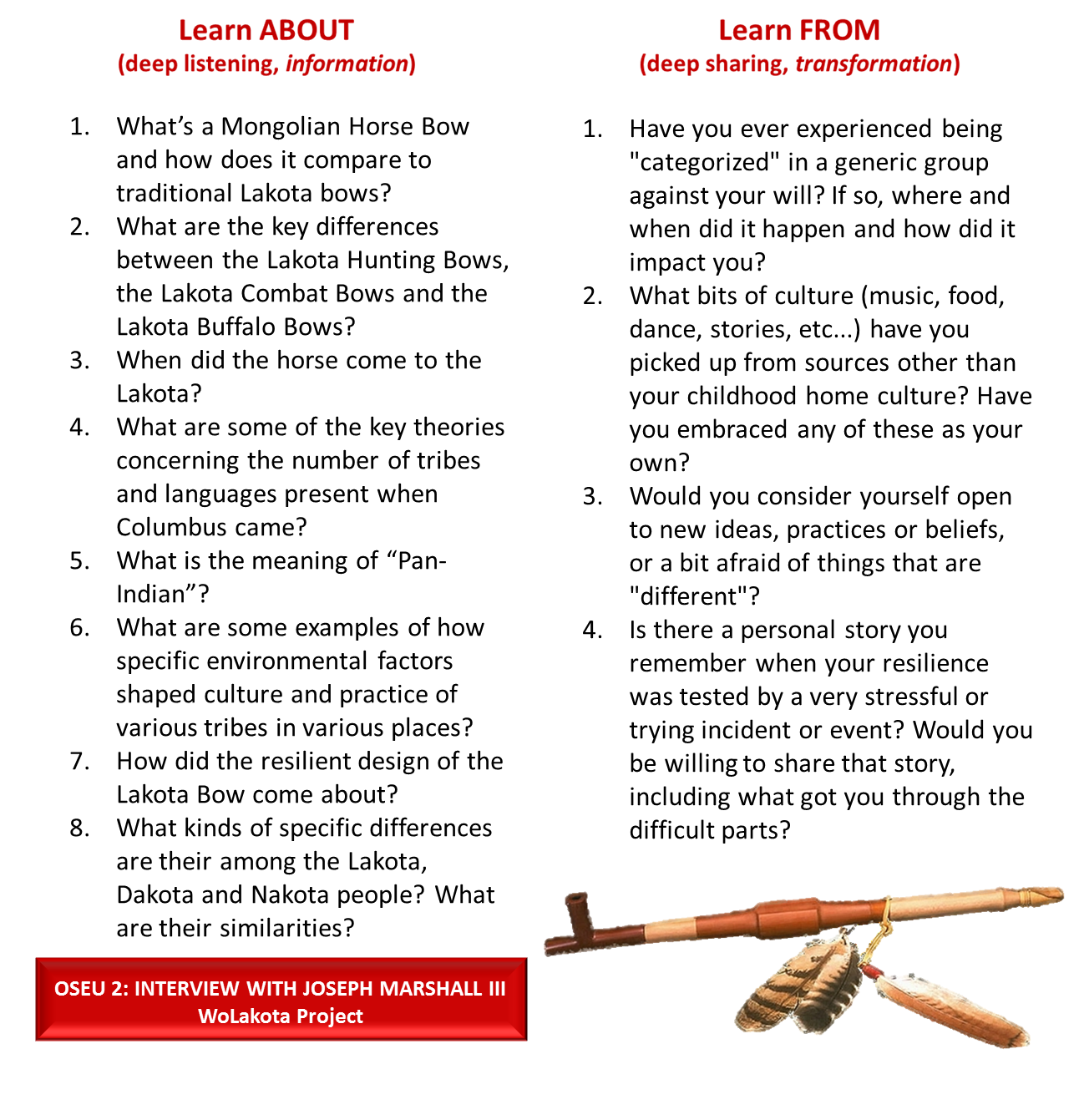
Learn About questions
What’s a Mongolian Horse Bow and how does it compare to traditional Lakota bows?
What are the key differences between the Lakota Hunting Bows, the Lakota Combat Bows, and the Lakota Buffalo Bows?
When did the horse come to the Lakota?
What are some of the key theories concerning the number of tribes and languages present when Columbus came?
What is the meaning of “Pan Indian”?
What are some examples of how specific environmental factors shaped the culture and practice of various tribes in various places?
How did the resilient design of the Lakota Bow come about?
What kinds of specific differences are there among the Lakota, Dakota, and Nakota people? What are their similarities?
Learn From questions
Have you ever experienced being “categorized” in a generic group against your will? If so, where and when did it happen, and how did it impact you?
What bits of culture (music, food, dance, stories, etc..) have you picked up from sources other than your childhood home culture? Have you embraced any of these as your own?
Would you consider yourself open to new ideas, practices, or beliefs, or a bit afraid of things that are “different”?
Is there a personal story you remember when your resilience was tested by a very stressful or trying incident or event? Would you be willing to share that story, including what got you through the difficult parts?
Transcripts
Bows & Variety & Culture Sharing - Joseph Marshall - OSEU 2
Watch this interview on YouTubeThat’s true. I mean…anymore than if you say the word “Caucasian.” That’s just an umbrella. No. I’m into bows and arrows big time…since my grandfather taught me. I make my own bows and arrows. I mean I love bows and arrows. I just bought a Mongolian horse bow…just to have it…just to see it…from another culture…how they did theres…and so forth. But…but I make my own bows and arrows. It’s a special connection when you do that…when you can do that…when you know that the bow that you’ve made…and there are different kinds…even among the Lakota bows, there is the hunting bow which is longer…and there’s the combat bow, or the war bow which is shorter…and then there’s is a very specialized bow used to hunt buffalo. So it was shorter. They became shorter after the horse came. Once the horse came, we had to have a bow that could be maneuverable on the back of a horse…so we shortened it up. So there’s different kinds of bows, even among the Lakota. But, when you consider…some anthropologists…I heard somewhere that there now sort of grudgingly saying, “Well there might have been as many as 2,000 different native tribes in North America when Columbus came.” I happened to think that myself. I think there was a lot more than 500. Then, if that was the case…whether there was 500 or 2,000…there were that many different languages…and that many different ways of identifying ourselves. So, we look at things so much differently than everybody else. There’s that many different ways to make bows and arrows. That variety is still here.
There’s a pan-Indianness now…because…in the last century…certainly within the last 75 years…we’ve had much more contact with one another…with different diverse tribes across the country. And so, some of us are copying the dance customs of tribes elsewhere…and the Northern Plains tribes are copying…and other people down there are copying our songs and customs and way of doing. Well, that’s the pan-Indianness. The variety is still there. I mean…we all have our own way of…even different ways that we dance…and our songs are different. Generally, our perception of our environment is different because we all come from different parts of this continent. The people who lived in the East were all sedentary hunters and gatherers, they stayed in one place.
While those of us in the Plains were all nomadic, we moved around and followed the game. And the people in the Southwest learned how to irrigate because water was a scarce commodity. And for heaven's sakes, the people in the Northwest coast chased whales in skin boats. And so, all the variety is there and that variety was sort of directly influenced by the environment itself. And that gets back to the earlier question about how we are related to the earth. It made us who we are. And that’s really the source of our variety. We can be resilient. I make bows and arrows…and one of the things that impressed me about a well-made bow…is how resilient it can be time after time after time. You bend that sucker back and the arrow flies…and you think “Well, if I pull it back too far, it is going to break.” But then you rely on what you’ve been taught as a bowmaker…what your grandfather said…ok.
First of all, he said it’s gotta look like a new moon…the thin sliver of a new moon. That’s the shape of our Lakota bows. And if you look at…the next time you have that opportunity…look at the brand new moon…it’s just thin in the sky…it’s thickest in the middle and tapers gracefully out to both ends. That’s what our bows look like.
Interestingly enough, that shape enables it to be resilient because it withstands the stress of being drawn…over the amount…both limbs, top and bottom. If you make it too thick in the middle, then it puts too much pressure on the outer limbs and it will break.
But if you use that shape, it gives them the ability to be resilient time after time after time. And we can be the same way if you stop to think about it. And part of our resiliency is all the ways that we are different…that variety…even among our own selves…the Lakota are different than the Nakota and the Dakota. They chose to stay on the east side of the river… and we went west… and scattered ourselves all over the place. Variety is a good thing.
Bows & Variety & Culture Sharing
Watch this interview on YouTubeBows & Variety & Culture Sharing - Joseph Marshall -
OSEU 2
That’s true. I mean…anymore than if you say the word “Caucasian.” That’s just an
umbrella. No. I’m into bows and arrows big time…since my grandfather taught me. I
make my own bows and arrows. I mean I love bows and arrows. I just bought a
Mongolian horse bow…just to have it…just to see it…from another culture…how they
did theres…and so forth. But…but I make my own bows and arrows. It’s a special
connection when you do that…when you can do that…when you know that the bow that
you’ve made…and there are different kinds…even among the Lakota bows, there is the
hunting bow which is longer…and there’s the combat bow, or the war bow which is
shorter…and then there’s is a very specialized bow used to hunt buffalo. So it was
shorter. They became shorter after the horse came. Once the horse came, we had to
have a bow that could be maneuverable on the back of a horse…so we shortened it up.
So there’s different kinds of bows, even among the Lakota. But, when you
consider…some anthropologists…I heard somewhere that there now sort of grudgingly
saying, “Well there might have been as many as 2,000 different native tribes in North
America when Columbus came.” I happened to think that myself. I think there was a lot
more than 500. Then, if that was the case…whether there was 500 or 2,000…there
were that many different languages…and that many different ways of identifying
ourselves. So, we look at things so much differently than everybody else. There’s that
many different ways to make bows and arrows. That variety is still here.
There’s a pan-Indianness now…because…in the last century…certainly within the last
75 years…we’ve had much more contact with one another…with different diverse tribes
across the country. And so, some of us are copying the dance customs of tribes
elsewhere…and the Northern Plains tribes are copying…and other people down there
are copying our songs and customs and way of doing. Well, that’s the pan-Indianness.
The variety is still there. I mean…we all have our own way of…even different ways that
we dance…and our songs are different. Generally, our perception of our environment is
different because we all come from different parts of this continent. The people who
lived in the East were all sedentary hunters and gatherers, they stayed in one place.
While those of us in the Plains were all nomadic, we moved around and followed the
game. And the people in the Southwest learned how to irrigate because water was a
scarce commodity. And for heaven's sakes, the people in the Northwest coast chased
whales in skin boats. And so, all the variety is there and that variety was sort of directly
influenced by the environment itself. And that gets back to the earlier question about
how we are related to the earth. It made us who we are. And that’s really the source of
our variety. We can be resilient. I make bows and arrows…and one of the things that
impressed me about a well-made bow…is how resilient it can be time after time after
time. You bend that sucker back and the arrow flies…and you think “Well, if I pull it back
too far, it is going to break.” But then you rely on what you’ve been taught as a
bowmaker…what your grandfather said…ok.
First of all, he said it’s gotta look like a new moon…the thin sliver of a new moon. That’s
the shape of our Lakota bows. And if you look at…the next time you have that
opportunity…look at the brand new moon…it’s just thin in the sky…it’s thickest in the
middle and tapers gracefully out to both ends. That’s what our bows look like.
Interestingly enough, that shape enables it to be resilient because it withstands the
stress of being drawn…over the amount…both limbs, top and bottom. If you make it too
thick in the middle, then it puts too much pressure on the outer limbs and it will break.
But if you use that shape, it gives them the ability to be resilient time after time after
time. And we can be the same way if you stop to think about it. And part of our
resiliency is all the ways that we are different…that variety…even among our own
selves…the Lakota are different than the Nakota and the Dakota. They chose to stay on
the east side of the river… and we went west… and scattered ourselves all over the
place. Variety is a good thing.
Resource text
NEW!!!
“Self Timing” version of this interview with built-in instructions and “Learn From” questions for classroom circle activities:
OSEU 2: INTERVIEW WITH JOSEPH MARSHALL III
WoLakota Project
From the current WoLakota source page:
Bows & Variety & Culture Sharing
Joseph Marshall III
Transcript
(deep listening, information)
(deep listening, transformation)
Some indexed text was extracted from scanned material. Check the original source for exact wording and spelling.
Source materials
Transcripts from supplied documents and the current WoLakota source pages. Text preserved as published.