Interview · South Dakota · Vernon Ashley · OSEU 6
Themes: Land & stewardship, Kinship & family, Education & learning, Treaties & sovereignty, Boarding schools & assimilation, Values & generosity, Food & plants, Listening & observation, Intergenerational learning
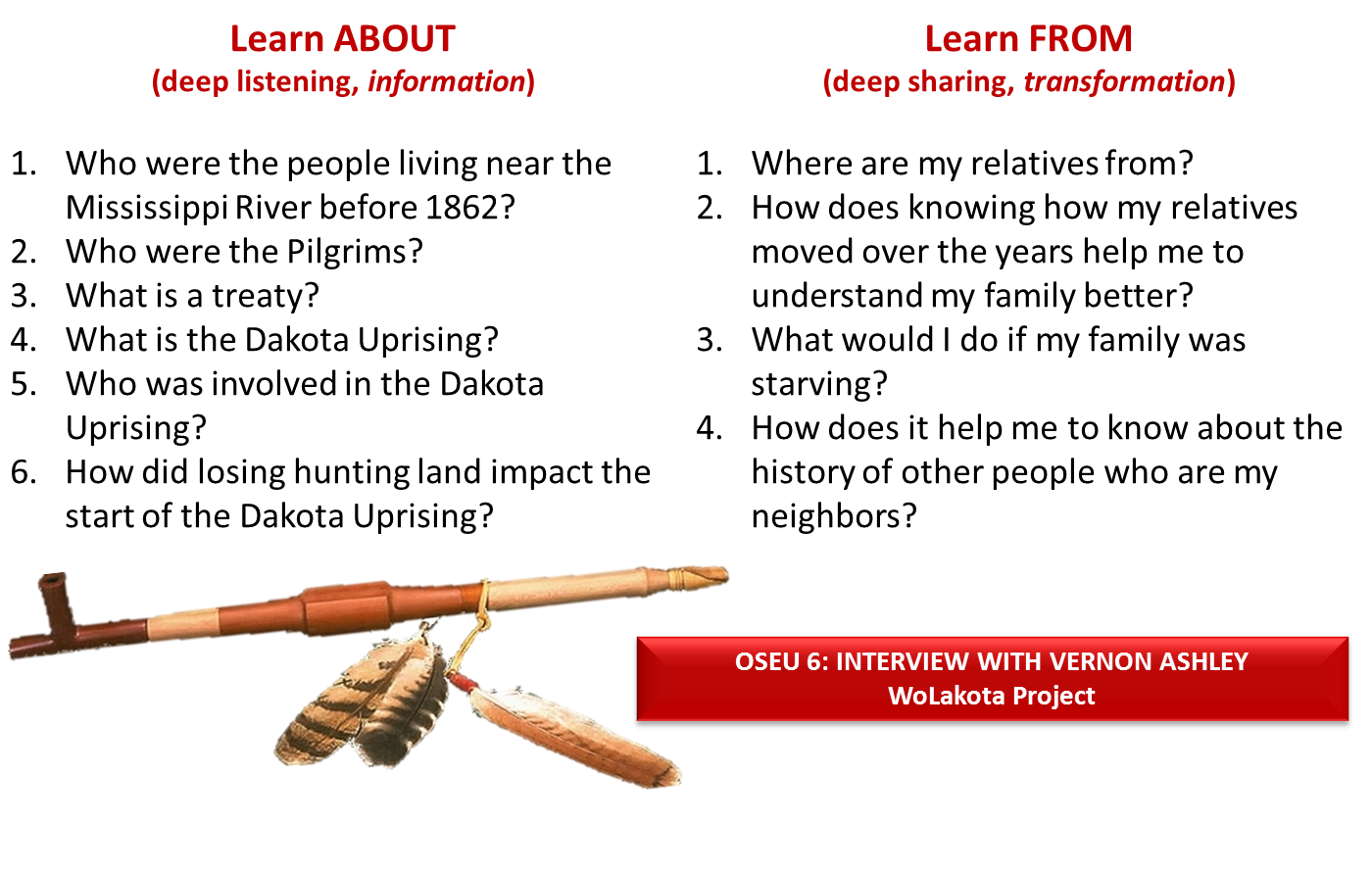
Learn About questions
1. Who were the people living near the Mississippi River before 1862?
2. Who were the Pilgrims?
3. What is a treaty?
4. What is the Dakota Uprising?
5. Who was involved in the Dakota Uprising?
6. How did losing hunting land impact the start of the Dakota Uprising?
Learn From questions
1. Where are my relatives from?
2. How does knowing how my relatives moved over the years help me to understand my family better?
3. What would I do if my family was starving?
4. How does it help me to know about the history of other people who are my neighbors?
Transcripts
Boarding School - Vernon Ashley - OSEU #6
Watch this interview on YouTubeHow my father got his name changed, when he was a young man they were sending young Indian men and women back east to school to Carlisle, Pennsylvania and Hampton, Virginia. And my father was sent to Hampton, Virginia. Now I've got records and all you'd have to do is to contact Hampton and you'll see. And my father only went to school maybe a little over two years, close to three years because his father was ailing. My grandfather, his name was Sinkpay. And he had a brother, Bowdhead, Pow Koodye Bowdhead and Sinkpay is a muskrat.
And I've only got one picture of my grandfather because the one lady that interviewed I said, you must remember cameras, you had nothing like this. And so cameras or pictures are hard to get.
Resource text
Additional Related Resources:
Elder Sidney Byrd’s interview on the Dakota Uprising
1862 Exhibit
US Dakota War of 1862
US Dakota War of 1862: History Site Treaty Center
Learn ABOUT Learn FROM
(deep listening, information) (deep sharing, transformation)
1. Who were the people living near the 1. Where are my relatives from?
Mississippi River before 1862? 2. How does knowing how my relatives
2. Who were the Pilgrims? moved over the years help me to
3. Whatis a treaty? understand my family better?
4. What is the Dakota Uprising? 3. What would | do if my family was
5. Who was involved in the Dakota starving?
Uprising? 4. How does it help me to know about the
6. How did losing hunting land impact the history of other people who are my
start of the Dakota Uprising? neighbors?
s PA OSEU 6: INTERVIEW WITH VERNON ASHLEY
ee WolLakota Project
Some indexed text was extracted from scanned material. Check the original source for exact wording and spelling.
Source materials
Supplied transcript document. Text preserved as supplied; spellings and transcription uncertainties have not been corrected.
Additional source transcripts
The Dakota Uprising
The Dakota Uprising - Vernon Ashley - OSEU #6
In the mid-1800s, 1862, my ancestors were living in along the Minnesota and
Mississippi River in these tributaries in the Minnesota. And, but as the pilgrims came to
the our eastern shores and they started to move, move us west, and I wanted to tell you
that the government made treaties with the tribes. But those so-called commissioners, I
don't know how much authority they had to make treaties. What started the Dakota
Uprising in Minnesota in 1862, the government was reneging on this treaty to provide
foodstuff and a place to live and so forth.
Well, in 1862, the government reneged because you must remember there was a Civil
War on at that time. And so they, of course, when they cut back on the rations, see the
people couldn't hunt because the farmers were already established. And so they were
hungry. And finally, it got to a point where some of the men went hunting and they went
back and they were unsuccessful. So they stole some eggs and, and some chickens.
But that's what started it. And when the farmers objected, well then they killed, they
killed the farmers and his families even.
And that's what started this Dakota Uprising.