Interview · South Dakota · Sidney Byrd · OSEU 5
Themes: Kinship & family, Storytelling & oral tradition, Values & generosity, Culture & continuity, Arts & expression, Listening & observation, Children & young people, Humor & play, Intergenerational learning
Learn About questions
How do battles differ from massacres?
How are medals of honor traditionally received?
What was the Battle of Wounded Knee? The Battle of Little Big Horn?
How does hearing multiple perspectives on history develop our understanding?
What impacted the number of medals of honor given out for these battles described by Mr. Byrd, compared to a much larger battle like Iwojima?
Learn From questions
Have you ever learned another perspective about a story you have known a certain way for much of your life? How does that new perspective impact you?
Do you or your family have war stories that are shared down generations? Have you considered the opposing side’s perspectives in those stories?
Can you remember a time when you were treated unfairly? How did it resolve, or did it resolve?
Are you aware of a defining moment in your family’s history…either positive or negative?
Transcripts
Wounded Knee - Sidney Byrd - OSEU #5
Watch this interview on YouTubeI wish that I had a tape and could tape the stories the old grandfathers and grandmothers told me. There were a wealth of stories in history, the old men. It is from the old men telling me that I was able to write the Wounded Knee story, the massacre. The white man always calls it the Battle of Wounded Knee. There was not a battle.
Eighteen Congressional Medals of Honor awarded for gallantry above and beyond the call of duty for massacring defenseless women and children. They disarmed him and then one of them resisted. Didn't want to.
I gave five ponies for this rifle. You give me five ponies and I'll give it to you. But it's mine. I paid for it. I'm not going to give it to you. And the first shot went off. And that started it. Women, children, didn't make any difference. It is the 7th Cavalry that had been wiped out. The Big Horn, Custer's former unit. This was the same unit. They had brought four Hotchkiss cannon, point-blank range, less than 100 yards. Rapid fire, artillery, four of them shooting. Women, children, one woman was hidden in a drawer.
Two little girls came screaming. She grabbed them and pulled them in there with her. She looked up, shoulder mounted, shot. One little girl, she raised her hand, shot the woman. She fell down. She was mortally wounded, still alive. Shoulder rolled down and pulled up her dress. That rolled away. She told this story to Dr. Eastman. He was from here. Dr. Eastman was a Santee, medical doctor. He was the doctor at Pine Ridge at the time of the Wounded Knee Massacre. She told that story to him.
For gallantry above and beyond the call of duty, they ordered battle. Iwo Jima, the bloodiest battle in the Pacific, lasted over a month. Many, many Marines gave their lives, 28 Congressional medals of honor, for a battle. The enemy was armed and they fought back. By comparison, here's something that lasted for only a couple hours.
Disarmed them, then they shot them like fish in a barrel. They were ordered. All we can surmise is that they were rewarded for finally avenging Custer's death. They called it the Battle of Wounded Knee.
It's not a battle, it's a massacre. But that's not the only time the Army, there were other massacres that happened, where the Native people were. But I like to think that Custer was seeking disobeyed orders, the Little Bighorn. He thought all he had to do was ride into the, he didn't know the size of the camp. I read this story, The Last Stand. One of the funny things, after the battle, the Sioux and Cheyenne were having a victory celebration. They were dancing and they were having some, there were some soldiers still surrounded on the hill.
And they heard it and one of those soldiers captured a bugle. And he's blowing that bugle and he away, back up at the soldiers on the hill. He's blowing that bugle and he's away. And all of a sudden, soldiers, mounted soldiers were coming by in front of these other soldiers. Those Indians took the soldiers, their uniforms and rode by and they rode by, paraded by. Said Custer is the first one to wear an arrow shirt.
Resource text
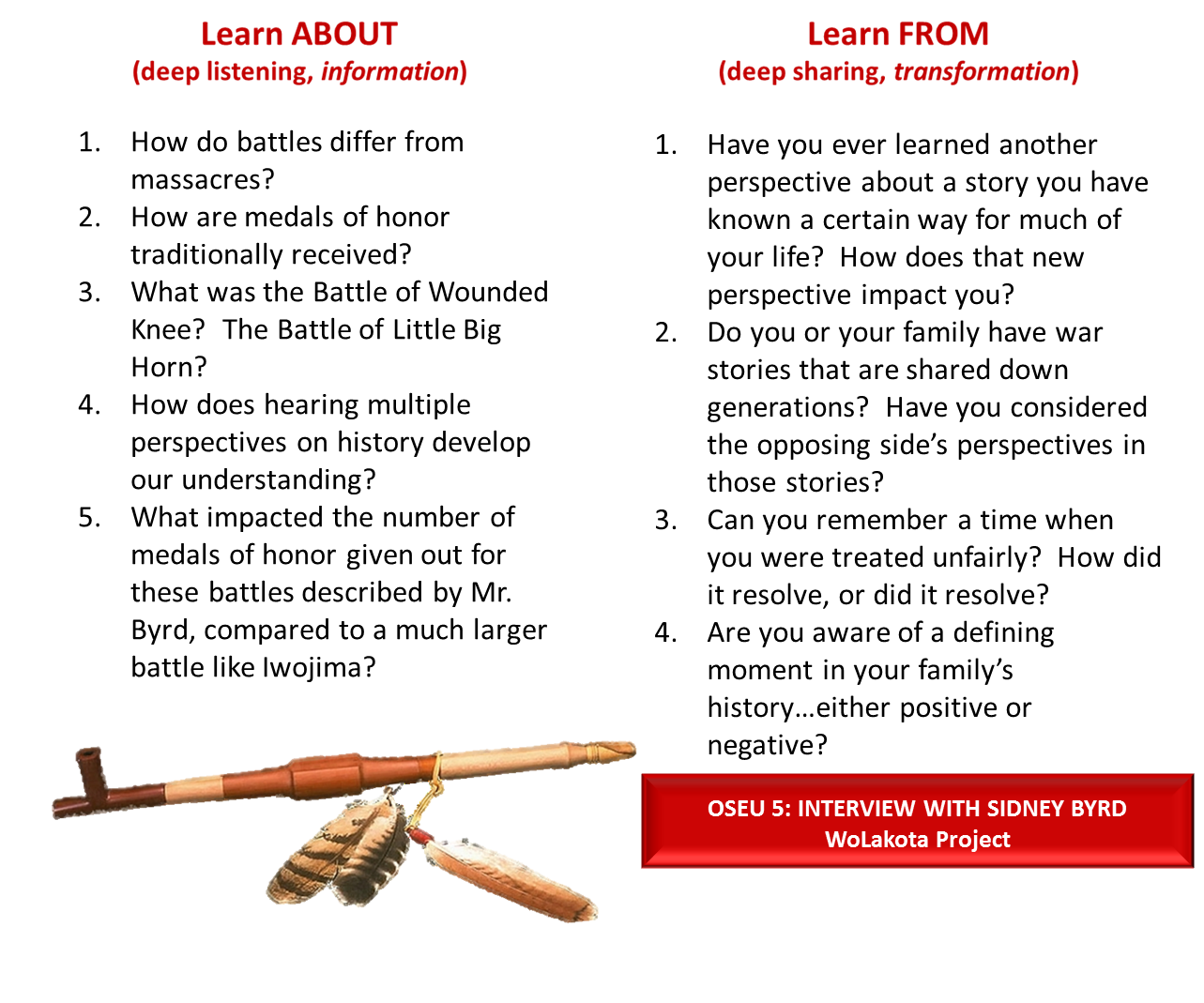
Learn ABOUT Learn FROM
(deep listening, information) (deep sharing, transformation)
1. How do battles differ from 1. Have you ever learned another
massacres? perspective about a story you have
2. How are medals of honor known a certain way for much of
traditionally received? your life? How does that new
3. What was the Battle of Wounded perspective impact you?
Knee? The Battle of Little Big 2. Do you or your family have war
Horn? stories that are shared down
4. How does hearing multiple generations? Have you considered
perspectives on history develop the opposing side’s perspectives in
our understanding? those stories?
5. What impacted the number of 3. Can you remember a time when
medals of honor given out for you were treated unfairly? How did
these battles described by Mr. it resolve, or did it resolve?
Byrd, compared to a much larger 4. Are you aware of a defining
battle like lwojima? moment in your family’s
history...either positive or
negative?
OSEU 5: INTERVIEW WITH SIDNEY BYRD
WoLakota Project
From the current WoLakota source page:
Wounded Knee
Sidney Byrd
Transcript
(deep listening, information)
(deep listening, transformation)
Some indexed text was extracted from scanned material. Check the original source for exact wording and spelling.
Source materials
Supplied transcript document. Text preserved as supplied; spellings and transcription uncertainties have not been corrected.