Interview · South Dakota · Stephanie Charging Eagle · OSEU 6
Themes: Land & stewardship, Identity & belonging, Treaties & sovereignty, Values & generosity, Listening & observation, Children & young people
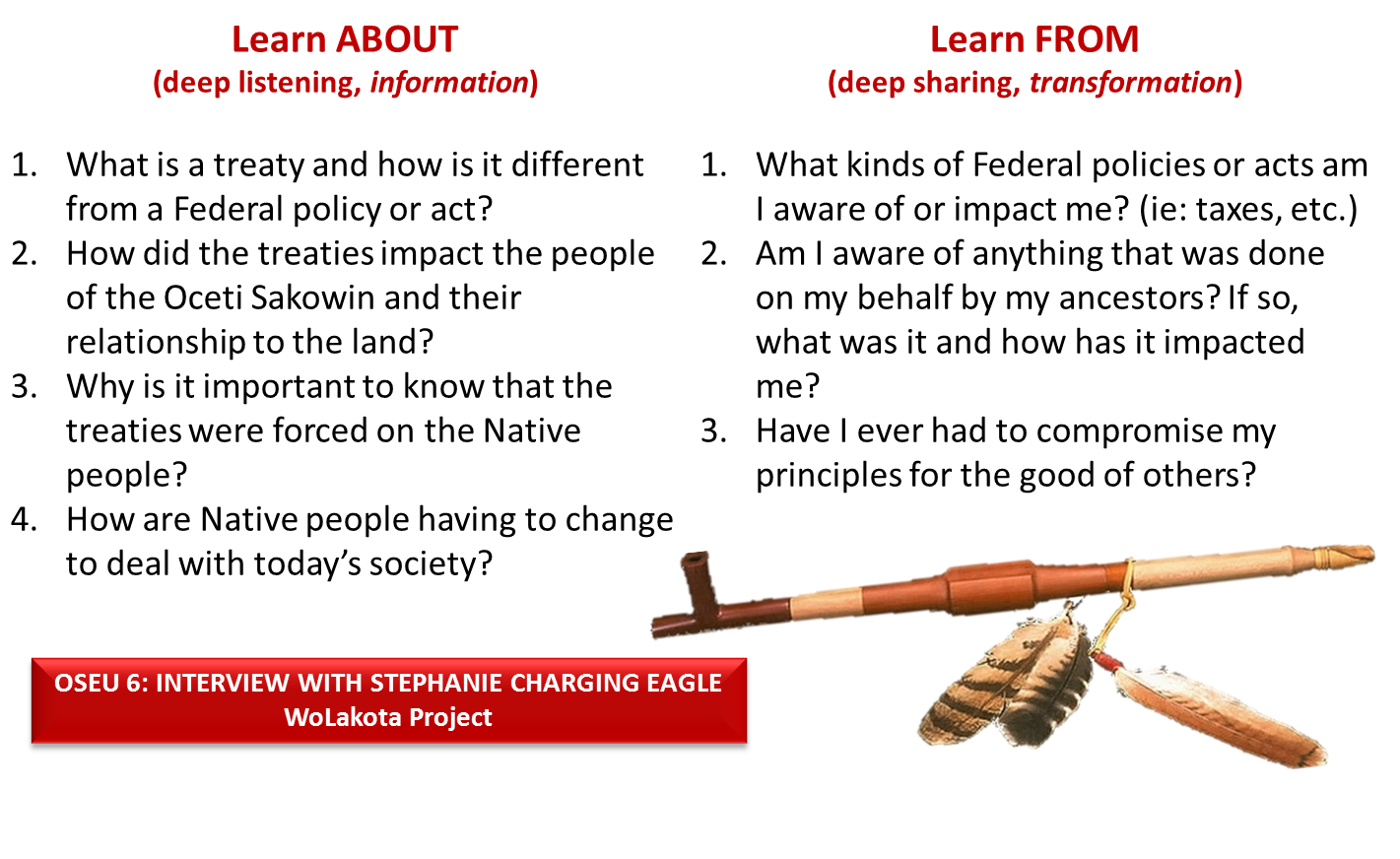
Learn About questions
What is a treaty and how is it different from a Federal policy or act?
How did the treaties impact the people of the Oceti Sakowin and their relationship to the land?
Why is is important to know that the treaties were forced on the Native people?
How are Native people having to change to deal with today’s society?
Learn From questions
What kinds of Federal policies or acts am I aware of or impact me? (ie: taxes, etc.)
Am I aware of anything that was done on my behalf by my ancestors? If so, what was it and how has it impacted me?
Have I ever had to compromise my principles for the good of others?
Transcripts
The Impact of Forced Treaties - Stephanie Charging Eagle - OSEU #6
Watch this interview on YouTubeThere are some things that were put in place called treaties, federal policies, acts, you know, from a government. And those kept us from enjoying land like we used to as Oceti Sakowin people, and that these are things that were not done by our own people, ideally.
And so, you know, I think what I would like the lesson, the objective of that lesson, would be to understand that these are things that were put upon us and that they have nothing to do with what we think about the land, about where we are, and what we are forced to do, or that we have been, that we've understood that we do, and that it's not part of who we are, that we buy land because we live there. We were forced to give up some parts of our land by treaty acts, but we still have connection to that land.
And that in today's society, sometimes we have to do things that go against our beliefs just to maintain the environmental stewardship of that land. Like, for example, the one that comes to mind is the Presla, Presla, the baldie head on the whole land thing that just happened with all the tribes contributing to buy that. That is, you know, some people said, why should we buy land back that was stolen? You know, and that's very much a, it's very much a relevant argument.
But at the same time, you have to look at how times have changed, and sometimes we have to do what needs to be done to get that land back so that we can now be stewards again of that land. And if that means we have to do something that is contrary to our beliefs, for that time, for that situation, that's what we'll do. But we will never lose the concept of why we acquired, reacquired that land. And it was for our children, our generations, and not just because we, you know, we want that land.
You know, for all I know, you know, maybe it's Prime Valley, you know, I don't know. And that, I don't think, was the primary goal of the tribes who bought it, you know.
Resource text
Learn ABOUT Learn FROM
(deep listening, information) (deep sharing, transformation)
What is a treaty and howis it different 1. What kinds of Federal policies or acts am
from a Federal policy or act? | aware of or impact me? (ie: taxes, etc.)
How did the treatiesimpact the people 2. Am| aware of anything that was done
of the Oceti Sakowin and their on my behalf by my ancestors? If so,
relationship to the land? what was it and how has it impacted
Why is it important to know that the me?
treaties were forced on the Native 3. Have | ever had to compromise my
people? principles for the good of others?
How are Native people having to change
to deal with today’s society?
From the current WoLakota source page:
The Impact of Forced Treaties
Stephanie Charging Eagle
Transcript
(deep listening, information)
(deep listening, information)
Some indexed text was extracted from scanned material. Check the original source for exact wording and spelling.
Source materials
Supplied transcript document. Text preserved as supplied; spellings and transcription uncertainties have not been corrected.
Additional source transcripts
The Impact of Forced Treaties
The Impact of Forced Treaties - Stephanie Charging
Eagle - OSEU #6
There are some things that were put in place called treaties, federal policies, acts, you
know, from a government. And those kept us from enjoying land like we used to as
Oceti Sakowin people, and that these are things that were not done by our own people,
ideally.
And so, you know, I think what I would like the lesson, the objective of that lesson,
would be to understand that these are things that were put upon us and that they have
nothing to do with what we think about the land, about where we are, and what we are
forced to do, or that we have been, that we've understood that we do, and that it's not
part of who we are, that we buy land because we live there. We were forced to give up
some parts of our land by treaty acts, but we still have connection to that land.
And that in today's society, sometimes we have to do things that go against our beliefs
just to maintain the environmental stewardship of that land. Like, for example, the one
that comes to mind is the Presla, Presla, the baldie head on the whole land thing that
just happened with all the tribes contributing to buy that. That is, you know, some people
said, why should we buy land back that was stolen? You know, and that's very much a,
it's very much a relevant argument.
But at the same time, you have to look at how times have changed, and sometimes we
have to do what needs to be done to get that land back so that we can now be stewards
again of that land. And if that means we have to do something that is contrary to our
beliefs, for that time, for that situation, that's what we'll do. But we will never lose the
concept of why we acquired, reacquired that land. And it was for our children, our
generations, and not just because we, you know, we want that land.
You know, for all I know, you know, maybe it's Prime Valley, you know, I don't know. And
that, I don't think, was the primary goal of the tribes who bought it, you know.