Interview · South Dakota · Ricky Gray Grass · OSEU 6
Themes: Language & revitalization, Kinship & family, Identity & belonging, Education & learning, Treaties & sovereignty, Boarding schools & assimilation, Healing & resilience, Spirituality & ceremony, Values & generosity, Culture & continuity, Racism & representation, Arts & expression, Listening & observation, Children & young people, Self-determination & leadership, Intergenerational learning
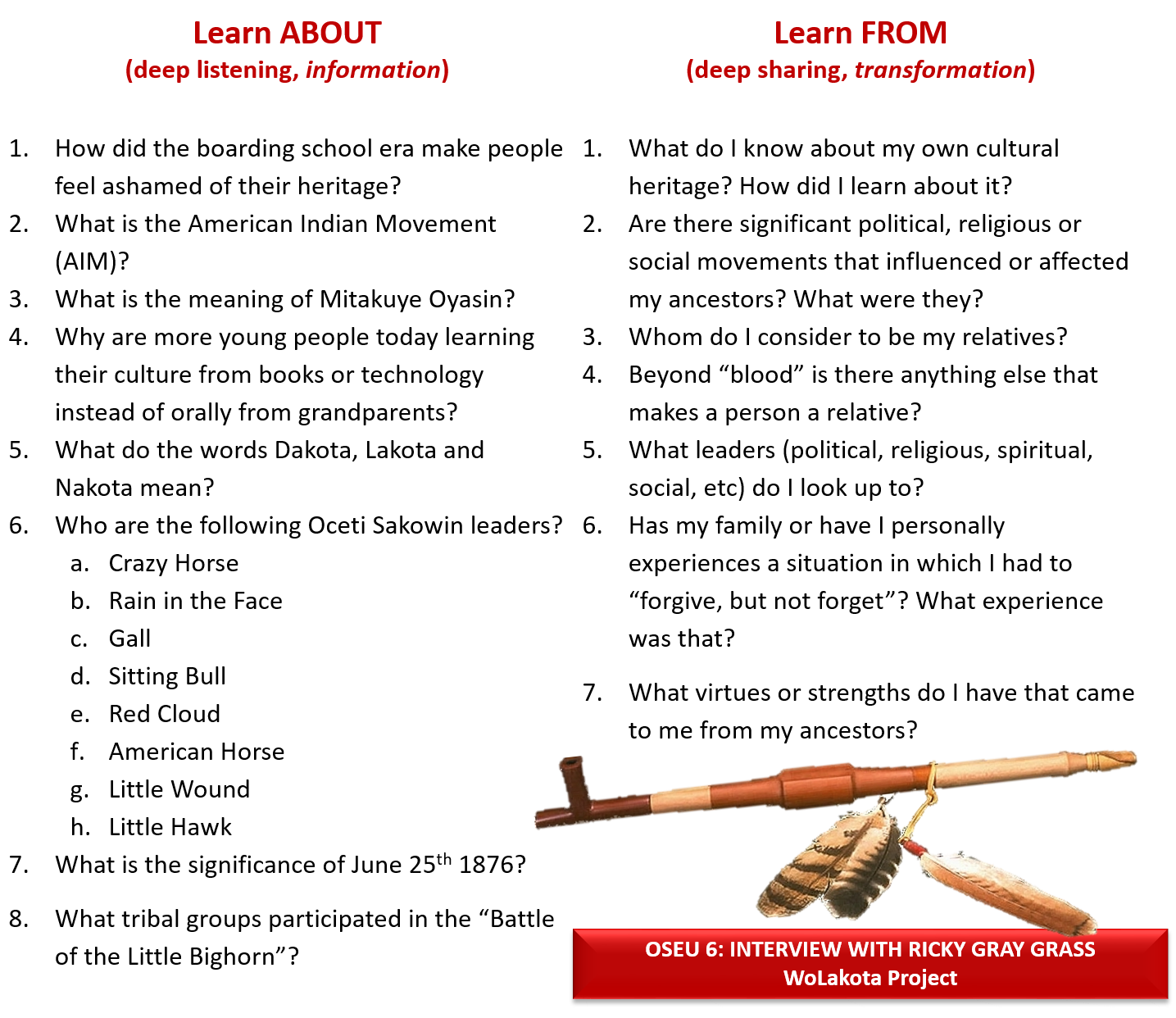
Learn About questions
How did the boarding school era make people feel ashamed of their heritage?
What is the American Indian Movement (AIM)?
What is Mitakuye Oyasin?
Why are more young people today learning their culture from books or technology?
What do the words Dakota, Lakota, and Nakota mean?
Who are the following Oceti Sakowin leaders?
Crazy Horse
Rain in the Face
Gall
Sitting Bull
Red Cloud
American Horse
Little Wound
Little Hawk
What is the significance of June 25, 1876?
What tribal groups participated in the “Battle of the Little Bighorn”?
Learn From questions
What do I know about my own cultural heritage? How did I learn about it?
Are there significant political, religious, or social movements that influenced or affected my ancestors? What were they?
Whom do I consider to be my relatives?
Beyond “blood” is there anything else that makes a person a relative?
What leaders (political, religious, spiritual, social, etc.) do I look up to?
Has my family or have I personally experienced a situation in which I had to “forgive but not forget”? What experience was that?
What virtues or strengths do I have that came to me from my ancestors?
Transcripts
Mitakuye Oyasin - Ricky Gray Grass - OSEU #6
Watch this interview on YouTubeThe cultural, spiritual way of our people was back in the 50s, 40s, 50s, 60s, you know, was kind of, because of the boarding school era, you know, it was kind of shameful to be a Lakota, to be speaking your language and practicing ceremonies. But in the 70s there was a movement, an American Indian Movement, that came about to say it's okay to practice your way, it's okay to talk your language, it's okay to sing and dance the way your grandpa and grandma did, the ancestors did. And so that movement got stronger and stronger as it went on in years.
And in my day, the movement of spirituality was slowly picking up. I was probably one of the younger spiritual leaders slowly learning the way, because I was still in my 20s and I was still learning and learning and learning. But as that was going on, it became stronger. It was stronger to be Lakota, to talk the language, to understand the treaties, to understand the culture, to understand dance, to understand spirituality. So the younger people today, you know, are taught the concept of oyase, a relation. When you... relations.
But oyase is the relations of us, human, grandma, grandpa, mom and dad. Mitakuye is everything that is. And so the young people today, that are learning a way of life from their grandma and grandpa, who didn't experience what my grandma and grandpa did or my mom and dad went through, is learning from books through technology. But to have friends out there that are Lakota, Dakota, to have that background and teaching and learning and words are being said and prayers are connecting.
And so, you know, the importance for our younger people today is to continue to teach and spread the word that I'm Lakota and I'm your friend, because Lakota is an ally and I'm going to be your ally. We're no longer enemies. What happened to my grandpa and grandma and my ancestors has nothing to do with me today, with my friends that are non-Indian. It's their ancestors that made that mistake of coming to divide and conquer what happens today in the world. And so we forgive. A part of us healing is to forgive.
Forgive what happened to my grandpa and grandma. We're not going to forgive, forget, but we're going to forgive you because your ancestors did no better. Greed. Greed is what brought them here to Black Hills to massacre and to bring sickness and to starve our people. But we're strong people. We survived. So, you know, I always tell my kids that, my grandkids that, you know, it's not right to be racist. It's not right to say rude remarks, but to embrace, to show compassion and love, you know.
So, you know, that's what needs to continue with our younger people, you know, because it's going to make a better place in the world for our younger people to understand that it's okay to shake hands with the non-Indian. It's okay to shake hands with the African-American, the Asian person, because we're from one creator. I created heaven and earth. We're from one creator and we all bleed, you know, and we're all going to die. We're all going to go home one day.
And so, you know, our younger people need to know that it's okay to have that compassion with the non-Indian race and continue to be Lakota and be proud of being Lakota. Be proud to speak your language. Be proud that you have a way of life with spirituality. The ancestors, Crazy Horse and Rain in the Face and Gaul and Sitting Bull and Red Cloud, American Horse, Little One, all the great leaders, you know, it still runs through our blood. It didn't stop. They might have passed on, but that bloodline still runs through our blood, you know.
And to be proud of our warrior ancestors and Crazy Horse, you know, all of them, Little Hawks and all the ones that sacrificed themselves, that little bighorn, June 25th, 1876, to show the United States government, the Seventh Cavalry, that you messed with the wrong force of Indians. You know, you've messed with the Lakota, Dakota, Nakota, the Arapaho, and the Cheyenne. And so, you know, I always tell my kids and whoever I'm talking with, the youth, be proud of who you are. You know, we beat the United States government in war.
We took their flag, and that old glory that you see flying at your school, I said, people talk bad about that flag. That flag doesn't belong to the United States of America. That belongs to our ancestors, as we took that from them at war. And so be proud. Be proud of who you are and continue to be proud.
Resource text
Learn ABOUT Learn FROM
(deep listening, information) (deep sharing, transformation)
1. How did the boarding school era make people 1. What do! know about my own cultural
feel ashamed of their heritage? heritage? How did | learn about it?
2. What is the American Indian Movement 2. Are there significant political, religious or
(AIM)? social movements that influenced or affected
3. What is the meaning of Mitakuye Oyasin? my ancestors? What were they?
Why are more young people today learning 3. Whom do | consider to be my relatives?
their culture from books or technology 4. Beyond “blood” is there anything else that
instead of orally from grandparents? makes a person a relative?
5. What do the words Dakota, Lakota and 5. What leaders (political, religious, spiritual,
Nakota mean? social, etc) do | look up to?
6. Who are the following Oceti Sakowin leaders? 6. Has my family or have | personally
Crazy Horse experiences a situation in which | had to
Rain in the Face “forgive, but not forget”? What experience
Gall was that?
Sitting Bull
7. What virtues or strengths do | have that came
Red Cloud
American Horse
Little Wound
. Little Hawk
7. What is the significance of June 25 1876?
to me from my ancestors?
sm +O Q290 TD
8. What tribal groups participated in the “Battle
of the Little Bighorn”? OSEU 6: INTERVIEW WITH RICKY GRAY GRASS
WoLakota Project
Some indexed text was extracted from scanned material. Check the original source for exact wording and spelling.
Source materials
Supplied transcript document. Text preserved as supplied; spellings and transcription uncertainties have not been corrected.
Additional source transcripts
Mitakuye Oyasin
Mitakuye Oyasin - Ricky Gray Grass - OSEU #6
The cultural, spiritual way of our people was back in the 50s, 40s, 50s, 60s, you know, was kind of, because of the boarding school era, you know, it was kind of shameful to be a Lakota, to be speaking your language and practicing ceremonies. But in the 70s there was a movement, an American Indian Movement, that came about to say it's okay to practice your way, it's okay to talk your language, it's okay to sing and dance the way your grandpa and grandma did, the ancestors did. And so that movement got stronger and stronger as it went on in years.
And in my day, the movement of spirituality was slowly picking up. I was probably one of the younger spiritual leaders slowly learning the way, because I was still in my 20s and I was still learning and learning and learning. But as that was going on, it became stronger. It was stronger to be Lakota, to talk the language, to understand the treaties, to understand the culture, to understand dance, to understand spirituality. So the younger people today, you know, are taught the concept of oyase, a relation. When you... relations.
But oyase is the relations of us, human, grandma, grandpa, mom and dad. Mitakuye is everything that is. And so the young people today, that are learning a way of life from their grandma and grandpa, who didn't experience what my grandma and grandpa did or my mom and dad went through, is learning from books through technology. But to have friends out there that are Lakota, Dakota, to have that background and teaching and learning and words are being said and prayers are connecting.
And so, you know, the importance for our younger people today is to continue to teach and spread the word that I'm Lakota and I'm your friend, because Lakota is an ally and I'm going to be your ally. We're no longer enemies. What happened to my grandpa and grandma and my ancestors has nothing to do with me today, with my friends that are non-Indian. It's their ancestors that made that mistake of coming to divide and conquer what happens today in the world. And so we forgive. A part of us healing is to forgive.
Forgive what happened to my grandpa and grandma. We're not going to forgive, forget, but we're going to forgive you because your ancestors did no better. Greed. Greed is what brought them here to Black Hills to massacre and to bring sickness and to starve our people. But we're strong people. We survived. So, you know, I always tell my kids that, my grandkids that, you know, it's not right to be racist. It's not right to say rude remarks, but to embrace, to show compassion and love, you know.
So, you know, that's what needs to continue with our younger people, you know, because it's going to make a better place in the world for our younger people to understand that it's okay to shake hands with the non-Indian. It's okay to shake hands with the African-American, the Asian person, because we're from one creator. I created heaven and earth. We're from one creator and we all bleed, you know, and we're all going to die. We're all going to go home one day.
And so, you know, our younger people need to know that it's okay to have that compassion with the non-Indian race and continue to be Lakota and be proud of being Lakota. Be proud to speak your language. Be proud that you have a way of life with spirituality. The ancestors, Crazy Horse and Rain in the Face and Gaul and Sitting Bull and Red Cloud, American Horse, Little One, all the great leaders, you know, it still runs through our blood. It didn't stop. They might have passed on, but that bloodline still runs through our blood, you know.
And to be proud of our warrior ancestors and Crazy Horse, you know, all of them, Little Hawks and all the ones that sacrificed themselves, that little bighorn, June 25th, 1876, to show the United States government, the Seventh Cavalry, that you messed with the wrong force of Indians. You know, you've messed with the Lakota, Dakota, Nakota, the Arapaho, and the Cheyenne. And so, you know, I always tell my kids and whoever I'm talking with, the youth, be proud of who you are. You know, we beat the United States government in war.
We took their flag, and that old glory that you see flying at your school, I said, people talk bad about that flag. That flag doesn't belong to the United States of America. That belongs to our ancestors, as we took that from them at war. And so be proud. Be proud of who you are and continue to be proud.