Interview · South Dakota · Vernon Ashley · OSEU 1
Themes: Land & stewardship, Storytelling & oral tradition, Values & generosity, Culture & continuity, Food & plants, Listening & observation
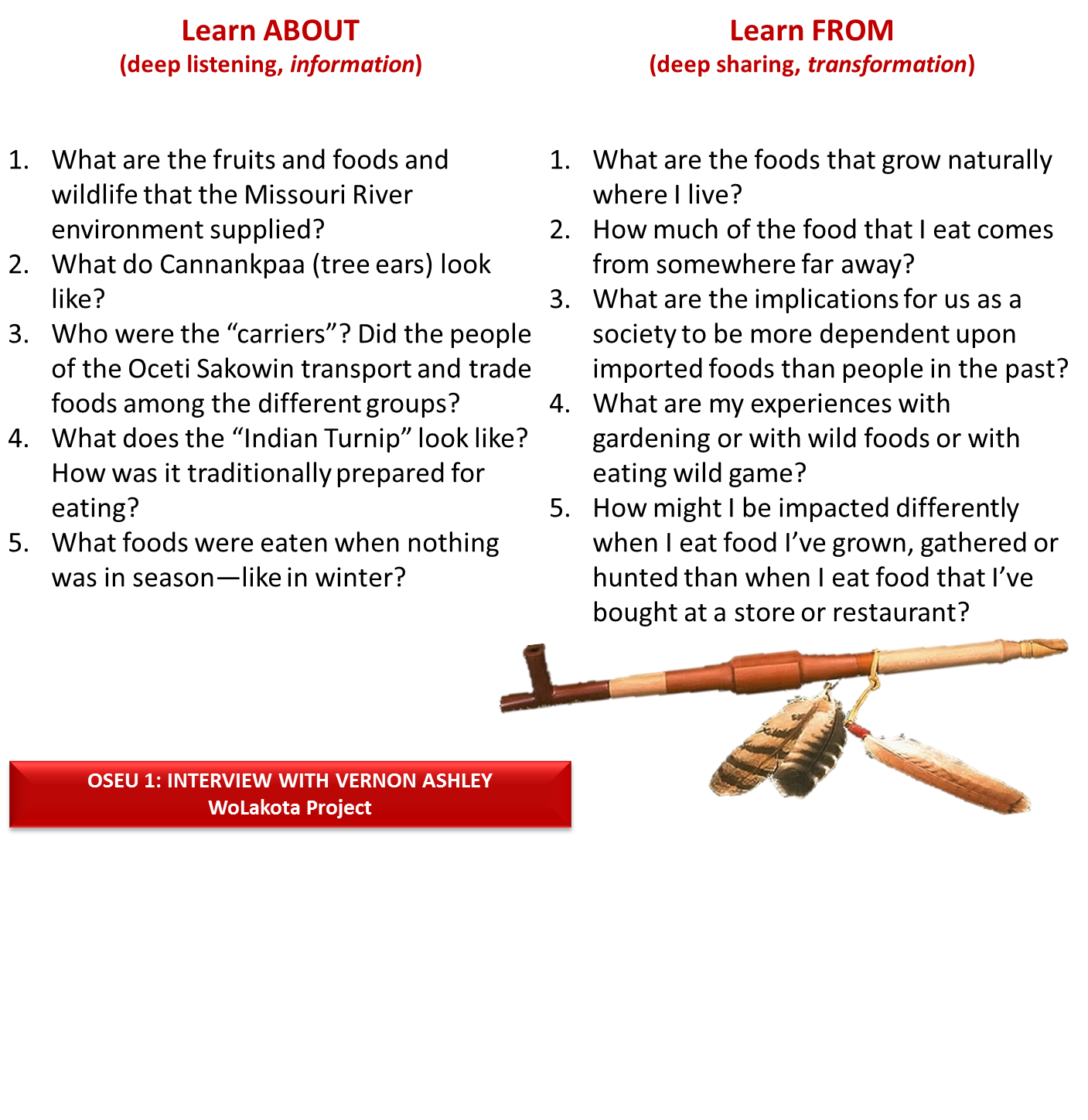
Learn About questions
What are the fruits and foods and wildlife that the Missouri River
What do Cannankpaa (tree ears) look like?
Who were the “carriers”? did the people of the Oceti Sakowin transport and trade foods among the different groups?
What does the “Indian Turnip” look like? How was it traditionally prepared for eating?
What foods were eaten when nothing was in season–like winter?
Learn From questions
What are the foods that grow naturally where I live?
How much of the food that I eat comes from somewhere far away?
What are the implications for us as a society to be more dependent upon imported foods than people in the past?
What are my experiences with gardening or with wild foods or with eating wild game?
How might I be impacted differently when I get food I’ve grown, gathered or hunted than when I eat food that I’ve bought at a store or restaurant?
Transcripts
Indian Foods
Watch this interview on YouTubeIndian Foods - Vernon Ashley - OSEU #6
The Missouri River was the only treed areas. And as I said, there was all kinds of fruit, wildlife, and this sustained us. I grew up eating all this stuff and knowing what the foods are. And the Fish and Wildlife had an article not long ago about Indian foods. I said they forgot one thing: LAKOTA WORD, Tree Ears. But those Tree Ears are mushrooms that grew on trees. The Indians ate those. Because they're finding out those mushrooms were really nutritious, you know. And you find those things. And then when the carriers were traveling from one reservation to the other. And of course, in those days, as I said there’s no transportation. So they just went on foot. But you could dig turnips out here. Right along this bluff. We would probably go out there and find the Indian turnips this spring. That Indian turnip is it's got a nice flower on top, kind of a purplish flower. And the stem is furry, but underneath is a turnip. And that turnips got. Now, I used to have a whole string of them here, but I guess my grandsons took it. It has a bark on it like a tree. Only what you do is you just peel it, and in the center, you'll find this nice white turnip. That was one of the things that the Indian people dried. See, they use the sun to cure their food. There was no refrigeration, so they were ingenious in using the sun and harvesting these foods in season. You know, like a turnip. And Juneberry, the only in June you harvest those because, you know, they turn bitter. And I wanted to tell the Fish and Wildlife that, but I never got a chance to. But the SAME LAKOTA WORD AS ABOVE is a Tree Ear.
Resource text
Additional Related Resources:
Cannunkpaa
or “Tree Ears”
“Indian Turnip” or
Timpsila
Hunting Timpsila in Porcupine
Reservation Maps and Prairie Turnips
Interrelationships Through Storytelling
OSEU 1: INTERVIEW WITH VERNON ASHLEY
WoLakota Project
4.
From the current WoLakota source page:
Indian Foods
Vernon Ashley
Transcript
(deep listening, information)
(deep sharing, transformation)
Some indexed text was extracted from scanned material. Check the original source for exact wording and spelling.
Source materials
Transcripts from supplied documents and the current WoLakota source pages. Text preserved as published.