Interview · South Dakota · Victor Douville · OSEU 2
Themes: Kinship & family, Identity & belonging, Education & learning, Values & generosity, Culture & continuity, Community & responsibility, Listening & observation
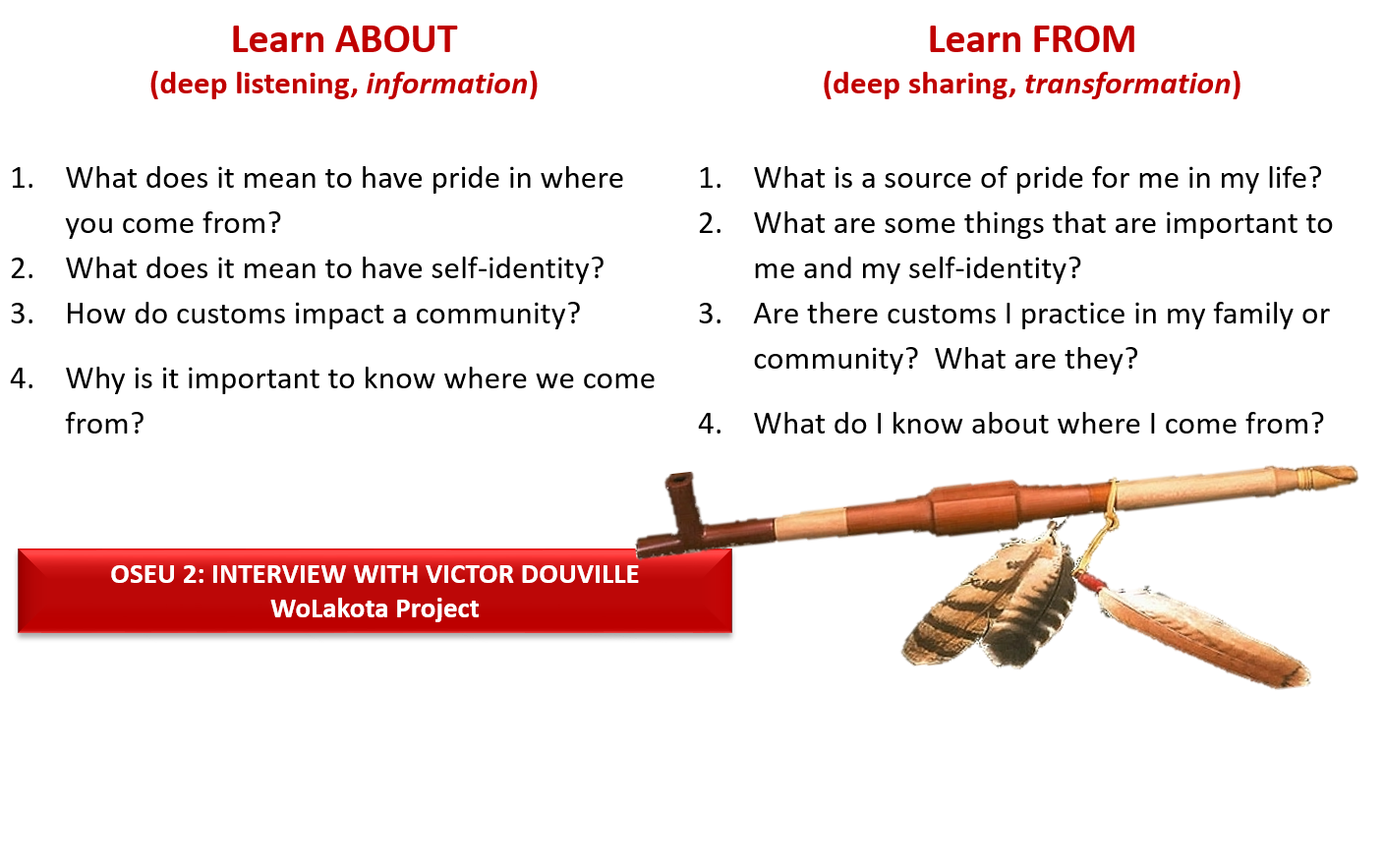
Learn About questions
What does it mean to have pride in where you come from?
What does it mean to have self-identity?
How do customs impact a community?
Why is it important to know where we come from?
What is a source of pride for me in my life?
What are some things that are important to me and my self-identity?
Are there customs I practice in my family or community? What are they?
What do I know about where I come from?
Learn From questions
(deep sharing, transformation)
What is a source of pride for me in my life?
2. What are some things that are important to
me and my self-identity?
3. Are there customs | practice in my family or
community? What are they?
4. What do! know about where | come from?
Transcripts
Pride In Where I Come From - Victor Douville - OSEU #2
Watch this interview on YouTubeYeah, that's true that our traditional culture taught us… that we belong to a specific group. So we identify with a special group that we belong to. So everybody has pride in where they come from… and that's really one of the things that we teach…try to teach the tribe members… because they lost that self-identity. So they're wondering…walking in, in the world of acculturation... and it really hits the family's hard because essentially the family groups are together. They're now being individualized and that…and there's no coherent organization between them.
Whereas a long time ago, they all grouped together, had the same laws… the same customs. So one… if somebody committed a crime, they'd be run out of one committee. They can't join another one unless they change ways. So it's really important to know where you came from… and that's what one of the goals is to teach that.
Resource text
Learn ABOUT Learn FROM
(deep listening, information) (deep sharing, transformation)
1. What does it mean to have pride in where 1. What is a source of pride for me in my life?
you come from? 2. What are some things that are important to
2. What does it mean to have self-identity? me and my self-identity?
3. How do customs impact a community? 3. Are there customs | practice in my family or
woe community? What are they?
4. Why is it important to know where we come y Y
from? 4. What do! know about where | come from?
OSEU 2: INTERVIEW WITH VICTOR DOUVILLE
WoLakota Project
From the current WoLakota source page:
Pride in Where I Come From
Victor Douville
Transcript
(deep listening, information)
What does it mean to have pride in where you come from?
What does it mean to have self-identity?
How do customs impact a community?
Why is it important to know where we come from?
(deep listening, transformation)
What is a source of pride for me in my life?
What are some things that are important to me and my self-identity?
Are there customs I practice in my family or community? What are they?
What do I know about where I come from?
Some indexed text was extracted from scanned material. Check the original source for exact wording and spelling.
Source materials
Supplied transcript document. Text preserved as supplied; spellings and transcription uncertainties have not been corrected.
Additional source transcripts
Pride in Where I Come From
Pride In Where I Come From - Victor Douville -
OSEU #2
Yeah, that's true that our traditional culture taught us… that we belong to a specific
group. So we identify with a special group that we belong to. So everybody has pride
in where they come from… and that's really one of the things that we teach…try to
teach the tribe members… because they lost that self-identity. So they're
wondering…walking in, in the world of acculturation... and it really hits the family's
hard because essentially the family groups are together. They're now being
individualized and that…and there's no coherent organization between them.
Whereas a long time ago, they all grouped together, had the same laws… the same
customs. So one… if somebody committed a crime, they'd be run out of one
committee. They can't join another one unless they change ways. So it's really
important to know where you came from… and that's what one of the goals is to
teach that.