Interview · South Dakota · Victor Douville · OSEU 7
Themes: Land & stewardship, Kinship & family, Education & learning, Values & generosity, Culture & continuity, Food & plants, Community & responsibility, Economy & livelihoods, Listening & observation, Self-determination & leadership, Intergenerational learning
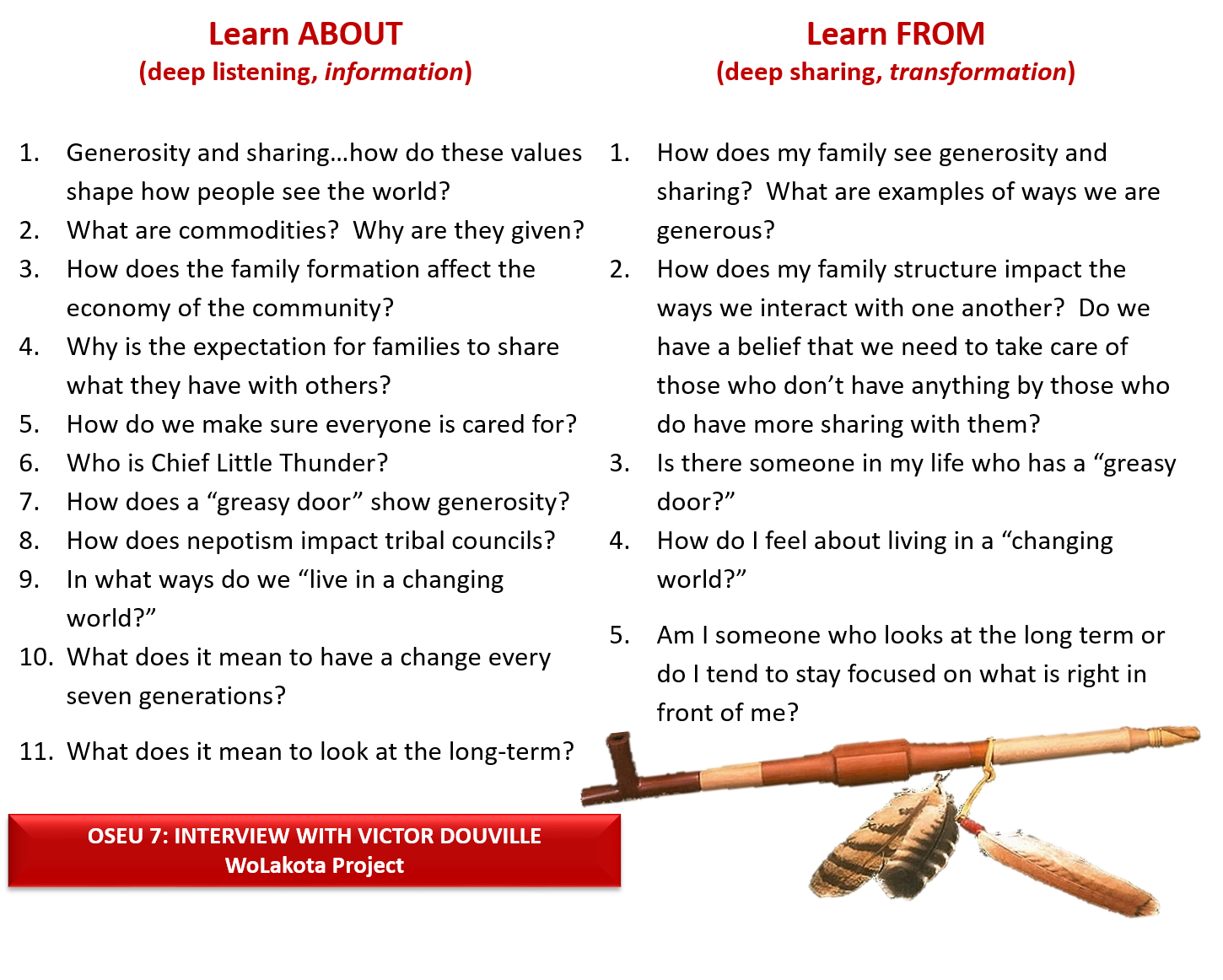
Learn About questions
Generosity and sharing…how do these values shape how people see the world?
What are commodities? Why are they given?
How does the family formation affect the economy of the community?
Why is the expectation for families to share what they have with others?
How do we make sure everyone is cared for?
Who is Chief Little Thunder?
How does a “greasy door” show generosity?
How does nepotism impact tribal councils?
In what ways do we “live in a changing world?”
What does it mean to have a change every seven generations?
What does it mean to look at the long-term?
Learn From questions
How does my family see generosity and sharing? What are examples of ways we are
generous?
How does my family structure impact the ways we interact with one another? Do we have a belief that we need to take care of those who don’t have anything by those who do have more sharing with them
Is there someone in my life who has a “greasy door?”
How do I feel about living in a “changing world?”
Am I someone who looks at the long term or do I tend to stay focused on what is right in front of me?
Transcripts
Generosity & Sharing - Victor Douville - OSEU #7
Watch this interview on YouTubeAgain, we look at the value systems that we have, generosity, caring for our people. We have to be able to work out things as a group rather than individuals. I found out from early life you cannot make it singly. Before I got married, I came back and didn't have a job, so I relied on commodities. I'd get a little box there, it'd be a can of beans, half a cheese, and so I'd get that. When I got married and had family, then those multiplied in four boxes. So as a group, you get not equality, but quantity of food there.
So we know if you work in as a group with mutual sharing, then you'll get ahead. That's why we have to drive the economy that way. We can make changes, too, because I noticed that through all the years of living on reservation in Mission, South Dakota, which is a shopping center for most of our people who go there, I used to go down there and bargain for a can of beans for a family of three. And eventually, because my family numbered about six or seven, we needed more cans. So the buoy store came up with those bigger cans.
And for Powell, it was a big one, a gallon can. So now we change it because we're able to impact the economy. So we used to go down and order maybe a pound of hamburger to feed six of us. It was not enough. So the package got bigger. So we can make those changes if we set our minds to doing that, but we're not sitting there batting over other issues that are coming. So economy is one of the important things, and we need to reform the family first before we get to that. Once we reform the family, then they'll know how to operate the economy.
Our economy has to be able to solve the problem of the non-Indian way, in our way, because sharing and generosity is a standard. And if you hold things, the people will turn their backs on you. If you get a large amount of money and put it in a bank and your relatives come with nothing, you'll expect to share with them. You don't. They'll turn their backs on you. I learned that from experience by trying to run there and get money and just turn away when they come for money. They cut me off a while, so I realized I came back and gave.
But it's mutual, like I said. They have to give back. So that way you share and make it work in the systems. We've got a long way to go because we have to figure out how to make a living off the land, and the family structure has to be improved, and then the economy will grow well. So it's always the idea of sharing, giving, and making sure everybody's taken care of. That's one of our leaders, Jan Rossi, played a large role in his life, a man by the name of Little Thunder, Chief Little Thunder.
When the people came to him, the strangers would come and look for the chief. And he noticed that everybody was going to his one teepee. When they leaved, the door was greasy. That meant that people got food, and when they came out, they opened it. It meant the guy was generous because he had a greasy door. So people knew that the highest value, and that's what he did, the highest value is he taught Spotted tail that. We're still trying to figure a way how Spotted tail, how he was able to take care of his relatives and non-relatives.
The government, when the oil came, they funded us for a lot of programs, and they did not want nepotism in there. And the T.O.H. by C.I.T., relative to care for each other, which by advanced system, how spontaneous, we have to learn how to do that. That's a problem for a tribal council, because a lot of self-interest in there. So that's what the values are learning, and it boils down to the values. So the economy has to work within our site as well as the non-Indian, maybe teach them a few things as they come down.
And that's one of the biggest things that I realized, that T.O.H. by C.I.T. was the center of this. It still wasn't broken, although the government pretty well fixed it, well, it kind of broke apart, but it began to band back together. They're trying to realize, trying to figure out why we have this 90% unemployment, and why there's low income rate. So you guys should be technically dead, but it's the relatives that go and they share. The T.O.H. by C.I.T. is still there.
It's beginning to, and Nucleus is always there to bring in the ones that share, and that's why we survive, you know. All these years that I finally realized that I'm in the center, my family, we're the Nucleus, we're all of our grandchildren, and the sons, they come to us when they need things. Well, we ensure that they use it for what it's supposed to. A lot of Nucleus, we don't give them the help that they need, and always take care of them as long as we live, and as long as they continue to build on their values, that's a good thing.
But we've got a long way to go on that. But that's what we teach at the university, those things, and sometimes it goes on one year or the other, so we're trying to make it to block inside, and it's a tough goal, but I think that's one of the dreams that we have. But I believe we're beginning to barely pull it together, and I think in the future it looks pretty good for us. Thank you so much for sharing. Just that the idea that we live in a changing world, and even our old tradition also talks about that.
They talk about every seven generations, the longest extended system, the seven generations, that seven generations, you must have a change. You must not go back to the, you have to continue to change, evolving. If we don't, then we'll surely do like, we'll live a stagnant life, and our societies will surely die. I never forgot that, we said that we live for this four generations, seven generations, which is the extended, and realized, how come we have like seven generations?
Because the oldest grandfather is 17 years old, that they know, that they know of now, so seven is the four generations, the longer extended generation, and four years is the family system. So that's quite a distance, so you have to change in 70 years, begin to change. In the next six generations of 70 years, you have to have that complete change at the end, which it's about 250 years, I think, is the entire. In the non-Indian world, you have to change real fast. It's a dynamic world that you live in, and they change rapidly.
So trends last for maybe four years, five years, and they move on, whereas we still build on them. But that's what I want to say, that we're looking at the long term, and looking at how our people can learn these and begin to reform and change those systems. In that way, as I've lived a long life, all the experience I had, trying to teach that to the younger generation, and mainly with my family, to be able to get them to understand what we're trying to do, and be able to build on that, and only then will we survive as a people.
Resource text
From the current WoLakota source page:
Generosity & Sharing
Victor Douville
Transcript
(deep listening, information)
(deep listening, transformation)
Some indexed text was extracted from scanned material. Check the original source for exact wording and spelling.
Source materials
Supplied transcript document. Text preserved as supplied; spellings and transcription uncertainties have not been corrected.