Interview · South Dakota · Donald Montileaux · OSEU 4
Themes: Kinship & family, Storytelling & oral tradition, Education & learning, Values & generosity, Culture & continuity, Food & plants, Listening & observation, Children & young people
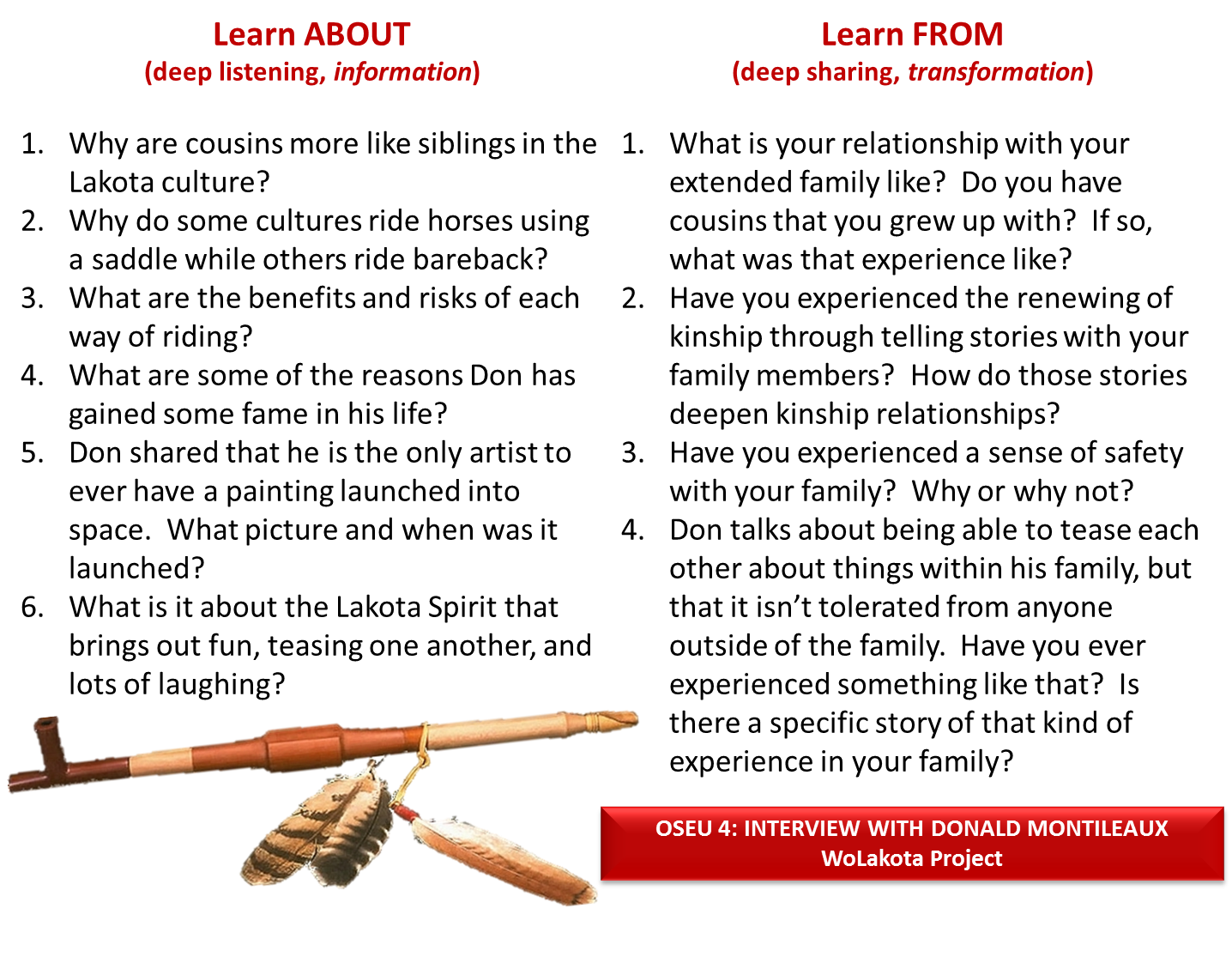
Learn About questions
Why are cousins more like siblings in the Lakota culture?
Why do some cultures ride horses using a saddle while others ride bareback?
What are the benefits and risks of each way of riding?
What are some of the reasons Don has gained some fame in his life?
Don shared that he is the only artist to ever have a painting launched into space. What picture and when was it launched?
What is it about the Lakota Spirit that brings out fun, teasing one another, and lots of laughing?
Learn From questions
Wha is your relationship with your extended family like? Do you have cousins that you grew up with? If so, what was that experience like?
Have you experienced the renewing of kinship through telling stories with your family members? How so these stories deepen kinship relationships?
Have you experienced a sense of safety with your family? Why or why not?
Don talks about being able to tease each other about things within his family, but that it isn’t tolerated from anyone outside the family. Have you ever experienced something like that? Is there a specific story of that kind of experience in your family?
Transcripts
Cousins and Relatives - Donald Montileaux - OSEU 4
Watch this interview on YouTubeI have real close relationships with my cousins, my first cousins, my mom's sister. My mom was Clara, her sister was Hope, and she had others too. But her and Hope were just real tight.
And that made me real tight with their kids too. Like, Hope's children are my brothers and sisters.
I mean, they're just, I'm one of the family, you know, I'm uncle to their kids, you know, and stuff like that.
But there's always something about brothers and sisters too, because brothers and sisters, they stay together 24 hours a day.
Like me, even though I was close, I still went home to bed, you know, so I did. And they'd wake up, but I'd be in bed with them because my folks went to school early, I mean, went to work early. But I have real close ties with a lot of my relations out on the reservation, because I'm also a cowboy. And we learned how to ride horseback and saddle up and all that stuff. And it was really unusual. My grandma and my uncle Lenny, who my dad reined cows with, were brothers and sisters.
And when I was with my grandma, and her name was Ellen Steele, but we couldn't ride with a saddle over at her place, we had to ride bareback. Because we'd get drugged, you know, that was her big thing. But then my uncle wouldn't let us ride bareback because that was unsafe. You better ride in a saddle because you're safer in a saddle than you are bareback.
So just brothers and sisters, but still two different views. So I learned how to ride bareback and saddle.
I was pretty good at both of them.
But it was just amazing. I didn't like riding bareback because I'd bounce all over and fall off. And saddle, I was pretty good with the saddle. But you don't know, you get those kinships when you're really young and you share them, you know, like somebody would cut themselves or hurt themselves. I always get trapped because one time I was eating Thanksgiving at my Aunt Hope's place and I was making fun of my cousin's food because he had a lot of it in there. He had a big pie with a lot of ice cream on top of it.
And I was making fun of him and I looked at my own and I had more than he had and I was going to cover it up and I was caught already, you know. And so wherever we're together, remember Donnie when you had all that? And so, you know, those things. But it's a way of renewing that kinship that you had, you know. It's a way of just making you common, you know. I have gained some fame for doing some things that others haven't.
And one time I got a painting launched in space and I called up my good buddy Arthur Amiet and I said, Arthur, I got my painting launched in space and I'm the only artist alive that has had this happen at this time period. He said, no, you're not. I said, oh yeah, I am because, I mean, they did research and I am the only one. And he said, well, I heard about that. And so I went down to the Coast to Coast in Custer last night and I got one of those sky rockets and I panned the nose cone and I launched it. So you're the second one.
So it's just a way of bringing you back, you know. And I think, I don't know, probably all people do that, you know.
All cultures do that.
But I'm familiar with Lakota culture and that's, and we're always laughing. We always have fun, you know. And no matter, they, I always, I see poverty down there. I see the hardness, the harshness of life that they have. But you sit with those people for five or ten minutes and we're all laughing. I mean, that totally a way, I mean, spirit. You know, it's a spirit within you that brings that out. The kinship and you're, nobody can hurt you when you're together. You know, you have a unity and a bond.
I mean, we can all make fun of each other, but don't anybody else make fun of us because that's, that wouldn't be good. That person better be running when he does it. So that's, you know, that's kinship. I mean, there's a lot of it.
Resource text
From the current WoLakota source page:
Cousins and Relatives
Donald Montileaux
Transcript
(deep listening, information)
(deep listening, information)
Some indexed text was extracted from scanned material. Check the original source for exact wording and spelling.
Source materials
Supplied transcript document. Text preserved as supplied; spellings and transcription uncertainties have not been corrected.