Interview · South Dakota · Faith Spotted Eagle · OSEU 6
Themes: Land & stewardship, Treaties & sovereignty, Healing & resilience, Values & generosity, Culture & continuity, Listening & observation
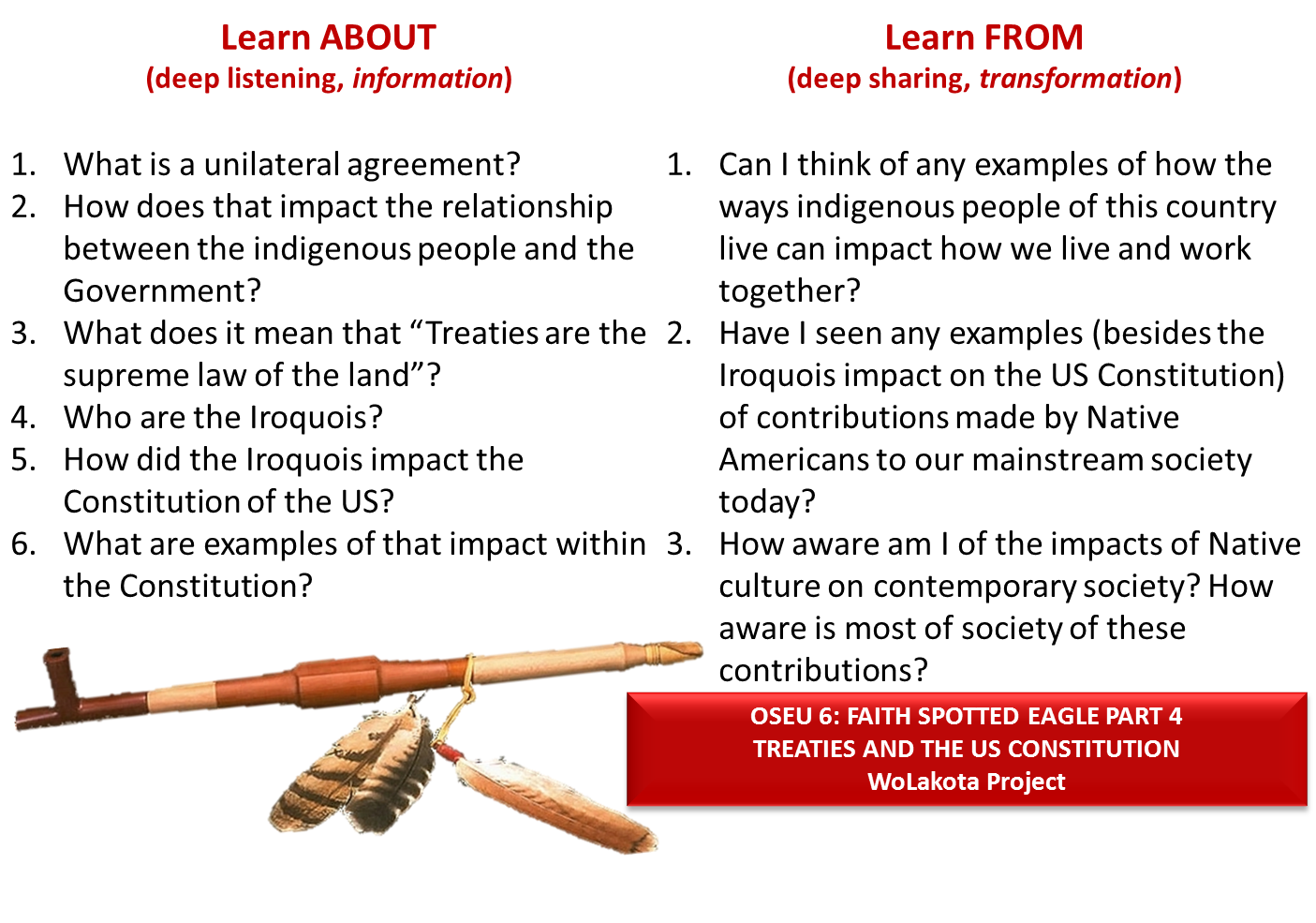
Learn About questions
What is a unilateral agreement?
How does that impact the relationship between the indigenous people and the Government?
What does it mean that “Treaties are the supreme law of the land”
Who are the Iroquois?
How did the Iroquois impact the Constitution of the US?
What are examples of that impact within the Constitution?
Learn From questions
Can I think of any examples of how the ways indigenous people of this country live can impact how we live and work together?
Have I seen any examples (besides the Iroquois impact on the US Constitution) of contributions made by Native Americans to our mainstream society today?
How aware am I of the impacts of Native culture on contemporary society? How aware is most of society of these contributions?
Transcripts
Pt 4 Treaties and the US Constitution - Faith Spotted Eagle - OSEU 6
Watch this interview on YouTubeThe exciting thing that is still retained about the treaties is that they were unilateral agreements between two sovereigns, meaning that it was indigenous Dakota Native people here and the U.S. government, and it was equal. And so that's still, we still retain that. The other way that it's supported and retained, even though the U.S. government refuses sometimes to recognize that, and maybe these younger people that are listening to this can change this because this is about healing, it's about forgiving, is to recognize that.
Do you know what the sixth article of the U.S. Constitution is? That treaties are the supreme law of the land. It actually says that in the U.S. Constitution. Treaties are the supreme law of the land. And so that somehow was able to be preserved in the U.S. Constitution. And then the other element, of course, and this could be exciting research for the classes that hear this, is to research how the U.S. Constitution was based on the Iroquois, and that Ben Franklin and other historians or politicians studied Native people and how we governed.
And so many of the ways of the Constitution were based on how we lived as a people, as aboriginal indigenous people.
Resource text
OSEU 6: FAITH SPOTTED EAGLE PART 4
TREATIES AND THE US CONSTITUTION
WoLakota Project
From the current WoLakota source page:
Treaties and the US Constitution
Faith Spotted Eagle
Transcript
(deep listening, information)
(deep listening, information)
Some indexed text was extracted from scanned material. Check the original source for exact wording and spelling.
Source materials
Supplied transcript document. Text preserved as supplied; spellings and transcription uncertainties have not been corrected.
Additional source transcripts
Treaties and the US Constitution
Pt 4 Treaties and the US Constitution - Faith Spotted
Eagle - OSEU 6
The exciting thing that is still retained about the treaties is that they were unilateral
agreements between two sovereigns, meaning that it was indigenous Dakota Native
people here and the U.S. government, and it was equal. And so that's still, we still retain
that. The other way that it's supported and retained, even though the U.S. government
refuses sometimes to recognize that, and maybe these younger people that are
listening to this can change this because this is about healing, it's about forgiving, is to
recognize that.
Do you know what the sixth article of the U.S. Constitution is? That treaties are the
supreme law of the land. It actually says that in the U.S. Constitution. Treaties are the
supreme law of the land. And so that somehow was able to be preserved in the U.S.
Constitution. And then the other element, of course, and this could be exciting research
for the classes that hear this, is to research how the U.S. Constitution was based on the
Iroquois, and that Ben Franklin and other historians or politicians studied Native people
and how we governed.
And so many of the ways of the Constitution were based on how we lived as a people,
as aboriginal indigenous people.