Interview · South Dakota · Faith Spotted Eagle · OSEU 2
Themes: Land & stewardship, Language & revitalization, Kinship & family, Education & learning, Treaties & sovereignty, Boarding schools & assimilation, Healing & resilience, Spirituality & ceremony, Values & generosity, Culture & continuity, Food & plants, Arts & expression, Community & responsibility, Listening & observation, Children & young people
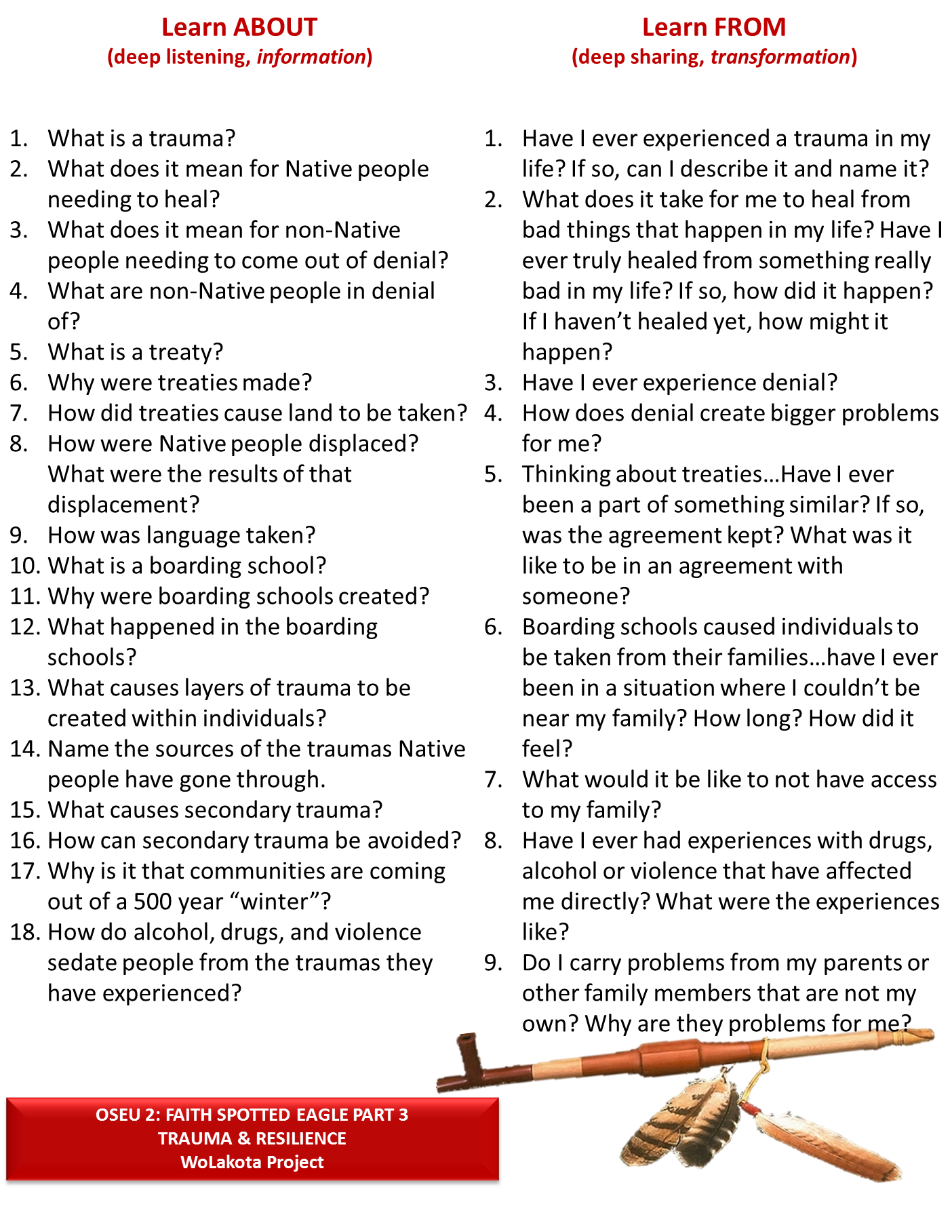
Learn About questions
What is trauma?
What does it mean for Native people needing to heal?
What does it mean for non-Native people needing to come out of denial?
What are non-Native people in denial of?
What is a treaty?
Why are treaties made?
How did treaties cause the land to be taken?
How were Native people displaced? What were the results of that displacement?
How was language taken?
What is a boarding school?
Why were boarding schools created?t
What happened in the boarding schools?
What causes layers of trauma to be created within individuals?
Name the sources of the traumas Native people have gone through.
What causes secondary trauma?
How can secondary trauma be avoided?
Why is it that communities are coming out of a 500-year “winter”?
How do alcohol, drugs, and violence sedate people from the traumas they have experienced?
Learn From questions
Have I ever experienced trauma in my life? If so, can I describe it and name it?
What does it take for me to heal from bad things that happen in my life? Have I ever truly healed from something really bad in my life? If so, how did it happen? If I haven’t healed yet, how might it happen?
Have I ever experienced denial?
How does denial create bigger problems for me?
Thinking about treaties…Have I ever seen a part of something similar? If so, was the agreement kept? What was it like to agree with someone?
Boarding schools caused individuals to be taken from their families…have I ever been in a situation where I couldn’t be near my family? How long? How did it feel?
What would it be like to not have access to my family?
Have I ever had experiences with drugs, alcohol, or violence that have affected me directly? What were the experiences like?
Do I carry problems from my parents or other family members that are not my own? Why are they problems for me?
Transcripts
Trauma & Resilience - Faith Spotted Eagle - OSEU 2
Watch this interview on YouTubeI think probably…when we talk about these losses and these traumas, it’s important to…since the student body that will be watching this is native and non-native and other cultures… that when we talk about this, it is not to impart a sense of guilt. It is to impart a sense of freedom from denial. So, by…and when you look at that trauma response, the native peoples objective is to heal. The non-native peoples objective is to come out of denial. And when these folks can come out of denial…and these ones can start to heal…then they can start to come together on common ground. But I think, probably…there’s many layers of trauma. When the original treaties were made, there were two reasons why the treaties were made. One was to make peace, obviously, and the second one was for land taking. It was primarily to create agreements to take land. And so, that was a main trauma because we didn’t have a concept of, “Oh this is my forty acres.” It’s like, “I’m hunting in that area. Other relatives come and hunt.” So it wasn’t…it was more like natural law. You didn’t hunt in that area where the Blackfeet were there. You didn’t hunt in that area when the Shoshone were there. So you kind of give and take. But…when the immigrants started to come in from Europe, America primarily…what would begin to happen was…there was a sense of displacement where the hunting areas could no longer be accessed. And so, that really actually created direct starvation which is a major trauma with Indian children…or for any children. And then, another one that was really difficult…and we’re just now reclaiming that…we live in an exciting era of reclamation…is that the taking of one’s language is an act of war because you’re saying “You can’t speak anymore on the way you understand the world.” So, what happened was when…and that didn’t even affect our resiliency… when the language was taken…when the ceremonies were outlawed…I do believe that the thing that did the most damage was when thousands of Indian children…native children…were shipped off to boarding schools. And these boarding schools were not just down the road. They were like in…Minnesota…Wisconsin…California…Carlisle, Pennsylvania…West Virginia…all over the country. These little tiny children were put on trains. And at this point in my life, I have an eight-year-old granddaughter and I can’t even picture putting her on a train and sending her to Virginia by herself. I can’t even picture that. But they were…that was done…and when that happened…the children began to come home damaged with trauma. They had been molested and you can’t really tell your grandma about that. You say, “Grandma, something happened.” But you’re not going to describe it. And then it gets buried…and that’s a trauma…that’s another layer. And then, when you get to be twenty…sixteen…twenty-five…it’s still there. It doesn’t go away. So then people begin to sedate themselves…another layer happens where alcohol and drugs comes in. So there’s another layer of trauma. And then, when you have drugs and alcohol, violence enters the picture. Violence comes into the room. And then there’s another layer. It’s like, “Oh no. I saw an act of violence.” And actually that is something that all of America is dealing with. It’s not just native people… because we do live in a lot of violence. And so, those are those layers of trauma. And when you have a stack this high…and somebody is pushing on you…that stack gets a little bit shaky. And you have to be aware of that because…but the important thing is that you can begin to resolve some of those. And it’s…it behooves us to do that… because if we don’t do that, we’re going to impart this stack to our children. And they’re going to not only have to carry their own stacks, but they’ll have to carry our traumas. And that’s called secondary trauma. So, if I feel for ever…like a martyr…or I feel like a victim, then I am going to impart that to my children. And they have to carry that for me. But I think we’ve done…we’re in an era where we’ve come out of a very long…five-hundred year winter. And sobriety is happening in the communities. I think the current challenge…probably…is the violence…and the meth…the drugs in the community. And that’s for everyone. And so, hopefully, we won’t need those to sedate us if we can begin to address that trauma. And then the other…the exciting thing about it is that once healing starts, it doesn’t have to be a lifelong process…it gets to be a lifelong process. And so, I…the way I look at it is that…if you haven’t figured it out by you’re ninety, then you’re going to have to do it in the next lifetime…the next time around. But healing is an exciting process. And that’s what resiliency is. We’ve gone through so many traumas… and still here we are laughing…and we’re talking about round dances… and standing up for various things…so I think you just do what you have to do, especially when it involves children.
Resource text
OoNDW
10.
11.
12
13.
14.
15
18.
OSEU 2: FAITH SPOTTED EAGLE PART 3
TRAUMA & RESILIENCE
WoLakota Project
3.
How did treaties cause land to be taken? 4.
9.
From the current WoLakota source page:
Trauma & Resilience
Faith Spotted Eagle
Transcript
(deep listening, information)
(deep listening, transformation)
Some indexed text was extracted from scanned material. Check the original source for exact wording and spelling.
Source materials
Supplied transcript document. Text preserved as supplied; spellings and transcription uncertainties have not been corrected.