Interview · South Dakota · Joseph Marshall III · OSEU 4
Themes: Kinship & family, Identity & belonging, Education & learning, Values & generosity, Culture & continuity, Community & responsibility, Economy & livelihoods, Listening & observation, Children & young people, Humor & play, Intergenerational learning
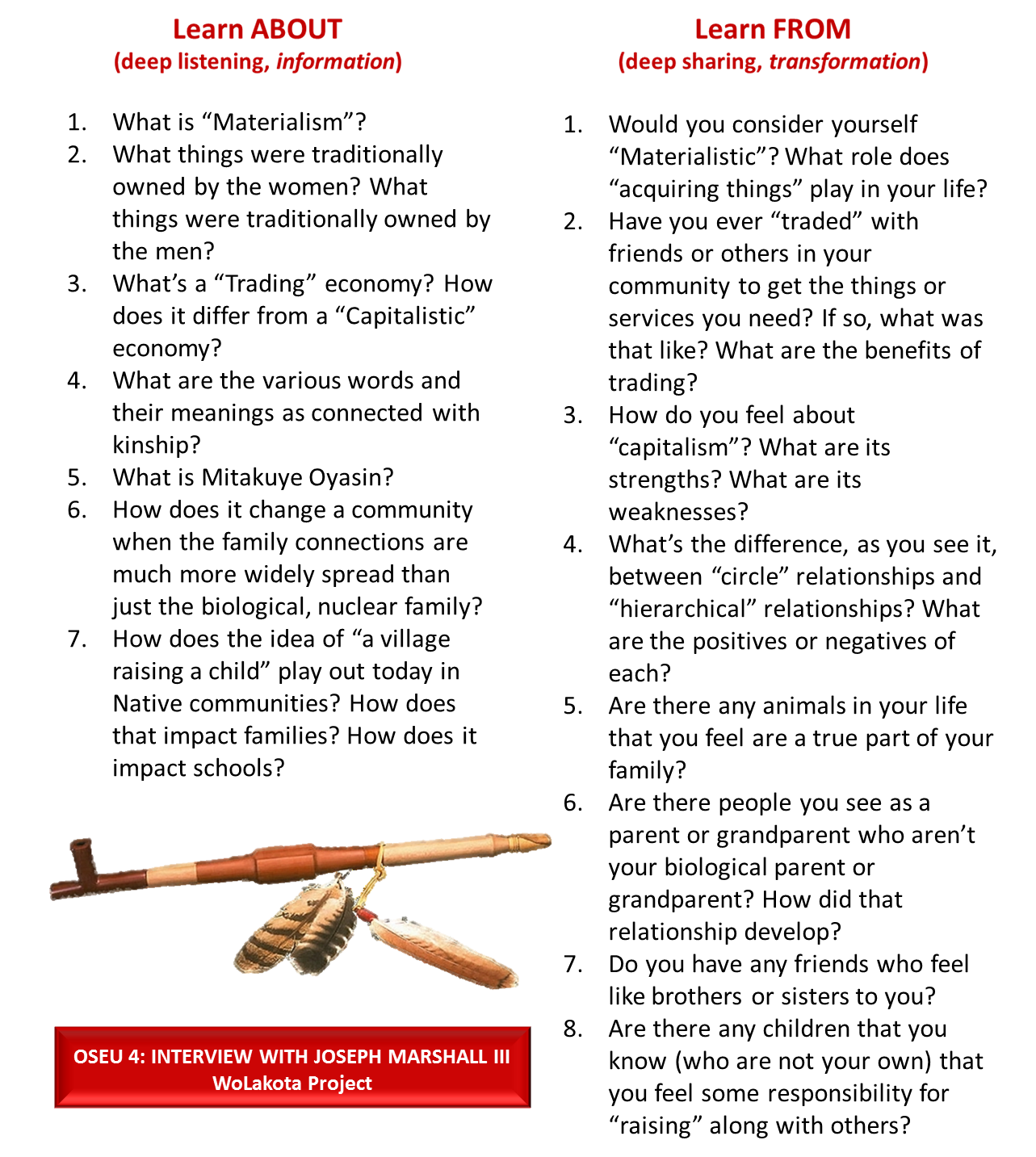
Learn About questions
What is “Materialism?”
What things were traditionally owned by the women? What things were traditionally owned by the men?
What’s a “Trading” economy? How does it differ from a “Capitalistic” economy?
What are the various words and their meanings as connected with kinship?
What is Mitakuye Oyasin?
How does it change a community when the family connections are much more widely spread that just the biological, nuclear family?
7. How does the idea of “a village raising a child” play out today in Native communities? How does that impact families? How does it impact schools?
Learn From questions
Would you consider yourself “Materialistic”? What roles does “acquiring things” play in your life?
Have you ever “traded” with friends or other in your community to get the things or services you need? If so, what was that like? What are the benefits of trading?
How do you feel about “capitalism”? What are its strengths? What are its weaknesses?
What’s the difference, as you see it, between “circle” relationships and “hierarchical” relationships? What are the positives or negatives of each?
Are there any animals in your life that you feel are a true part of your family?
Are there people you see as a parent or grandparent who aren’t your biological parent or grandparent? How did that relationship develop?
Do you have any friends who feel like brothers or sisters to you?
Are there any children that you know (who are not your own) that you feel some responsibility for “raising” along with others?
Transcripts
Mitakuye Oyasin - Joseph Marshall III - OSEU 4
Watch this interview on YouTubeMaterialism was not a big thing. I mean, we owned stuff. Sure, we did. We had to. We owned our... Other women owned their teepees, and we all owned our clothing and stuff. We had to acquire stuff in order just to get by every day. But it wasn't for the sake of stockpiling it so we could have more than everybody else, because that's not what our economy was based on. If we had an economy at all, it was a trading economy. We traded within our communities, and with other tribes. But it was not a capitalistic economy. It was not by any means.
And it all goes back to the circle. It's the ultimate symbol of kinship, as we were taught. Everything and everyone that's alive belongs in that circle. It's very simple. It doesn't matter whether you're an ant or a buffalo or people or a bird or anything else. Any of the variety of life that we have here in this part of the country, that our ancestors were part of, everything belonged in that circle. And so we're all related in that sense. That's the larger kinship. And that's why we say, because we invoke that connection to everything that is.
And no one has a higher or lower place in that circle. No one is first and no one is last. And it's the same way within our own familial kinship system. I mean, we all know it. I mean, those of us who are aware of our culture know it. The brothers of your father are also, you are dressed as ate. And the only uncle you have is your mother's brothers.
That's your uncle. And your mother's sisters, if she has any, you're also dressed as ina. And the only auntie you have are your father's sisters. So what that does is it brings everybody closer in concept.
Because look at all the mothers you have. Look at all the dads you have. By the same way, look at all the grandmas and grandpas you have out there. When I was a kid, all these old people would come visit us. My grandma and grandpa always said, there's your grandpa, there's your grandma. So I always addressed them as such. Whether they really were by blood or not didn't matter. Because what that did is it created that relationship. I have a grandmother to grandson relationship with that person. I have a grandfather to grandson relationship.
And there were numerous kinds of those relationships. And what it did is it enabled that sense of who I was. It affirmed it. It made me feel good about myself to have all these people there when I needed them, if I needed them. I remember a few years ago somebody was talking about the fact that somebody wrote a book or somebody came up with the concept that the village raises a child. No big deal. We've been doing that for a long time. It's not new to us. But we just need to do more of it. We need to, again, make it an important part of the process.
Resource text
OSEU 4: INTERVIEW WITH JOSEPH MARSHALL III
WoLakota Project
From the current WoLakota source page:
Mitakuye Oyasin
Joseph Marshall III
Transcript
(deep listening, information)
(deep listening, information)
Some indexed text was extracted from scanned material. Check the original source for exact wording and spelling.
Source materials
Supplied transcript document. Text preserved as supplied; spellings and transcription uncertainties have not been corrected.
Additional source transcripts
Mitakuye Oyasin
Mitakuye Oyasin - Joseph Marshall III - OSEU 4
Materialism was not a big thing. I mean, we owned stuff. Sure, we did. We had to. We
owned our... Other women owned their teepees, and we all owned our clothing and
stuff. We had to acquire stuff in order just to get by every day. But it wasn't for the sake
of stockpiling it so we could have more than everybody else, because that's not what
our economy was based on. If we had an economy at all, it was a trading economy. We
traded within our communities, and with other tribes. But it was not a capitalistic
economy. It was not by any means.
And it all goes back to the circle. It's the ultimate symbol of kinship, as we were taught.
Everything and everyone that's alive belongs in that circle. It's very simple. It doesn't
matter whether you're an ant or a buffalo or people or a bird or anything else. Any of the
variety of life that we have here in this part of the country, that our ancestors were part
of, everything belonged in that circle. And so we're all related in that sense. That's the
larger kinship. And that's why we say, because we invoke that connection to everything
that is.
And no one has a higher or lower place in that circle. No one is first and no one is last.
And it's the same way within our own familial kinship system. I mean, we all know it. I
mean, those of us who are aware of our culture know it. The brothers of your father are
also, you are dressed as ate. And the only uncle you have is your mother's brothers.
That's your uncle. And your mother's sisters, if she has any, you're also dressed as ina.
And the only auntie you have are your father's sisters. So what that does is it brings
everybody closer in concept.
Because look at all the mothers you have. Look at all the dads you have. By the same
way, look at all the grandmas and grandpas you have out there. When I was a kid, all
these old people would come visit us. My grandma and grandpa always said, there's
your grandpa, there's your grandma. So I always addressed them as such. Whether
they really were by blood or not didn't matter. Because what that did is it created that
relationship. I have a grandmother to grandson relationship with that person. I have a
grandfather to grandson relationship.
And there were numerous kinds of those relationships. And what it did is it enabled that
sense of who I was. It affirmed it. It made me feel good about myself to have all these
people there when I needed them, if I needed them. I remember a few years ago
somebody was talking about the fact that somebody wrote a book or somebody came
up with the concept that the village raises a child. No big deal. We've been doing that for
a long time. It's not new to us. But we just need to do more of it. We need to, again,
make it an important part of the process.