Interview · South Dakota · Eli Tail Sr. · OSEU 7
Themes: Land & stewardship, Values & generosity, Community & responsibility, Economy & livelihoods, Listening & observation, Self-determination & leadership
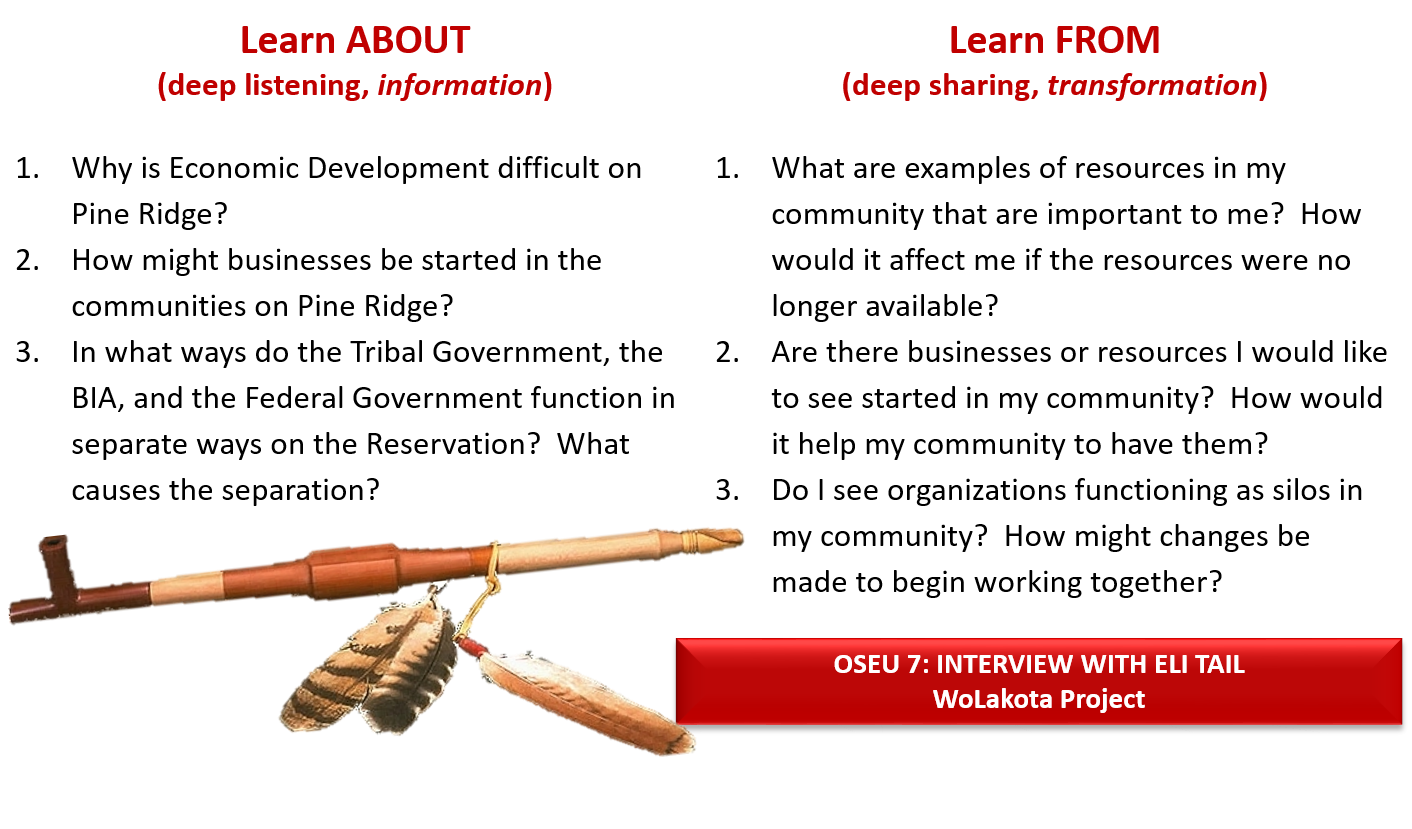
Learn About questions
Why is Economic Development difficult on Pine Ridge?
How might businesses be started in the communities on Pine Ridge?
In what ways do the Tribal Government, the BIA, and the Federal Government function in separate ways on the Reservation? What causes the separation?
Learn From questions
What are examples of resources in my community that are important to me? How would it affect me if the resources were no longer available?
Are there businesses or resources I would like to see started in my community? How would it help my community to have them?
Do I see organizations functioning as silos in my community? How might changes be made to begin working together?
Transcripts
Economic Development
Watch this interview on YouTubeEconomic Development - Eli Tail Sr. - OSEU 7
We have ideas about how we can get our people working there, because Pine Ridge,
Nebraska, it goes to Pine Ridge Reservation on to Rapid City, and there is no gas
station, restaurant, anything there. And this is why I'm trying to get one there close to
the housing projects on Two Rapid City, get someone to get gas station restaurants
there so they can come to the restaurants. But there's nothing there.
Anything that money comes into, the tribe, the Oglala Sioux Tribe, they give us lots of
money, but the Oglala Sioux Tribe government is the people that govern. The center of
the Oglala Sioux Tribe gives us money to the Indians, goes to the Oglala Sioux Tribe,
and we don't give nothing. Because it's in their name, Oglala Sioux Tribe, the
government. And the Bureau of Indian Affairs is another one. And now there's a
Shannon County Board of Commissioners, another one. So there are three entities
there. They get their own money. They got their own money.
BIA got their own money. And we don't get nothing. They just use us. How many people
are there? Yeah, just this many people, okay. I don't know where they get their funding,
but they get their money. And how about these guys? Well, they use the same system.
They get their money in the Bureau of Indian Affairs too. have nothing. They give us
Social Security. That's all they do. They push us off on Social Security. Grants, they call
it a grant. And these other governments, they have our money. In fact, there's three of
them.
What's the last one, Sharpsville? No, it's not Sharpsville. Thunder Valley. There's
another one. They get reform and cooperation. They get their own. There's Pocopan
District. There's a government committee, each one. We live in everything. But the
reform and cooperation, it's not how it was set up a long time ago for the Lakota or
Indians. Now it's all gone. And we are all just like out here. Just like out here. State, do
anything you want to, but you have to go with, to the county or state or that way.
So you can sit by land and you just create something there. See, that's simple. The
tribal government is not tribal government no more. It's just Shannon County, tribal
government, Bureau of Indian Affairs, three entities, three bosses sitting on primary
resolutions.
Resource text
OSEU 7: INTERVIEW WITH ELI TAIL
WoLakota Project
From the current WoLakota source page:
Economic Development
Eli Tail Sr.
Transcript
(deep listening, information)
(deep listening, information)
Some indexed text was extracted from scanned material. Check the original source for exact wording and spelling.
Source materials
Transcripts from supplied documents and the current WoLakota source pages. Text preserved as published.