Interview · South Dakota · Faith Spotted Eagle · OSEU 6
Themes: Land & stewardship, Treaties & sovereignty, Healing & resilience, Values & generosity, Culture & continuity, Listening & observation, Children & young people
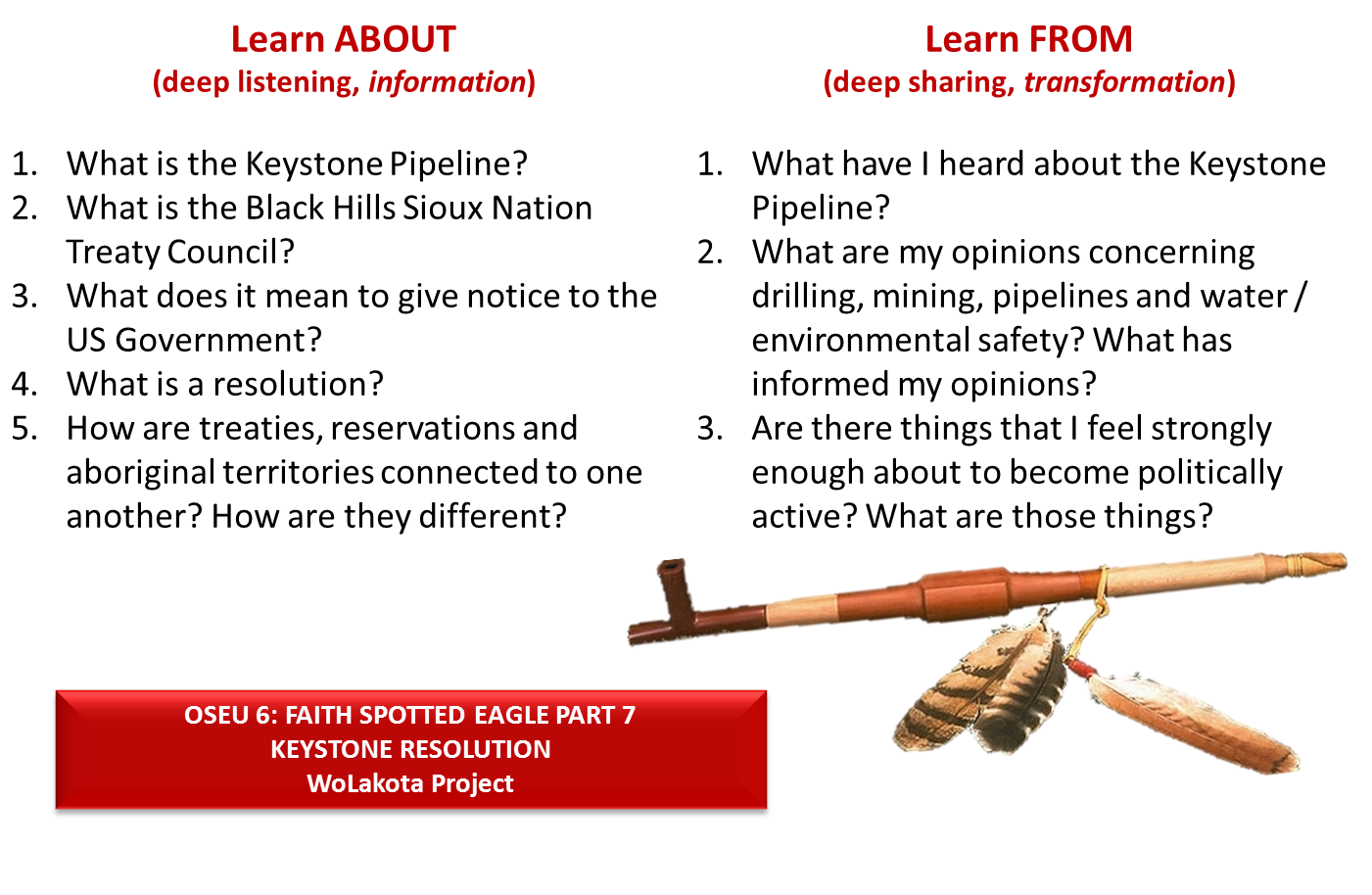
Learn About questions
What is the Keystone Pipeline?
What is the Black Hills Sioux Nation Treaty Council?
What does it mean to give notice to the US Government?
What is a resolution?
How are treaties, reservations and aboriginal territories connected to one another? How are they different?
Learn From questions
What have I heard about the Keystone Pipeline?
What are my opinions concerning drilling, mining, pipelines and water / environmental safety? What has informed my opinions?
Are there things that I feel strongly enough about to become politically active? What are those things?
Transcripts
Pt 7 Keystone Resolution - Faith Spotted Eagle - OSEU 6
Watch this interview on YouTubeSo now we come to 2012 and we believe, and we just, I just came from a treaty council meeting this morning, and on behalf of the Ihanktowan we've presented, and I hope the young people that listen to this will know that they can be players in this history of healing and resolution, that we have presented a resolution to the Black Hills Sioux Nation Treaty Council, and they accepted it, that we are, that the giving notice to the
U.S. government that they have abrogated the 1863 treaty by allowing a destructive pipeline to come through our territory.
And so on January 23rd, which is just like a month away, we are giving notice to the government that they have abrogated that treaty and that we will take measures to stop the pipeline. So those treaties are alive for us. They weren't just in the past, but they're, you know, we're going to utilize them. We have elders and the meeting that I just came to was facilitated by Chief Oliver Red Cloud, descendant obviously of Red Cloud, and he's dedicated his whole life to honoring these documents.
But having talked about the treaties, I want to say something for the understanding of the young people that are watching. If you look at reservations, you have the reservations that were created by congressional action. And then when you think of treaty, the treaty was larger. And then when you think about federal law, which says that according to the Native American Graves Act and Federal Historic Preservation, it says aboriginal territory, so it gets bigger. So in our minds, we think reservation, we think treaty, and we think aboriginal territory.
So our aboriginal territory that we have a right to protect, where our burials and our sacred sites are, on into Wyoming, like Devil's Tower, Harney Peak, all of those sacred sites in this area, those are our aboriginal lands. And if I could recommend a book to the young people that are watching is something that is kind of a bible for me in treaty work, but it's called American Indians and American Justice. And it was written by my uncle, Vine Deloria Jr., along with Clifford Little.
And one of the things that he says in here is he said that in working with treaty law, if you can stand a federal law alongside a treaty, that's probably the most powerful position that we can have as Native people. Because Congress has approved that federal law and Congress was the unilateral sovereign that entered this agreement with us as sovereigns. And so in cultural resources, that's the case that we have.
And that's why we've taken the stand in recognizing that the government has to take notice that they've abrogated this treaty within the last few years, and we'll take measures to ensure that happens.
Resource text
OSEU 6: FAITH SPOTTED EAGLE PART 7
KEYSTONE RESOLUTION
WoLakota Project
From the current WoLakota source page:
Keystone Resolution
Faith Spotted Eagle
Transcript
(deep listening, information)
(deep listening, information)
Some indexed text was extracted from scanned material. Check the original source for exact wording and spelling.
Source materials
Supplied transcript document. Text preserved as supplied; spellings and transcription uncertainties have not been corrected.
Additional source transcripts
Keystone Resolution
Pt 7 Keystone Resolution - Faith Spotted Eagle -
OSEU 6
So now we come to 2012 and we believe, and we just, I just came from a treaty council
meeting this morning, and on behalf of the Ihanktwon we've presented, and I hope the
young people that listen to this will know that they can be players in this history of
healing and resolution, that we have presented a resolution to the Black Hills Sioux
Nation Treaty Council, and they accepted it, that we are, that the giving notice to the
U.S. government that they have abrogated the 1863 treaty by allowing a destructive
pipeline to come through our territory.
And so on January 23rd, which is just like a month away, we are giving notice to the
government that they have abrogated that treaty and that we will take measures to stop
the pipeline. So those treaties are alive for us. They weren't just in the past, but they're,
you know, we're going to utilize them. We have elders and the meeting that I just came
to was facilitated by Chief Oliver Red Cloud, descendant obviously of Red Cloud, and
he's dedicated his whole life to honoring these documents.
But having talked about the treaties, I want to say something for the understanding of
the young people that are watching. If you look at reservations, you have the
reservations that were created by congressional action. And then when you think of
treaty, the treaty was larger. And then when you think about federal law, which says that
according to the Native American Graves Act and Federal Historic Preservation, it says
aboriginal territory, so it gets bigger. So in our minds, we think reservation, we think
treaty, and we think aboriginal territory.
So our aboriginal territory that we have a right to protect, where our burials and our
sacred sites are, on into Wyoming, like Devil's Tower, Harney Peak, all of those sacred
sites in this area, those are our aboriginal lands. And if I could recommend a book to the
young people that are watching is something that is kind of a bible for me in treaty work,
but it's called American Indians and American Justice. And it was written by my uncle,
Vine Deloria Jr., along with Clifford Little.
And one of the things that he says in here is he said that in working with treaty law, if
you can stand a federal law alongside a treaty, that's probably the most powerful
position that we can have as Native people. Because Congress has approved that
federal law and Congress was the unilateral sovereign that entered this agreement with
us as sovereigns. And so in cultural resources, that's the case that we have.
And that's why we've taken the stand in recognizing that the government has to take
notice that they've abrogated this treaty within the last few years, and we'll take
measures to ensure that happens.